
In recent years, there has been renewed scholarly interest in the work of French actor and theatre director, Jean-Marie Serreau (1915-1973). The Sorbonne Nouvelle (Paris 3) launched, in December 2022, a major new collaborative research project (vaste chantier) on the director reputed to have given Samuel Beckett his first big break on French stages. Serreau’s early career was dominated by the White European playwrights who were associated with Martin Esslin’s label of the “Theatre of the Absurd”, applied retroactively (in 1960) to the avant-garde theatre of Samuel Beckett, Eugène Ionesco, Jean Genet, and Arthur Adamov—all of whom wrote plays that Serreau would direct. However, recent critical literature has turned to his interest in decolonization. As Serreau specialist Sylvie Chalaye hypothesizes, his encounter with wife and actress Danielle Van Bercheycke (Chalaye 355-356), whom he met in 1962, likely intensified this interest.1 Serreau began exploring this subject in 1958 when he produced Kateb Yacine’s Cadavre encerclé, on the French repression of anti-colonialist demonstrators during the 8th May massacre in 1945 in the Algerian towns of Sétif and Guelma.
Throughout the sixties and up until his death in 1973, Serreau not only continued to direct plays associated with Esslin’s “The Theatre of the Absurd”; he was active in promoting playwrights concerned with staging decolonization, including the Martiniquais Aimé Césaire, Ivorian Bernard Dadié, and Haitian René Depestre. This combined articulation of the Absurd and the political was a specificity of Serreau’s approach (Livingston 180); his development of what editors of the 1986 anthology on the director Élisabeth Auclaire-Tamaroff and Barthélémy call “a theatre of decolonization” (110) can be understood as an extension of a long-standing commitment to social, particularly class-based, issues. From his earliest forays into the field of directing, Serreau engaged with the Marxist model of Bertolt Brecht (staging The Exception and The Rule in 1947, 1950; Man Equals Man in 1954; and Hommage to Brecht in 1956). Whether or not one agrees with the idea of a White man as being a creator of “a theatre of decolonization”, there is no doubt that Serreau was an important figure in raising awareness among his French avant-garde followers about colonialist corruption, racial injustice, and the urgency of anti-imperialism—and this concurrently with the fall of numerous Francophone imperial regimes on the African continent.
What has been overlooked in recent scholarship, however, is the question of the intersection of gender-based and race-based discriminations in the director’s output. What cultural debates and aesthetic practices would have informed Serreau’s approach to intersectional discrimination? The only two plays by US playwrights in his repertoire provide fertile ground for examining this question because they do not just build a platform for “the cause of Black Americans”2 as Chalaye states (361); they highlight more specifically the struggles of two Black women: Sarah, the fictional biracial character of African American playwright Adrienne Kennedy’s debut play, Funnyhouse of a Negro (1964) (henceforth Funnyhouse), and Bessie Smith, the real-life blues singer who tragically lost her life at forty-three after a car accident, and whose death is reimagined in White American playwright Edward Albee’s The Death of Bessie Smith (1959) (henceforth Bessie Smith).
Serreau staged Funnyhouse in 1968 at the annex theatre of the Odéon, on Paris’s Left Bank, a stone’s throw from the epicenter of the students’ and workers’ riots, which occurred two months later in May 1968. He subsequently directed Bessie Smith for the SIGMA festival in Bordeaux and during a tour of Languedoc-Roussillon in 1970. Funnyhouse revealed the riven mindscape of Sarah, whose mother is White and father is Black. Several Black and White characters from history (for example, Queen Victoria, Patrice Lumumba) wander disparately on- and off-stage, repeating themselves often. The non-linear style reflects the heroine’s inability to reconcile parts of herself, and her torn state eventually drives her to suicide. Bessie Smith, less Expressionist in style, reimagines the final moments leading up to the death of the blues singer as a result of a White nurse who refuses to admit her to hospital. Like Funnyhouse, the Black and White characters of Bessie Smith (two White nurses and a doctor, the nurse’s father, a light-skinned Black orderly, Bessie’s lover) are unable to communicate meaningfully. This prevents a satisfying ending—and survival of the eponymous character.
This article is structured around a cultural as well as aesthetic contextualization of the director’s work on these two plays. My methodology is archival and draws out common patterns by investigating production documents from the Jean-Marie Serreau holdings at the Bibliothèque Nationale de France in Paris (BnF) and the National Archives in Saint-Denis—without claiming to provide a comprehensive approach. The first part of this article presents Serreau’s selection of Funnyhouse and Bessie Smith as a distancing from the principles of the Black Arts Movement (henceforth, the BAM), led by Amiri Baraka, prominent among the African American theatrical avant-garde in the late sixties. Serreau’s choice can be read in the light of the Gallic critique of US Black revolutionary politics at the turn of the seventies, fitting with a wider French view of the cultural tribalism of the United States. The male-dominated BAM was also criticized for downplaying the issue of gender. The very play that Serreau staged, Kennedy’s Funnyhouse, was deemed too pessimistic by BAM figures. A corollary (albeit unintended) of Serreau’s turn to playwrights outside of the BAM’s sphere (Albee was also jettisoned) is his exploration of the issue left by the wayside in the US cultural movement: the complex intertwining of sexism and racism in the lived realities of Black women. The second part of the article considers the plays in terms of Serreau’s interest in the chiefly Paris-based aesthetic that had come to be known (after Esslin’s coining of the term in 1960) as the “Theatre of the Absurd.” The nihilistic strain of Absurdism, as we shall see in the third part of the article, allowed the director to stage a double destruction of gender- and race-based hierarchies—a kind of negative universalism that brings into relief, and perhaps even empowers, Black women.
The Cultural Context: Not the Black Arts Movement, Not Francophone Négritude
The director’s preparatory documents for Bessie Smith include an excerpt from an analytical article (one copy of which is handwritten and a second of which is typewritten) on US Black revolutionary politics of the late sixties and early seventies. The excerpt analyzes the Black Panthers, the political branch of the Black Power movement that was founded in 1966 as a more militant and separatist form of anti-racist and anti-imperialist organizing in the wake of the perceived failings of Martin Luther King Jr.’s policies of Black-White integration and non-violence that had dominated the question of civil rights in the early 1960s. In this excerpt, the Panthers’ emphasis on Black nationalism is condemned, and framed as a “Manichean vehemence” that was “more mystical than Marxist” in the end (archival document, La Mort de Bessie Smith 1970). The fragment was originally taken from an article written by Jean-Marie Domenach in a special issue of the renowned French Marxist publication, Esprit, published in 1970 and addressing “The USA in Revolution.”
The document is in fact symptomatic of the French perspective circulating in theatre in the late sixties and early seventies. The cultural branch of Black Power, the BAM, was similarly viewed with skepticism in France. This designation was coined retrospectively in 1968 by Larry Neal but the movement had begun when dramatist Amiri Baraka (formerly named LeRoi Jones) cofounded the Black Arts Repertoire Theatre School in 1964. The BAM foregrounded “a black aesthetic” and Black pride at a time when virulent racism continued unabated and KKK violence was intensifying (despite the passage of the Civil Rights Act of 1964) (Blec 2019). By the mid-sixties, Baraka’s plays had been imported to France via the mises-en-scène of Antoine Bourseiller in Paris and Avignon. Many French theatre critics judged Baraka’s Dutchman and The Slave too aggressive and violent (Falb 83) just as Domenach had condemned “Manichean vehemence” in the 1970 article in Esprit that Serreau had consulted to mount Bessie Smith. Baraka’s work combined Dadaist nihilism (Wong-Gu Kim 2003) and a fervent anti-White sentiment.3 Serreau not only never staged the best-known ambassador of the BAM; his reference to Domenach’s condemnation of Black Power’s “vehemence” also indicates the director’s wariness of the movement and its values. Serreau would not have been ignorant of Baraka’s work. Several actors and crew members who had worked for Bourseiller, Baraka’s French director, also participated in Serreau’s productions. This shared network suggests that Serreau would have at least been aware of Baraka’s œuvre.4
Serreau’s distance from the foremost representative of the BAM is elucidated by his alignment with the Francophone Négritude movement and the latter’s tensions with the American BAM. Martiniquais playwright Aimé Césaire, whose work Serreau had staged multiple times throughout the 1960s, complained of the BAM’s lack of Marxist analysis (like Domenach with the Black Panthers) while Baraka could not abide what he viewed as a form of false nostalgia for a “pure” and unified Africa, before colonial times, that the Francophone movement extolled.5 Négritude leader Léopold Senghor championed a “civilization of the universal” where African cultures and societies fragmented by colonialism would seek out their common ground rooted in pre-colonial mythology; a restored and common “Négritude” could then be used in the service of uniting with European and wider cultures beyond the African diaspora, again in terms of these cultures’ shared values. Schooled in France, Senghor innovated a corrective to the original concept of French Republican universalism, which overlooked the history of empire and racism. Downplaying ethnic, religious, and cultural particularism, modern French universalism has, since the Revolution of 1789, conceived equality and human rights as bound up in people’s essential sameness in the eyes of the law (Schor 2001). Senghor’s vision aligns with an alternative genealogy of universalism developed by Francophone Négritude intellectuals and artists during the mid-twentieth century, described by philosopher Nadia Yala Kisukidi (2020) as fueled by a “dynamic of hope” (espérance) against the “story of domination” of White French Universalists.6 Serreau’s stance chimed with the universalist ethos of Négritude; he was known as the “messenger of inter-racial union” (messager du métissage) (Auclaire-Tamaroff and Barthélémy 107).7
It is thus no surprise that an article condemning the anti-White separatism of the African America avant-garde, the BAM, may be found in Serreau’s production notes for Bessie Smith. By the time he explored the realm of US theatre in 1968 (with Funnyhouse) and 1970 (with Bessie Smith), Serreau’s view on decolonization had been shaped by writers of the Négritude movement: he staged Algerian Kateb Yacine’s pro-independence play Cadavre encerclé in 1958, and went on to mount work authored by the Martiniquais Aimé Césaire (in 1965 and 1967) and Haitian René Depestre (in 1968).
However, it would be misguided to assume that Serreau’s US cycle falls neatly alongside his work on the Francophone Caribbean and Africa continent. He prepared Funnyhouse for the “USA season” organized by the Petit Odéon theatre (directed then by Jean-Louis Barrault). The Parisian theatre hosted works by both Black and White writers from the US theatrical avant-garde, including Sam Shepard’s Chicago (1965) that ran in a double bill alongside Funnyhouse. These plays aimed to denounce the American political establishment, dominated by McCarthyism and its aftermath in the shadow of the Vietnam War (Carmody 258).
In this context of rising tension, of double-edged antipathy toward what “America” stood for and sympathy for its struggling vanguardists, Funnyhouse, for Paris-Normandie theatre reviewer Yves-Marie Choupaut, was about as far away from the Francophone Négritude movement as could be. The torn psychological state of the heroine Sarah, as the daughter of a White mother and a Black father, illustrated “a whole people uprooted from their original continent and locked into a Blackness (négritude) which cannot, in the socio-economic context of the USA, open onto the civilization of the universal so dear to Léopold S[é]dar Senghor” (my emphasis) (23). Radically different from the universalism “of hope” (espérance) adhered to by a number of decolonial Francophone intellectuals of the mid-twentieth century (Yala Kisukidi 2020), the heroine of Funnyhouse is a cipher for a devasted population, “a whole people uprooted” (Choupaut). In part three of this article, we shall see that this may not be as hopeless as Choupaut makes out, as both Funnyhouse and Bessie Smith gesture toward a negative form of universalism that foregrounds Black women. But Choupaut encapsulates a perspective that many held at the time: that the US brand of “Négritude” signaled a people deprived of their pre-colonial past on the African continent by slave trade; only a Francophone “Négritude” could hope to counteract this. A poem by Senegalese writer Younousse Seye, delivered at the Pan-African Festival of Algiers the following year in 1969, similarly decried the “racial segregation” that had reduced the lives of Black Americans (le Noir-américain) and insisted on the rallying call of Francophone “négritude” as a salve.8
The gulf signaled by Choupaut between Funnyhouse and the output of the proponents of Francophone Négritude must be qualified, even if his judgement of the differences remains valid. Serreau may have turned to Funnyhouse in part because it featured Patrice Lumumba. He staged Aimé Césaire’s Une Saison au Congo, also depicting the Congolese revolutionary, the year before Funnyhouse in 1967 at the Théâtre de l’Est Parisien. Nevertheless, Kennedy’s Lumumba is not the equivalent of Césaire’s. He is a reduced, bit character in Funnyhouse, one of the alter egos of the heroine Sarah. Far from presenting audiences with the inroads that Lumumba made into Congolese independence, it is the first prime minister of the Democratic Republic of Congo’s unfortunate end fate—his death by a Belgian-supported firing squad—that is dwelled on. The (putative) suicide of Sarah’s father is repeatedly described as happening concurrently with Lumumba’s murder. Unlike the fantasized extension of the heroine’s father in Funnyhouse, Césaire’s play revisits Lumumba, the play’s central character, in the last days of his life, showing him as a flawed leader but poetic visionary, complex, all-too-human, but ultimately an agent of revolution.
I would argue that the two plays that Serreau selected for his US cycle were focused more on the destructive effects of US racial segregation on Black Americans than they were on links to the Pan-African Négritude movement. Sarah of Funnyhouse hangs herself in the midst of an irresolvable tension between White and African American heritages; caricatured versions of historical figures—aristocratic (a balding Queen Victoria and Duchess of Hapsburg), religious (a hunchbacked Jesus Christ), and political (a Lumumba aligned with her self-hating father)—wander through her internal psychical drama, as fragmented “one[s] of herselves” who can never unite (Kennedy 1). An equally tragic victim, Bessie Smith, the eponymous Blues singer of Albee’s play, dies at the hands of White supremacy, after she is denied admission into the emergency room of a White hospital during the Jim Crow era, following a car accident. Both heroines perish under the poisonous effects of US segregation, the very antithesis of Black-White union and a universalism of “hope” (espérance) (Yala Kisukidi 2020) of Francophone Négritude.
In looking to the US, Serreau was drawn to two plays that neither privileged the principles of Francophone Négritude, nor those of the BAM. Indeed, it is the distance from the latter that potentiates an intersectional re-reading of the productions. Both Kennedy and Albee were placed at a remove from the BAM. In Larry Neal’s seminal 1968 article on the US cultural movement, Albee’s theatre was cast as amounting to nothing more than a flight from reality made to ease the discomfort of White middle-class audiences, a mise-en-scène of the latter’s “sick white lives” (33).9 We need only think of the web of lies created by Martha and George in Who’s Afraid of Virginia Woolf? for an example of this. While Albee was dismissed for encouraging White escapism, it was for gender-related reasons that Adrienne Kennedy found her work underappreciated; the suicidal, self-doubting heroine of Funnyhouse was deemed to embody neither Black self-determination nor the strength of African Americans, qualities central to the BAM’s vision of the Black Revolutionary subject (Barrios 201-202). Critics have pointed out the masculinism (and homophobia) lying behind the BAM’s view of the ideal agent of Black liberation. Like many Black women, Kennedy was unable to establish a place for her theatre in a movement that downplayed intersectional issues of racism and sexism, and that was dominated by heterosexual men.10
Funnyhouse and Bessie Smith foregrounded the very issue left on the sidelines of the BAM: the mutually constitutive nature of sexism and racism in Black women’s lives. Yet this is not the reason that Serreau would have been drawn to them. Rather, it is their aesthetic links to the Theatre of the Absurd that most likely stoked his interest.
The Aesthetic Context: America, the Absurd
During the 1950s, Serreau brought Eugène Ionesco and Samuel Beckett to renown in France even before Martin Esslin catapulted the two playwrights to fame with The Theatre of the Absurd (published in 1961). Kennedy and Albee earned critical recognition as Absurdists a decade later in the late fifties and early sixties. Esslin compared Albee’s impugnment of “American optimism” (312) in his début play, The Zoo Story, to Beckett’s Krapp’s Last Tape, an alignment facilitated by the Provincetown double bill production in 1958. Kennedy’s non-linear theatre would later be interpreted by critics as Absurdist because of her association with Edward Albee, with whom she had workshopped Funnyhouse at the beginning of the 1960s (Hatch 388).
The Fonds Jean-Marie Serreau underscore Albee’s relationship to Absurdism. In a document entitled “Analysis” dating probably from the early dramaturgical explorations of Bessie Smith, Beckett and Ionesco are mentioned. Another document from this dossier, named “The Play”, dwells on the “incommunicability between beings in this country of Babel.” Esslin, too, favored the trait of linguistic “incommunicability” to describe the Absurdists, for instance describing Ionesco’s The Chairs as “the incommunicability of a lifetime’s experience” symbolized by the progressive proliferation of empty chairs on the stage (151). The characters of Bessie Smith are unable to listen to each other: the White nurse ignores the numerous cries for help over the telephone following Bessie Smith’s accident; her cantankerous father rejects the care offered by his daughter, instead judging her as sexually promiscuous; a mixed-race male nurse is repeatedly berated by the nurse; a naïvely romantic White doctor is unable to see the poverty around him and the privilege within himself. The United States, the so-called nation of immigrants and of the melting pot, is a Babel-turned-battleground destined for failure.11
Concerning Funnyhouse, photographs in the archives indicate the influence of the Theatre of the Absurd, and in particular a Beckettian aesthetic, on the production and its marketing. In Figure 1, the Odéon theatre billboard demonstrates that Beckett’s Happy Days (Oh, les beaux jours) ran simultaneously with the double show Funnyhouse (Drôle de baraque) and Shepard’s Chicago. Beckett’s show was staged in the Odéon theatre’s “petite salle” and the Kennedy-Shepard double bill in the sister theatre of the Petit Odéon. The presence of “Matias” (full professional name), who worked as a scenographer for all three shows and was a Beckett favorite, also suggests the imprint of the Absurd on the Kennedy show.
Figure 1. The Odéon Theatre billboard February-March 1968.
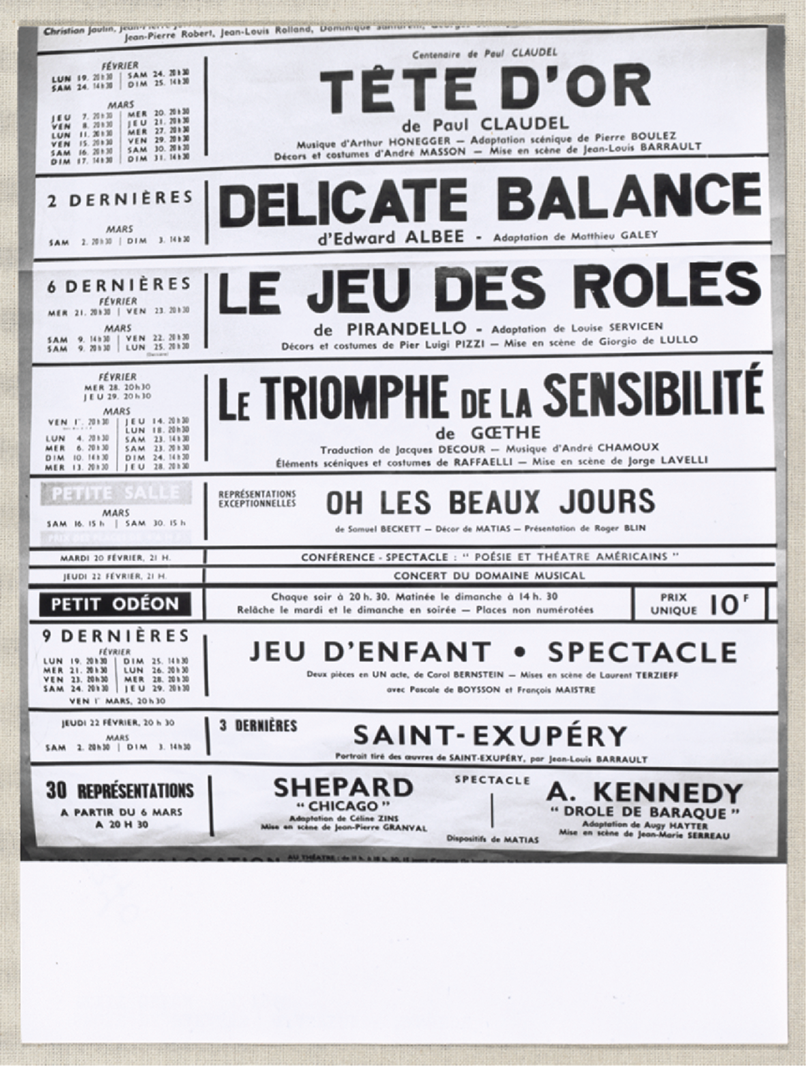
Center: Beckett’s Happy Days (Oh, les beaux jours). Bottom: the double bill Funnyhouse (Drôle de baraque) and Shepard’s Chicago. Both productions ran in March 1968 and all three featured a scenography designed by Matias. Archives of the Département des Arts du spectacle, Bibliothèque Nationale de France. (Reproduced with the kind permission of Coline Serreau).
As a Beckett scenographer, Matias had carved out a trademark in the onstage creation of fragmented bodies, ranging from Winnie (played by Madeleine Renaud) buried in a mound of mud in Happy Days, to the three heads floating in funeral urns in Beckett’s Play, which he worked on with Serreau in 1964, 1966, and 1969 (Auclaire Tamaroff and Barthélémy 207-208). Similarly, a body deprived of its limbs fills the photographs of Funnyhouse. Queen Victoria, represented by an imposing bust (equally present in Kennedy’s text), figures in four of the ten images of the production. This enormous object, made from clay cast in a mold, wrapped in fiberglass (highly resistant to distortion) and resin (a varnishing agent that weighs down its objects), then painted white,12 connotes rigidity and intransigence, an immobile feature of the set also implied in the sketched mockup of the stage seen in Figure 2. By contrast, the Victoria statue has a more fleeting presence in Kennedy’s text, a whole-bodied “sitting figure” (Kennedy 22), who watches over the end scene while Sarah commits suicide as a reminder of the stain of colonialism and empire on the heroine’s fragile psyche.
Figure 2. Sketch of the set for Funnyhouse of a Negro (Drôle de baraque).
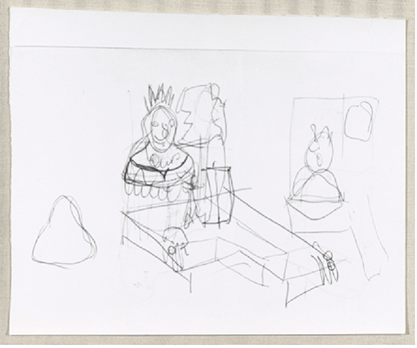
In the center: a sketch of the Queen Victoria bust hanging on the back wall; on both sides of the L-shaped stage, two hands can be seen. Archives of the Département des Arts du spectacle, Bibliothèque Nationale de France. (Reproduced with kind permission of Coline Serreau).
In Figure 2, it is also possible to make out two disembodied hands emerging on both sides of the L-shaped stage, made from the same material as the bust,13 limbs of the undead rising out of the ground as a visual metaphor of the English Queen’s creeping stranglehold on the heroine’s mental state. Added to this is a final white headpiece, which we see in Figure 3. This headwear is of a rigid quality, resembling the material composition of the bust upstage and the hands downstage. This weighs heavily on the head of what is most likely the Duchess of Hapsburg, played by Danielle Van Bercheycke. In Kennedy’s text, the Duchess’s “kinky hair spring[s] out from under” (16) this headpiece, which is meant as a skull cap that masks hair loss. In Serreau’s production, it is replaced with white tentacles of an accessory that inflates the Duchess’s head to unreal, almost extraterrestrial, proportions. These tentacles are somewhat removed from the “persistent sign of the real body beneath the mask” (59) described by Kennedy’s dramaturg Faedra Carpenter.
Figure 3. Photograph from the production of Funnyhouse of a Negro, directed by Jean-Marie Serreau.
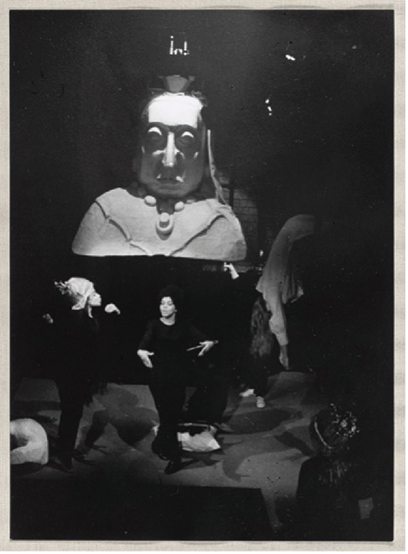
From left to right: (probably) Danielle Van Bercheycke as the Duchess of Hapsburg, Toto Bissainthe as Sarah, (probably) Emmanuelle Parèze-Belda as Sarah’s Mother. Archives of the Département des Arts du spectacle, Bibliothèque Nationale de France. (Reproduced with kind permission of Coline Serreau).
Indeed, color is more prominent than weight in Carpenter’s dramaturgical assessment of the play, with “haunting and perverse images of whiteness” (57). In Serreau’s production, judging by the photographs, size and density seem to prevail over color as lasting impressions. The imposing bust, freakish hands, and monstrous prosthetic skull cap imbue the scene with a sense that the two Black actresses inhabit a space constrained by the accoutrements and synecdoche of White culture. The Theatre of the Absurd is rife with such shrinking and crowded-out spaces as is exemplified by the colossal cadaver in Ionesco’s Amédée, or How to Get Rid of It (1954), the so-called “fetish play” (Auclaire-Tamaroff and Barthélémy 72) of Serreau’s theatre company, since the director returned to staging it time and again throughout his career. In Amédée, the growing corpse ends up occupying the entirety of the stage at the expense of the eponymous character and his wife. Shrunken by Matias’s monstrous white sculptures, the actresses from Funnyhouse similarly connote the Black body threatened with crushing by Whiteness.
The Kennedy and Albee plays provided Serreau with a chance to connect his taste for the Theatre of the Absurd (its themes and scenography) with his growing interest, throughout the 1960s, in a theatre of decolonization.
Absurdism as an Opportunity for Intersectionality: The Double Negation of Black Men and White Women
According to Chalaye, Serreau started to decolonize the stage and the perceptual habits of the audience not simply by staging the plays of writers associated with the Francophone Négritude movement. The Theatre of the Absurd occupied a central, if not pioneering, role in this endeavor. In 1963, Serreau cast Toto Bissainthe and Danielle Van Bercheycke, who both later featured in Funnyhouse, in Jean Genet’s The Maids. The year before, these two women played in Ionesco’s The Picture and Beckett’s Play. Chalking these “polychromatic casts” up to Serreau’s encounter with Danielle Van Bercheycke in 1962, Chalaye positions these mises-en-scène as the “real innovative and visionary force of Jean-Marie Serreau”, proof of a “plural theatre where differences are mixed together” (355-356).
Funnyhouse and Bessie Smith are best considered in the lineage of these earlier Absurdist plays. The Theatre of the Absurd, as a label Esslin developed in response to the common themes and aesthetic emerging from theatre mostly in Paris in the mid-century, was attributed a universalist ethos but in a different sense to a decolonized universalism “of hope” (espérance) (Yala Kisukidi 2020) that, as we saw in part one of the article, many Francophone Négritude writers engaged in. In The Theatre of the Absurd (1961) Esslin repeatedly alluded to the Absurdists’ concern for the existential crises of the common “Man” in a humanist (albeit gender normative) idiom. But, unlike Senghor’s view, this did not constitute the building blocks for the new beginning of a future “civilization”; rather, the Absurdists’ placed emphasis on a common ending to civilization—“a world that won’t finish finishing” (monde qui n’en finit pas de finir) (Auclaire-Tamaroff and Barthélémy 68) as Serreau termed the apocalyptic meltdown of language, God, and political ideologies that he found presented in Ionesco’s, Genet’s, and Beckett’s plays.
The Absurdists’ take on the mutually assured destruction of different cultures seems to have figured in Serreau’s dramaturgical reflections on Bessie Smith. Another part of Jean-Marie Domenach’s article on the revolutions in the USA, a copy of which is found in the Albee dossier, turns to “Women’s Lib” (486), in a document that Serreau or his team retitled “‘Pink Panthers’ and the feminine revolt in the USA.” The excerpt highlights the wage inequalities at stake in the second-wave struggle. The choice to rename “Women’s Lib” the “Pink Panthers” recalls the popular cartoon character but also positions feminism alongside the “Black Panthers” (the latter being roundly critiqued, as I pointed out earlier). Another document states the production’s intention to bring to the fore this “America of yesterday” with “especially [the America] of today.” We might venture then that Serreau sought not simply to contextualize the Albee play with regards to the Black Panther politics of the late 1960s and 1970s, which he condemned, but also, seven years after Betty Friedan’s Feminine Mystique (1963), with regards to second-wave feminist politics. There is no reason to suggest that Serreau would have been any more positive about the “Pink Panthers” than he would a Black counterpart. In Albee’s text, it is the White nurse, an irascible and intolerant character, who most closely articulates the class-focused version of the second-wave feminism pointed out by Domenach: she laments her piteous salary and limited economic prospects in the Depression era 1930s when the play is set.
The double distance that these production notes assert from US antiracist and feminist movements resonates with the Theatre of the Absurd’s loss of faith in salvatory political ideologies—what Esslin earlier described as the “shatter[ing]” of “the certitudes and unshakable basic assumptions of former ages” such as “faith in progress, nationalism, and various totalitarian fallacies” brought about by the horrors of the Second World War (23). Recontextualized in the social movements of the late sixties, this Absurdist loss of faith in political ideologies potentially highlights what Kimberlé Crenshaw (1989) describes as the “location that resists telling” (1242) that Black women are often relegated to—between White-dominated second-wave feminist and male-dominated Black nationalist movements. A possible interpretation of Serreau’s production notes is that Bessie Smith cannot rely on either “the Black Panthers” or the feminist counterpart of “Pink Panthers” to save her.
Bessie Smith indeed seems to approximate the idea of a “location that resists telling” (Crenshaw 1242) in Serreau’s production. In the text, she remains offstage and has no voice of her own (unlike Sarah in Kennedy’s Funnyhouse, it must be added). Yet in Serreau’s production this invisibilization is brought into relief. According to Jacqueline Cartier, who reviewed the Albee production for the SIGMA festival in Bordeaux in 1970, tension emerged during the show through a juxtaposition of Bessie Smith, rendered in an “effigy” by the “play of lighting” and the technique of “projections [already so] dear to Jean-Marie Serreau” with the physical presence of Michelle Moretti in the role of the White nurse (Cartier 1970). Though I cannot find further details of what Cartier means by Serreau’s much-loved resort to “projections”, two copies of the same photograph of Bessie Smith in the archives (Figure 4) imply the reproduction on the stage of this image in an enlarged format. Elegant and joyous in this photograph, with her bob haircut of the roaring twenties, the huge ostrich feather on her pearl-encrusted bandeau, Bessie Smith, projected like this, might have been the ghost who haunts the dramatic action, an absent presence and polar opposite of the embittered, physically present, “unsatisfied, avid” (Cartier 1970) White nurse.
Figure 4. Bessie Smith.
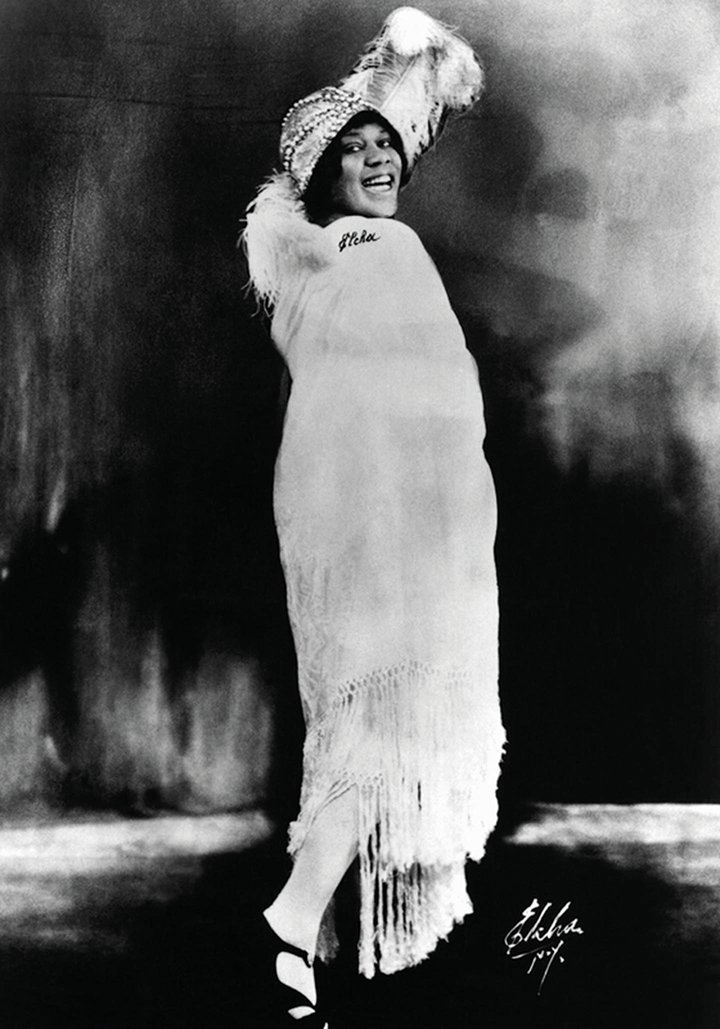
This image, found in the Albee dossier, was a possible source of inspiration for a projected image of the singer during performance. Image also found in the archives of La Mort de Bessie Smith, directed by Jean-Marie Serreau, 1970. (Reproduced with kind permission of New Orleans Jazz Museum).
Similarly, Serreau’s Funnyhouse staged a double negation of cultures—this time in relation to Sarah’s Black father and, significantly, her White mother. Closer examination of Figure 3 indicates that Sarah’s suicide is accompanied by another woman’s fatal ending. The latter is found hanging to the right of the image as if having jumped out of a window, her long blonde hair and clothing emphasizing and extending her Whiteness. This was likely Emmanuelle Parèze-Belda, who played Sarah’s mother. Pierre Humbourg, reviewer for Nice Matin, confirms the significance of this detail: “[W]e become very afraid when seeing a lady, not at all black doing acrobatics…an accident so quickly happened” (23). The hapless gymnastics described by Humbourg constitute Serreau’s addition to Funnyhouse. In the play-text, symbolic allusions are made to the heroine’s Black father who “diseased my birth…killed my mother” (21), but no stage directions indicate the physical materialization of a fatal accident.
Critics remain divided over whether Sarah’s suicide is the result of the heroine’s inability to “unify . . . Victorian, Christian, and African avatars and doppelgangers” (Bower 8) or whether it is a more targeted act of assassination against her Black origins represented by her father (Wilkerson 72). The play-text indicates that Sarah’s father “shot himself” (9), “hung himself in a Harlem hotel” (8) when Lumumba was assassinated; yet it also denies the father’s suicide at the end of the play, hinting that it was a tragic invention of Sarah’s mind that pushed her to her own self-annihilation. On the other hand, Sarah fantasizes a moment, when “the room will grow bright and [her] mother will come toward [her] smiling” (Kennedy 22), just before her own suicide. This could signal a ghostly apparition of the heroine’s White mother—the mother’s symbolic death—conjuring the metaphor of the flooding of consciousness with divine light just before death.
It seems likely, given the additional accident which befalls the White woman, that Serreau’s production opted to tell Sarah’s story as a suicide of both her Black and White sides. To cement the idea of White death, the bust of Queen Victoria, watching over the action, collapses under its own weight. Le Figaro theatre reviewer Jean-Jacques Gautier describes:
A bunch of hair falls to the ground. . . . Tzim-tzim, bang-bang, choo-choo, atchm, crash, bang, wallop! The orchestra creates a wild fracas that prevents us from hearing the slightest thing. Again, the falling hair and…to finish, the plaster-cast of Queen Victoria falls to the ground. (Gautier 11)
Queen Victoria haunts Sarah’s imagination throughout the dramatic action and her death signals the end of imperialism that the monarch represented. Yet, together with the mother’s death, it is not Whiteness in general but White women specifically who are targeted for destruction. Whereas Sarah finds it impossible to link together the disparate personages of her mind in “a logical relationship” (Kennedy 7), the double accident of the Serreau production (of the mother, of the Victoria bust) implies a metonymical relationship between the White women of the play that could also have extended to the third Caucasian woman in Sarah’s psychological repertoire, the Duchess of Hapsburg.
Through their respective strategies, Bessie Smith and Funnyhouse create opportunities to counteract the double marginalization of Black women pointed out by intersectional feminism. In the former, Bessie Smith is de-centered, her subordination to the White nurse is made palpable by a projected photograph that cannot speak or move. On the other hand, Sarah in Serreau’s Funnyhouse is at the heart of a wasteland of destroyed figures: the White Queen Victoria bust and mother, the heroine herself through her suicide.
Though I would caution against idealizing the heroine’s demise, before the play’s culmination Sarah appears to have more agency than Bessie Smith. Serreau invited Adrienne Kennedy to participate in rehearsal by paid invitation (financed by the Odéon theatre) in December 1967. Cayotte Bissainthe, sister of Toto who was cast as Sarah, played the role of translator. As Kennedy recounted, Serreau nodded along approvingly as the playwright read out some of her heroine Sarah’s lines. At one point, she cried out, vocally resistant to the forces that would quash Sarah. Kennedy would recall with fondness the director’s respect for her input: “Serreau gave me the impression that everything I said was of importance, crucial: at the same time, I felt that he was studying my physical sensations, my emotions” (qtd in Auclaire-Tamaroff and Barthélémy 113). The director’s collaboration with Kennedy focused on the power of the voice and words of three Black women—the character Sarah who finds restored agency in her voice, her creator Kennedy who had enacted this, and the translator Bissainthe who bridged the language gap between playwright and director. This reverses, quite literally, Black women’s consignment to a “location that resists telling” (my emphasis) (Crenshaw 1242).
In this article, I have sketched out how Serreau’s distancing from the BAM and Francophone Négritude, to embrace the negative universalism of the Theatre of the Absurd, potentially shone a spotlight on the intersectional nature of the discrimination facing Black women. In Funnyhouse and Bessie Smith, there appears a mutually assured negation of Black men and White women (particularly in the Kennedy production) and the social justice movements of the 1960s and 1970s that developed around the question of their rights (in the Albee production). With Funnyhouse, I have argued, the Black heroine may have emerged as a visible and vocal opposite of the “location that resists telling” (1242) pointed out by Kimberlé Crenshaw.
This article’s comparison of the two US plays in Serreau’s repertoire leaves us with several questions. Given Sarah’s vocal agency in Funnyhouse, to what extent would Serreau’s strategy of reinstating Bessie Smith in the form of a static, silent photograph (if my hypothesis is accurate) have worked to empower the eponymous subject? This question is especially pertinent given that the production process seemed not to have involved (in any archival or anecdotal evidence I have found) the intervention of Black women, unlike in rehearsals for Funnyhouse. We might wonder how the characterization of Bessie Smith would have differed had a Black woman been involved in the theatre-making process.
Alternatively, could Serreau’s earlier encounter with Kennedy have nourished the director’s approach in Bessie Smith? The archives indicate a double bill of Funnyhouse and Bessie Smith that suggest the former’s influence on the latter. A series of contracts with cast members, an itinerary, several inventories for the reservation of hotel rooms, and a double synopsis of Kennedy’s and Albee’s plays (presumably for the purposes of marketing) demonstrate that Funnyhouse was revived in 1970 alongside Bessie Smith on a tour of southwestern France between the 2 and 11 December. Serreau invited several of the actors who had played parts in the 1968 Funnyhouse (Toto Bissainthe, Danielle Van Bercheycke, Marie-Claude Benoît, Douta Seck, and Akonio Dolo) for this tour, which was hosted by the Théâtre du Midi, a network of theatres in the Southwest headed by Jean Deschamps until 1975.
It is, however, crucial not to read too much into this detail. Contrary to how it has been officially remembered,14 Bessie Smith was also a standalone production at the SIGMA festival in Bordeaux a full month before the Kennedy-Albee double bill. It should equally not be forgotten that the aesthetic paradigm that drew Serreau to both plays—the Absurd—was dominated by White names. Negative universalism may contain potential to highlight and even destroy the gendered and racial ideologies constricting the lives of Black women, as I have suggested, but its distinction from the universalism “of hope” (Yala Kisukidi 2020) propounded by the intellectuals and artists of Francophone Négritude must not be elided. Black women, though sometimes active participants, seem still not to be “the privileged subject” (Yala Kisukidi 2020) in the Absurdist articulations of universalism adumbrated in this article. It behooves us, finally, to avoid hagiographic re-tellings in moves to recuperate both Serreau and the plays connected with the Theatre of the Absurd as potential enactors of intersectional feminism.
