
Introduction
In remembrance of Armenian Martyrs Day, Anna Antaramian and William Rolleri co-authored The Armenian Question, a two-act courtroom drama that debuted at the Armenian Church of America in New York on 24 April, 1977, before making its way to Off-off Broadway within the same year. Over time, the play has undergone revisions, including updates following the events of 9/11. The story revolves around a fictional appeal by the Turkish government from the United Nations Famine Relief Agency (UNFRA) during a global drought. Three survivors of the Armenian Catastrophe, comprising two women and one man, alongside their African-American attorney, have embarked on a journey from America to Paris to confront the Turkish Deputy Prime Minister, the General, in court. In their quest for justice in exchange for food relief, they demand that Turkey officially acknowledge the Catastrophe and provide an accurate account of the nine million Armenians who were either murdered or unborn, as documented in the census report. Despite the compelling survivor testimonies, supported by non-fictional historical documents, eyewitness accounts, and photographic evidence of the Catastrophe, the General endeavours to persuade the UNFRA Committee to provide food relief without acknowledging the Catastrophe.
Image 1: The 1977 poster of The Armenian Question.
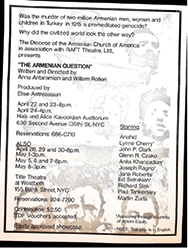
Image courtesy of Zohrab Information Centre, Diocese of the Armenian Church of America (Eastern).
The Armenian Question, co-created by Armenian-American Anna Antaramian, exemplifies what Marianne Hirsch describes as “postmemory”: the relationship that the generation following those who directly experienced cultural and collective trauma maintains with past events. This connection is forged through stories, images, and behaviours present in the upbringing of subsequent generations, known as postgenerations. These familial elements are mediated by widely accessible public images and narratives, adding historical and cultural context to the personal and familial intergenerational link (2008: 106-107). Antaramian’s incorporation of photographic evidence illustrates this “generational structure of transmission,” strongly grounded in archival materials (Hirsch 114). “I am still emotionally bound to the visions of my ancestors, my family, and all their suffering. The pictures still come back at times,” Antaramian states (Karali par. 2). Remarkably, The Armenian Question expands the notion of postmemory by focusing on firsthand memories of those who lived through the Catastrophe, highlighting the heterogeneity of experiences and memories of two female survivors, each undergoing equally valid processes of remembering and imagination. Through these survivors, the play establishes a new and expanded community of postmemory that conveys traumatic experiences to postgenerations through historical archives, the survivors’ embodied memories and narratives. Notably, the play exclusively features survivors and does not incorporate postgenerations as traditional postmemory subjects, who would ultimately comprise the audience, including postgenerations. It offers deep insights into the Catastrophe and its enduring impact on survivors, emphasising the importance of recognising both their suffering and that of postgenerations for the purposes of mourning, healing, and reconciliation.
Creative Process of a Documentary Play
“It began when I was asked by Archbishop Torkom Manoogian to do something theatrical for Martyrs Day April 24, 1977,” recalls Antaramian about the genesis of The Armenian Question (Karali par. 3). Archbishop Manoogian had a keen interest in advancing Armenian arts and culture among both American and Armenian audiences through English-language plays (Parlakian 12). He specifically requested an English-language drama that would function as a means of commemoration, aimed at ensuring the ongoing remembrance and honouring of the “over 200 Armenian leaders” who were detained in Istanbul in 1915—a “prelude to a general extermination” (Kambourian par. 2). Antaramian reflects on the play’s origins:
While searching for a play, I also researched the genocide. After a month or so I mentioned my project to a friend of mine, Bill Rolleri, who suggested I write a play since there seemed to be nothing available. He was a playwright, was excited about the material I was researching, and volunteered to work with me. That was the beginning of The Armenian Question. (Karali par. 3)
The playwrights attempted to quantify the Catastrophe with numerical figures, sparking controversy between the General and Freeman, the opposition attorney:
GENERAL. […] the government had to relocate some 400.000 people […]
FREEMAN. The number of deportations we have is 2 million. […]
GENERAL. […] 15.000 perished on the road from…
ANAHID. More.
GENERAL. Disease took another 25.000 […]
ANAHID. Many more.
GENERAL. Only 40.000 out of 400.000 died. That is why this woman’s statistics are false. Based on the facts, if 2.000 people left Sivas, 1.800 arrived in Aleppo.
FREEMAN. We’ll be more than happy to play the numbers game a little later […] (Antaramian and Rolleri 291).
The dispute over the number of Armenian deaths has been a longstanding issue, with estimates ranging from 600,000 to 2 million (Hovannisian 15). Nevertheless, some scholars argue that the Armenian population could not have exceeded 600,000, intensifying the ongoing debate (Dündar 194). Adding to this discourse, the play introduces a novel fictional figure, derived from scholarly research by a former UNFRA member: nine million “dead” and “never-born” Armenians who, hypothetically, “would be living in Turkey” “if they had never been touched or disturbed in any way,” and “if they had been permitted to reproduce in a normal manner” (Antaramian and Rolleri 307). The demand for the subtraction of this figure from Turkey’s census report casts doubt on its “accuracy,” influencing the Committee’s decision regarding the allocation of surplus grain for Turkey (Antaramian and Rolleri 318).
Image 2. Confrontation between the Turkish minister and the opposition attorney.
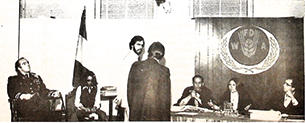
Image courtesy of The Armenian Church quarterly, Spring 1977.
Before finalising the script, auditions were conducted, and actors were recruited. Antaramian engaged the Armenian-American community in the process:
We set up interviews with Armenian survivors in the New York/New Jersey area and with the help of those Armenian actors who were fluent in Armenian and Elise Antreassian [the producer], we were able to get many eyewitness accounts of the marches without a language barrier.
We began with previously scripted dialogue at rehearsals and discovered that most of the actors wanted to know more about the Armenians, the marches, and the deaths. They began to research materials we were able to supply for them. With the script and the information they brought in we had a series of improvisational rehearsals that were taped; we transcribed the tapes and worked some of the dialogue into the script. It was a living moving force. (Karali par. 5)
These survivors’ memories provided a human and emotional dimension to the play, one that could not be conveyed through mere numbers and statistics. By combining these traumatic memories with the actors’ research and improvisations, the play transformed into what Antaramian describes as a “living moving force,” capable of communicating the pain and suffering endured by the Armenian people during the Catastrophe. These “epic horror stories” of the survivors were instrumental in infusing “pathos” and a “sense of outrage” into both the theatre crew and the eventual audience (B. Rolleri 2-3). Furthermore, the incorporation of these memories served as a means of recognising and validating the experiences and memories of the survivors, those that had long been silenced and denied by the Turkish government. Freeman’s response to the General’s emphasis on numbers, when he states, “We’ll be more than happy to play the numbers game a little later,” clearly reflects his refusal to accept that numbers alone could adequately capture the full impact of the Catastrophe. This underscores the importance of recognising the personal and emotional dimensions of the Catastrophe that extend beyond statistical data.
Rehearsals for the play were held nightly at 7.30 pm in the Haik and Alice Kavookjian Auditorium of the Eastern Diocese of the Armenian Church of America in New York (Shahinian par. 2). The authors integrated the “most powerful” improvised courtroom scenes with the “best” pre-written material, resulting in a play that they believed to be unprecedented (Church 7). The autobiographical accounts of the survivors were “synthesised” into the testimonies of the survivors presented in the courtroom (W. Rolleri 280). This approach gave rise to a postmemorial dramaturgy rooted in the “facts themselves as [initially being] mouthed and recorded by actual survivors,” rather than being an “artist’s re-creation” (Parlakian 28). The authors regarded the 1977 production of The Armenian Question as a “truly collaborative work” that brought together the theatre crew and the Catastrophe survivors, whom they referred to as “seekers of justice” (W. Rolleri 280). The playbill for the 1977 production acknowledged these survivors:
Image 3. Special thanks extended to the Catastrophe survivors interviewed for the production.
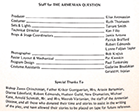
Image courtesy of Zohrab Information Centre, Diocese of the Armenian Church of America (Eastern).
The Armenian Question employs a fictional courtroom setting as the backdrop to showcase the survivor testimonies. Anna Antaramian explains the selection of a “modern courtroom,” highlighting that “the courtroom drama genre logically suggested itself” (Kambourian par. 3; Karali par. 4). This courtroom milieu provides an “arena” for a “head-on confrontation” between “truth” and “falsehood” and offers a platform for resolving international conflicts with the support of the United Nations, functioning as a “convenient ‘umbrella’ organisation” (B. Rolleri 2004: 1). However, it is crucial to note that the Committee members explicitly state that it is “not a court of law” but rather a “formal hearing” or a “court of reason” (Antaramian and Rolleri 285-306). While some reviewers classify The Armenian Question as a courtroom drama, others observe that it does not strictly adhere to this genre (Messina 2-3; Parlakian 28). Instead, the formal courtroom ambiance serves as a “theatrical ‘container’” to merge the real experiences of the survivors with the fictional storyline (W. Rolleri 2004: 280). The structured format of the formal hearing allows the characters to present their testimonies while encouraging the audience to critically engage with the historical events presented. This engagement is facilitated through survivor memories and archival evidence, rather than attempting a literal enactment or mimetic reproduction of the atrocities. This diegetic or narrative reproduction of the events not only circumvents the ethical dilemmas associated with representing trauma on stage but also challenges the audience to confront their own biases and assumptions about the Catastrophe. It prompts them to question the ways in which history is constructed and remembered. By adopting the diegetic trial form, the play actively involves the audience in interpreting themes of truth, justice, and accountability. This approach represents a holistic approach to theatre that challenges conventional mimetic theatre.
The Armenian Question illustrates the potential of documentary theatre in constructing postmemorial narratives and providing a platform for contemplation on the representation of traumatic histories. The play presents a fragment of reality drawn from life, relying on documented evidence and survivor testimonies to educate the audience about the injustices suffered by the Armenians. Instead of making claims of direct access to the truth regarding whether the Armenian deportations in 1915 constituted a genocide, the play aims to establish a “model schema” that highlights the aftermath of the Catastrophe, delves into its historical and political discourse, and underscores its enduring repercussions (Weiss 383). The play serves various objectives of documentary theatre: it “reassesses” two distinct historiographical accounts of the Catastrophe; “reconstructs” an inquiry courtroom to scrutinise the historical and political discourses surrounding the Catastrophe; “investigates” the contentious nature of the massacres; “intermingles” history with autobiography through survivor interviews; “celebrates” Armenians as a minority community in the face of oppression; and “disseminates” information to both community members and those less acquainted with the Armenian plight (Martin 22-23; Paget 227-228).
Following the 9/11 attacks, the original script underwent a series of staged readings. These readings benefited significantly from the dramaturgical guidance of Ed Shockley, the former artistic director of the American Concert Theatre, the insights from Nishan Parlakian, a prominent figure in Armenian-American theatre, and the feedback provided by Philadelphia’s InterAct Theatre Writers’ Group. Antaramian revealed that these readings prompted several changes in the script:
In the first production there were four women: Arpine Garabedian, Anahid, and Siranoosh Atamian, witnesses and Jennifer Goldsmith, UN. When the readings were done in 2002 and 2003 several changes were made and Siranoosh was one of the characters cut. Two male characters were also cut: The Turkish Ambassador and a witness Tavit Tavitian. (Karali par. 6)
Critiques of the original script characterised it as “preaching to the choir,” suggesting that it was “pretty straightforward and predictable,” with Armenians “providing evidence of genocide” and Turks “denying any wrongdoing” (W. Rolleri 280; Thomasian 2). However, the revised script has become “more sophisticated” embracing “both conflict and evidence,” representing a notable shift in how “Genocide denial” had been addressed over the past 25 years (Thomasian 2). The play incorporates a wealth of archival, scholarly, and legal evidence related to the Catastrophe and juxtaposes it with Turkish counter-arguments. Under the direction of Shockley, the play was presented as a staged reading at its original venue, the Haik and Alice Kavookjian Auditorium of the Eastern Diocese, on May 30, 2003 (Association pars. 3–4).
Sites and Sights of Postmemory
Within the tragically Armenian world of The Armenian Question, three Catastrophe survivors, namely Anahid, Arpine, and Gerard, symbolise what literary critic Lorne Shirinian characterises as “living links with the pre-diaspora past” (21). Notably, only the female survivors offer their testimonies, while Gerard, who has financed the entire journey to Paris and covered the legal expenses in his quest for recognition and justice, remains on the sidelines of the testimony process. Anahid conveys this when she informs the Committee: “He is a friend, he is… Armenian, but he is not going to…” (Antaramian and Rolleri 287). Antaramian clarifies this choice:
The Arpine and Anahid characters (also the Siranoosh character in the original) came from the women we interviewed enhanced with written material we had. They are extremely important as the main survivors of those marches were women and children. The men were killed before they started. Several of our interviewees had been small children. One should not see or experience what they did. Therefore, women survivors were significant in the project. (Karali par. 7)
Scholars have explored the sexual violations, massacres, abductions, and Islamisation of Armenian women and children during the Catastrophe (Miller D.E. and Miller L.T., 1991; Sanasarian, 1989). These “women and children” were often classified together as “innocent people” in literature on the Catastrophe until the mid-2000s (Ekmekçioglu 186). With the absence of male family members, who had already been murdered, Armenian women and children became particularly vulnerable to sexual abuse, exploitation, abduction, and forced assimilation through practices such as adoption, intermarriage, and Islamisation (Derderian 1-15). Some children were adopted and assimilated into mainstream Turkish society, while others were placed in orphanages following the murder of their families (Dadrian 428-435).
Image 4: The 1977 playbill of The Armenian Question.
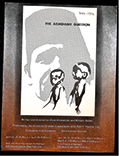
Image courtesy of Zohrab Information Centre, Diocese of the Armenian Church of America (Eastern).
Understanding the experiences of Armenian women and children is pivotal in gaining a comprehensive grasp of the scale of the massacres and deportations, especially considering the widespread elimination of male Armenians. The Armenian Question emphasises the dramaturgical significance of women and children to highlight the “utter senselessness” of a destruction like the Catastrophe, as illustrated by the images of starving children on the playbill cover, symbolising both “vulnerability and innocence” (Hirsch 1999: 12-16). In the play, Freeman, the attorney, presents archival evidence of the Catastrophe, including an official appeal by the United States to the Turkish government to halt the massacre of “innocent Armenians” and a warning from the French government to the Turks about being held accountable for the wholesale massacre of “innocent Armenians” (Antaramian and Rolleri 322-323). In a moment of remembrance, Gerard evokes the image of the innocent Armenians, describing how “bodies float in the river, women, children, babies” (Antaramian and Rolleri 337). One of the female survivors, Anahid, exhibits exceptional concern for all children, Muslim or Christian alike, expressing. “We do not wish to see innocent people suffer, least of all the children” (Antaramian and Rolleri 291). The postmemorial dramaturgy of the play accentuates the narrative of the unprotected innocent people, to evoke the relentless brutality, hatred, and unfathomable horror of the Catastrophe.
Anahid Siroonian, Survivor and Activist
Anahid, a ten year-old living a “peaceful and loving” life in Sivas, Turkey, had her life turned upside down when her male family members were conscripted into the Turkish army overnight (Antaramian and Rolleri 288). One week later, Turkish soldiers returned to kill all boys aged ten and older, and forced women, children, and the elderly out of the town. On the way to Aleppo, Syria, Anahid was initially sold as a slave to an “Arab,” who later sold her to her uncle in Merzifon, Turkey. There, she was raped:
ANAHID. My rainbow dress … my mother gave me that dress for my tenth birthday. It was covered with blood.
GENERAL. Grown men, away from their wives, evil thoughts …
ANAHID. It was torn to shreds …
GENERAL. Men who normally would never dream of …
ANAHID. It started to rain.
GENERAL. Oh, please do say it aloud, Madame.
ANAHID. I died here in the rain in that …
GENERAL. So I can deal with it.
MOURADIAN. She died.
GENERAL. Say it!
ANAHID. No!
GENERAL. Now!
ANAHID. It was a clear night. I was in the street, lost. Alone, I don’t know why. I couldn’t scream. He … the stars were shimmering … heaven was trying to catch her breath, I lay there wondering if God … if God even cared. The blood was inside me. My life was over sixty years ago! I have no children. I never married. (Antaramian and Rolleri 295)
Anahid’s description of her traumatic experience using euphemisms like her “rainbow dress covered with blood” and being “torn to shreds” casts a shadow over post-generations. Her use of these euphemisms might be influenced by the imposition of “narrow” and “rigid” Armenian “religious” and “patriarchal values” surrounding female sexuality. These values can exacerbate “feelings of shame” and lead survivors to withhold their experiences, reflecting the absence of open discussions about surviving sexual abuse during the 1960s (Okoomian 235). Anahid does not necessarily refrain from sharing her experiences but rather cloaks the act of sexual violation in euphemistic terms. The irony here lies in her reluctance or fear to explicitly utter the word rape, which parallels the General’s refusal to acknowledge the term genocide—the R-word versus the G-word. Despite the General’s repeated interruptions and her own vulnerability, Anahid weaves together the personal and the historical in a way that reflects the experiences of countless Armenian women. With her unwavering presence and resilience, Anahid explores themes of violation, loss, and hope, becoming a vessel for the voices of others who have endured similar trials.
Anahid’s journey from California to Paris to attend the hearing signifies her quest to raise awareness about the catastrophic history of Armenians and to seek acknowledgment for the pain and suffering endured by both herself and her people. As the central character, she occupies a pivotal role as a female survivor of genocidal rape who has dedicated her life to political activism. Anahid brackets the play as the first witness to speak and the last to command the spotlight. Her story resonates with the emerging identity politics of the 1970s, which focused on trauma and traumatised survivors within American culture, evident in the portrayal of traumatised Vietnam veterans in films like Taxi Driver (Martin Scorsese, 1976) (Luckhurst 58). Furthermore, the Holocaust gained renewed attention through television miniseries like Holocaust (Marvin J. Chomsky, 1978). Simultaneously, feminists began addressing the traumas of sexual violence. Anahid represents this new focus on trauma and feminist advocacy, as she embodies the traumatised female body and speaks out about the experience of sexual abuse, albeit using euphemisms. Her political activism becomes a critical component of the collective memory of the Catastrophe, as she endeavours to draw attention to the suffering of survivors and advocates for justice and healing to move beyond the traumatic past.
Postmemorial theatre experiments incorporate multiple forms of “texts,” ranging from “accounts of official histories inscribed with words and visual images” to “archival-repertorial forms performed through speech acts, gestures, movements, spatial relationships and sensorial expressions” (Hellier-Tinoco 35). Anahid draws upon fragments of these various texts, both oral and written, to embody her personal memories and connect them to the collective experiences of the Catastrophe. She reads aloud an archival telegram dated 1915, issued by Talaat Pasha, the Minister of the Interior, instructing the Governor of Aleppo to be ruthless towards women, children, and the elderly: “No regard must be paid to age, sex or conscientious scruple” (Antaramian and Rolleri 309). Furthermore, Anahid reads a series of real-life telegrams, which were smuggled and brought to court in the play by Armin Wegner, a historical German eyewitness to the Catastrophe. Anahid also introduces “The Ten Commandments,” a set of “tactics” employed in the execution of the Catastrophe (Antaramian and Rolleri 320-321).
Anahid reads aloud each written document to everyone present, disconnecting the words of violence from their original source and recontextualising them as spoken memories of her personal ordeal as a survivor. Through this act, she merges her own body with the collective corporeal body of the Catastrophe, forging a connection between her personal memory catastrophic experience and the collective trauma of all Armenians. The spoken telegrams, originally death warrants for all Ottoman-Armenians, unify Anahid’s body with the bodies of other Armenians, whether living or dead. This communion creates a sense of collective trauma that transcends individual experiences. By speaking out about the Armenian suffering and recontextualising the catastrophic past, Anahid challenges the narrative of the oppressor and the unjust status quo. She lives out her own resistance and survival. Her actions unite fellow Armenians in collective resistance and survival, creating a powerful force against continued repression and injustice.
Anahid stands up in protest against the Committee’s decision to demand a new census supervised by the United Nations in Turkey and close the hearing:
ANAHID: (On her feet.) No! This hearing is not closed! Not while children starve!
FREEMAN: (Grabs Anahid’s arm.) Anahid!
ANAHID: (To Goldsmith.) Please listen to me for one moment, I …
GOLDSMITH: (Hesitates.) We have already listened to you, this hearing …
ANAHID: This decision, Madame … people will … children will … this will bring shame to our cause, you make us all bear a terrible guilt.
GOLDSMITH: That is not my cause, Madame, and it is not my shame.
ANAHID: Please, listen, listen to me: We all stand here. We are all adults. It is the adults who make important decisions about what will be and what will not be. But who pays?
HEINMAN: We all pay.
ANAHID: We pay nothing. Infant. The old and the sick. They will be the first to die. Please, not again. I appeal to the mother in you. The mother I could never be. Do you feel nothing? (Antaramian and Rolleri 340)
Anahid’s concern lies in the Committee’s decision that prolonged the suffering of the innocent people like infants, the elderly, and the sick in Turkey, while also tarnishing the reputation of their quest for justice with shame and guilt. Her plea of “please, not again” harks back to the catastrophic past of the Ottoman-Armenians, where innocent people bore the brunt of consequential choices. Anahid is determined to prevent another catastrophe, performing both ethical care and resistance. Her embodiment of care and resistance prompts a re-examination of official narratives and power dynamics surrounding scenarios of destruction and compassion. This re-evaluation invites a new perspective on the image of starving Armenian children on the playbill, extending empathy to all children, including Muslim children. Anahid’s performance of motherliness and her unattainable motherhood revises and reproduces the historical reality of the Catastrophe. Anahid’s corporeality and survivor memory bridge personal past experiences with global political structures and processes. This connection between personal and global catastrophes offers a chance to revise historical circumstances and probe potential realities for a different future. Consequently, the personal dimension takes on both political and international significance in the play.
Arpine Garabedian, Survivor
Arpine, in her twenties in 1915, hailed from the town of Divriği in Sivas, just like Anahid. Arpine was older than Anahid, who was a teenager at that time. When Turkish soldiers came to eliminate the Armenian residents of the town, Arpine already had her baby, Zabel. Arpine recalls that the Turkish soldiers were given specific instructions to kill the Armenians in a different way, using the phrase “Oldermek farkli,” because burning the bodies would “stink up the city for weeks.” This phrase has left an indelible mark on Arpine, and she believes it will haunt her even beyond her death: “Those words will echo in my tomb. Kill different” (Antaramian and Rolleri 301).
Arpine’s account provides a harrowing account of the atrocities committed against Armenians during the Catastrophe, including various methods of torture and execution, such as foot whipping and nailing horseshoes into whipped feet. She also infuses a personal dimension into her narrative:
ARPINE. […] Zabel. My princess. I was holding her. A soldier tickled her. She giggled. I remember thinking maybe he has a little baby at home, and he … he asked if he could hold her. I told him she would cry, and then she did just that, she started to cry, and he told her to stop crying, why are you crying, little one, do you think the big, bad Turk would harm you, no, no, no, stop crying, little one, I said stop … […]
He took my little princess in one hand by the ankles, he wrenched her away from me, he swung her around singing some insane Turkish song and then he bashed her brains out against a rock. There, he said, she has stopped crying. She has stopped … (Antaramian and Rolleri 303)
In this account, the image of the “big, bad Turk” emerges as the “symbolic opposite” of Armenians, conjuring up the atrocities committed against Armenians (Shirinian 258). Zabel and her murder serve as an analogous symbol for Ottoman-Armenians and their Catastrophe, respectively. The “big, bad Turk” is depicted as a bloodthirsty killer, standing in stark opposition to the defenceless Zabel and, by extension, the Armenian minority of the Ottoman Empire.
As Arpine remembers Zabel, she becomes lost in her own thoughts, cradling an imaginary baby in her arms and humming a lullaby to soothe her:
FREEMAN. Mrs. Garabedian?
ARPINE. (To Freeman.) Don’t you think she’s beautiful?
FREEMAN. Uh … yeah. I, uh …
ARPINE. Maybe just to me she’s … she does have her father’s ears. Such big ears my baby has, but to me … she looks like an angel who just left the arms of God, an angel He sent to us …
GENERAL. The woman is lost.
ANAHID. We should let her go.
FREEMAN. Arpine? Mrs. Garabedian?
ARPINE. (Holds baby forth to Freeman.) My little baby girl. Just twenty days old. Isn’t she beautiful?
PENSAR. Mon Dieu. (My God.)
GENERAL. Madame, the poor woman is hallucinating. She’s repeating herself, rambling on and … She should be excused, she is not even here. (Beat.)
FREEMAN. She’ll be all right.
ARPINE. Are you blind? Look at her.
GENERAL. Mrs. Garabedian, do you know where you are? See? That look in her eyes?
ARPINE. He sends these little angels to teach us how to love. (Antaramian and Rolleri 303-304)
Arpine experiences a vivid visual hallucination of her deceased daughter, Zabel, a beautiful twenty-day-old baby with big ears—a visceral description. Arpine’s interaction with this imaginary child extends to holding her and singing to her. She asks Freeman and indirectly the audience to acknowledge the existence of the hallucinated baby. This blurs the boundary between the reality of the play and the imagined world of the character, creating a sense of ambiguity and challenging the linear time sequencing of the narrative. Arpine’s hallucination fragments her narration by bringing the past into the present, blurring the line between what is real and what is imagined, and is consonant with postmemory, emphasising the lasting impact of trauma on memory and perception. Zabel’s invisibility and silence symbolise the broader world’s non-recognition, ignorance, and indifference toward the Catastrophe, rendering Armenians incomprehensible and voiceless. Arpine’s hallucination symbolically represents the dispossession of Armenians from their old country and the resulting anguish.
Arpine interrupts the courtroom procedure to engage the audience in a reflective conversation. She is experiencing a disconnection between her past experiences and her current surroundings, as evidenced by her hallucination of Zabel. Her traumatised memory of Zabel is intertwined with her testimony of the murdered baby, causing her to feel a profound sense of loss. Despite physically being present in a municipal hall in Paris, Arpine is mentally transported back to her home country, which no longer exists in the same form, further complicating her experience. Her hallucination blurs the lines between reality and memory, making her feel as if she is holding Zabel in the present moment. However, this is ultimately an irretrievable experience, as both the baby and her hometown have been lost forever. Arpine is trapped in a perpetual cycle of reliving her traumatic past and struggling to reconcile it with her present existence. She is unable to escape the past and constantly moves between past and present.
Cathy Caruth’s trauma theory describes trauma as an “overwhelming experience of sudden or catastrophic events in which the response to the event occurs in the often delayed, uncontrolled repetitive appearance of hallucinations” (11). Arpine’s hallucination of her deceased daughter is an example of the “inability” of her “mind” to “avoid an unpleasurable event, “the gruesome murder of her baby, which she cannot comprehend (59). Her hallucination signifies the “very incomprehensibility of [her] own survival” during the Catastrophe, an event that resulted in the death of her daughter and countless other Armenians (64). Arpine’s inability to make sense of her survival is at the heart of the Catastrophe, illustrating the survivors’ experience of catastrophic trauma and the difficulty in understanding their own survival.
Arpine’s embodied and sensory memory of the Catastrophe transforms her body into a living archive of history. Her skin contains the traces of Zabel’s death and other traumatic experiences she endured. Her “terrifying distortions” serve as the sites and sights of her mental and corporeal fragility (Antaramian and Rolleri 305). When Arpine cradles an imaginary baby and hums to her, her gestures become vessels through which the past is brought into the present. Her movements and gestures embody the collective trauma of the Catastrophe, and she acts as a repository of memories that connect individual and collective suffering. Arpine’s act of remembering serves as a bridge between personal and collective trauma, and her physical embodiment of the past becomes a means of preserving the catastrophic history of the Armenian people. Her memories bear witness to all Armenian children who were killed during the Catastrophe and whose bodies were left unburied. Thus, Arpine’s body becomes a conduit through which the collective history and trauma of the Armenians are experienced and transmitted to both the audience and postgenerations.
Conclusion
This article has harnessed Marianne Hirsch’s postmemory theories to pioneer an analysis of the theatrical representations of the Armenian Catastrophe. It has shed new light on the intricate connection between the generational structure of memory transmission and the play structure of The Armenian Question. By delving into dramaturgy, often overlooked in postmemorial media, this research has revealed how this documentary play effectively translates intimate processes of remembering and imaginative re-creation into its dramatic framework. As a result, it brings both Armenian and non-Armenian audiences closer to a deeper understanding of the traumatic narratives of the past.
The choice of the courtroom genre has emerged as a potent and formal platform for conveying survivor testimonies, rooted in real-life interviews, while also juxtaposing them with Turkish counter-arguments. This approach invites the audience to question singular notions of truth, justice, accountability, violation, resilience, and hope—all grounded in the postmemory of the Catastrophe. Within this analysis, four pivotal components of the Catastrophe’s postmemorial dramaturgy stand out: survivor interviews, the Armenian-American version of the ancient quest pattern, gender-specific aspects of the massacres and deportations, and the representation of the Turk as the antithesis to the Armenian.
This article hopes to offer a more nuanced and subjective understanding of how theatre communicates the enduring impact of collective historical trauma. It encourages not only reflection on the catastrophic history of Armenians but also stimulates further research into the complexities of postmemory in contemporary media and its broader implications for both scholarly and practical contexts.