
Within Beau Willimon’s political television series House of Cards (2013-18) and Adam McKay’s bio-fictional comedy-drama film Vice (2018) there exists a unifying factor that drives their principal couples towards each other: an insatiable quest for power and the sacrifices that this entails. These modern productions provide, in various ways, material through which to examine key aspects of Macbeth’s narrative and its legacy beyond direct screen adaptations of the play, with a particular focus on childlessness, the Lady Macbeth archetype and the balance of power within the Macbeth partnership. I begin by exploring these aspects within Macbeth itself and then focus on a direct comparison between the play and the first two seasons of House of Cards (2013-14). I argue that both Lady Macbeth and Claire Underwood expose their husbands’ fragile masculinity and consider how each couple acknowledges and manages the absence and loss of children to achieve power. Finally, I return to the Lady Macbeth archetype to critique the character’s misrepresentation in popular culture with a focus on McKay’s satire of the politicisation of Macbeth in Vice.
Childlessness, Archetypes and Partnership in Macbeth
Upon my head they placed a fruitless crown,
And put a barren sceptre in my gripe,
Thence to be wrenched with an unlineal hand,
No son of mine succeeding (Shakespeare, 3.1.60-3).
Macbeth’s fear of Banquo and his “line of kings” (3.1.59) is most forcibly a moment of recognition of his failure to produce heirs of his own. Regarding his response to this supernaturally predicted absence of children, born out of the Witches’ prophecy during Act 1 Scene 3, Nicholas Brooke posits that these four lines are “alluding, of course, to their prediction that he would have no successors, but stressing childlessness, which they did not say” (144). Here, Macbeth not only betrays his anxieties about this slur on his virility, but also uses violent imagery in the soliloquy, to display his guilt that he has “wrenched” (3.1.63) power from Duncan in order to take the throne. Realising that, “for Banquo’s issue have I filed my mind” (3.1.64), Macbeth recognises in this moment the futility of his murderous act. As Carol Chillington Rutter suggests, within Macbeth
tyranny is not the motive force, Macbeth’s need to cover his back, to keep the past at bay by committing greater and greater atrocity. Tyranny is merely the accessory. The motive is barrenness: Macbeth’s appalled, delayed, recognition of the black joke that mocks his dynastic project. Having no children, he has no future. To keep that future at bay, he must kill it – by crushing the “seeds of time” (1.3.56) that are the future. The children (165).
In this attempt both to banish the past and delay his fruitless future, the Witches’ prophecy, therefore, becomes Macbeth’s subconscious prompt to rebel against this particular absence, which has the potential to rob him both of his status as a progenitive male and any hope of a legacy.
Janet Adelman believes that Shakespeare’s interest in the nature of Macbeth’s manipulation may have been more domestic than supernatural, suggesting that “Lady Macbeth brings the witches’ power home, they get the cosmic apparatus, she gets the psychic force” (137). Framed thus, the witches simply provide the match for Macbeth; it is Lady Macbeth who must light the touch-paper that ignites his “brief candle” (5.5.22) of ambition. This is further supported by Adelman’s conclusion that Lady Macbeth was “the more frightening figure […] even before belief in witchcraft declined [which] suggests the firmly domestic and psychological basis of Shakespeare’s imagination” (137). It is this combination of rooted domesticity and intensely cerebral authority that has made Lady Macbeth culturally synonymous with both fictional and non-fictional women, driven to dominate in a man’s world, “whether she is portrayed as an “unsexed” woman bent on political advantage […] or as a hypersexual seductress” (Garber 93). Central to both these representations of Lady Macbeth is her questioning of the strength of her husband’s convictions when presented with the opportunity to kill Duncan, asking him, “art thou afeard / To be the same in thine own act and valour / As thou art in desire?” (1.7.39-41). Most significantly, in Act 1 Scene 7, she equates the sacrifice of her femininity represented by the absence of children, with his masculine necessity to commit murder, in order to further their shared ambitions:
I would, while it was smiling in my face,
Have plucked my nipple from its boneless gums
And dashed the brains out, had I so sworn
As you have done this (1.7.56-9).
“A logic of association may be working here, analogising gender: that is, childbirth makes a woman like killing makes a man” (170), and Rutter’s further suggestion that, “to make Macbeth a man, Lady Macbeth produces the death of a child” (170), indicates the depths to which she is prepared to sink in order to achieve success. She galvanises Macbeth at this moment, not only by using the image of infanticide, but also by seizing upon the aspect of their relationship that tacitly represents their greatest weakness as a couple and transforming it into a grotesque strength. The absence of children is simultaneously their unifying strength and the most obvious contradiction in the Macbeths’ desire for power, resulting in, as argued by Carolyn Asp, “the tension which raises them to the level of tragedy in the eyes of the audience […] created by the conflict between the roles they think they must play to actualize the self and achieve their destiny and the limits imposed by both nature and society” (209).
The Macbeths further represent a united couple through their shared problem in reconciling the belief in their own self-ordained potential with a sense of domestic duty. For instance, Macbeth’s deferral to Duncan as “his kinsman”, “subject”, and “host” (1.7.13-4) conflicts with his own personal ambitions, whilst Lady Macbeth may attempt to strip away her femininity to assert herself within male-dominated society but is undone by her husband’s ultimate sense of chauvinistic superiority. To the modern audience, this has resulted in a shift of focus away from Macbeth’s “supernatural soliciting” (1.3.132) and onto both his psychological instability which, coupled with Lady Macbeth’s increasing manipulation, results in the malfunction of the play’s central domestic dynamic.
Aside from the absence of children, the couple’s actions produce a patriarchal absence when they kill Duncan. This murder results in the gradual disintegration of both Scotland as a country, and their unity as a couple, whereby, “in his absence male and female break apart, the female becomes merely helpless or merely poisonous and the male merely bloodthirsty; the harmonious relation of the genders imaged in Duncan fails” (132). Adelman here confronts Lady Macbeth’s ultimate inequality and failure to fulfil her earlier promise to “unsex” (1.5.41) herself. It is worth noting that, in the first two acts of Macbeth, Shakespeare presents a couple with a shared consciousness rarely observed in couples elsewhere in his canon of work, who, despite their ultimate disintegration, remain the paradigm of a completely unified couple. Asp also suggests Lady Macbeth’s failure, believing that,
ironically, her assumption of a masculine role does not create partnership; rather it distances Lady Macbeth from her husband. As long as he retained elements of so-called feminine sensibility, he was susceptible to her appeal: there was a “weakness” in him that responded to her challenge. After he fully assumes the stereotype she urges upon him, there is nothing in him she can manipulate (204).
Lady Macbeth’s diminishing influence over her husband is made clear by his patronising, post-regicide command for her to “be innocent of the knowledge, dearest chuck, / Till thou applaud the deed” (3.2.46-7). However, I disagree with Asp that “by making him “manly” she has guaranteed that he will think of her as subordinate and unworthy of truly sharing power” (204), since her presence, even in absence, continues to haunt and influence Macbeth throughout the play, up until his moment of existential crisis on learning of her death in Act 5 Scene 5. The literal distance that develops between them during the last three acts of the play instead strengthens my argument that they symbolise a modern power couple, supported by Abbott’s belief that “towards the end of the twentieth century […] many of our couples were cut off from each other for long periods [and] with independent opportunities for women, a new species of loneliness emerged – the loneliness of couples with demanding parallel careers” (6).
Consequently, it would be incorrect to interpret the growing silence within their relationship as purely diminishing as Banquo, for instance, draws attention to the ecstatic quality of Macbeth’s reaction to his first encounter with the witches, observing “how our partner’s rapt” (1.3.145) representing Macbeth’s singular focus upon and savouring of the prophetic moment. The word “rapt”, meaning to be “completely fascinated or absorbed by what one is seeing or hearing”, reoccurs in Act 1 Scene 5, during which Macbeth in a letter to his wife informs her that, when faced with the prophecy, he “stood rapt in the wonder of it” (1.5.5-6). This is one example of why Macbeth’s connections with those he values most highly do not necessitate conversation, supporting the argument that Macbeth’s relationship with his wife does not fail due to silence. The acute understanding between husband and wife subsequently emerges within the rest of this scene in two respects.
Firstly, without needing to see her husband, Lady Macbeth senses that his enraptured self “is too full o’th’ milk of human kindness” (1.5.17) and thus tasks herself with tempering his warm feelings with cold calculation. Given that this is the audience’s first encounter with Lady Macbeth, Shakespeare relies here on our assumption that Macbeth must love as valiantly as he fights, since it is with Banquo that we first see him in partnership, rather than with his wife. Consequently, Banquo’s relationship with Macbeth during the encounter with the Witches foreshadows Lady Macbeth’s role in activating her husband’s potential. When Banquo asks Macbeth, “why do you start and seem to fear / Things that do sound so fair” (1.3.51-2) Macbeth’s passivity within this exchange with Banquo prefigures his relationship with Lady Macbeth, who initially acts as the driving force within their power couple.
The way in which Shakespeare crafts the scene shows Banquo speaking at greater length to the Witches, interrogating them in twenty lines of speech, whilst Macbeth is slower to react, speaking only twice before the Witches begin to leave and, recognising the lost moment, begs them to “[s]tay, you imperfect speakers, tell me more” (1.3.70). Banquo contrasts with Macbeth both in his combination of fearlessness when faced with the unknown, and his ability to articulate this, unlike his rapt partner. The same brevity can be seen as the second sign of Macbeth and Lady Macbeth’s mutual understanding in Act 1 Scene 5 in the way they conspire to engineer their desire for power by concocting a murder plot between them within just eleven lines of their reunion. This makes clear the couple’s intimate anticipation of each other’s ambitions, and the speed with which Shakespeare establishes this shared decision is significant in establishing the level of synergy between the two characters.
Fragile Masculinity in House of Cards
In these next two sections, rather than comparing Shakespeare’s overall resonance throughout the entire five seasons of House of Cards, I focus on a single aspect of Shakespearean appropriation in the first two: the psychology of absence which it shares with Macbeth. House of Cards, the first original series produced by Netflix in 2013, is an American adaptation of a 1989 novel by British Conservative politician and author Michael Dobbs and its subsequent small-screen version. Both the British and American iterations featured an actor associated with Shakespearean performance in the principal role of Francis Underwood: Ian Richardson and Kevin Spacey. In particular, both actors had played Richard III prior to House of Cards and visibly brought this experience to bear as Underwood, a power-hungry, morally duplicitous politician.
In Willimon’s adaptation, where Underwood’s name is shortened to Frank, the character is depicted as a Democratic congressman who harbours ambitions of supreme office above his role as House majority whip, aided by his equally conniving wife, Claire Underwood, played by Robin Wright. The most self-aware acknowledgement of Shakespearean influence appears in the penultimate episode of its second season, when Underwood paraphrases lines delivered by Mark Antony in Act 3 Scene 1 of Julius Caesar, exclaiming: “‘Cry havoc!’ said he who fought chaos with chaos ‘and let slip the dogs of war’” (“Chapter 25”). Therefore, a cursory analysis of such tropes and dramatic conventions might render House of Cards, to the Shakespeare-initiated viewer, as a bricolage of Richard III’s Machiavellian deception, with a splash of Macbeth’s power couple dynamic, and a dash of Julius Caesar’s portrait of political plotting. The show’s web of Shakespearean intertextuality is made unambiguous by its creative team’s recognition of the playwright’s service as a touchstone for their casting choices and decisions informing characterisation, such as when Robin Wright stated that “the way it was displayed to us, long before Episode 1 was ever written in Season 1 was: you are Lady Macbeth to his Richard III” (D’Addario 2014).
How, then, did Shakespeare’s representation of the Macbeths as a dynamic and well-defined power couple who are driven by mutual ambition influence Willimon’s portrayal of the Underwoods? The fundamental drive behind both these couples is indicative of a particular human instinct to desire what you do not or cannot have. This might suggest that Macbeth and House of Cards offer pessimistic life-views; however, their central protagonists demonstrate how, when a sense of fulfilment is absent, this can induce a positive effect by enhancing an individual’s ability to achieve the unattainable and live life in constant pursuit of the next goal. Frank and Claire “support and love one another. They suffer together. And if, as time goes on, they drift a little apart, they are not vulgar souls, to be alienated and recriminate when they experience the fruitlessness of their ambition” (Bradley 113). Bradley’s description here of Macbeth and Lady Macbeth’s relationship resonates precisely with the trajectory of the Underwoods, as shown in the following exchange during the first episode, when Frank has just been overlooked for the position of Secretary of State within the new Democratic administration, promised him by President Walker (Michel Gill), who has chosen a younger, more camera-friendly politician:
|
Claire: |
You don’t usually underestimate people, Francis. |
|
|
Frank: |
I know. Hubris. Ambition. |
|
|
Claire: |
You should be angry. |
|
|
Frank: |
I’m livid. |
|
|
Claire: |
Then where is that? I don’t see it. |
|
|
Frank: |
What do you want me to do? Scream and yell? Throw a tantrum? |
|
|
Claire: |
I want more than I’m seeing. You’re better than this, Francis. |
|
|
Frank: |
Well, I’m sorry, Claire. I am sorry. |
|
|
Claire: |
No, that I won’t accept. |
|
|
Frank: |
What? |
|
|
Claire: |
Apologies. My husband doesn’t apologise, even to me (“Chapter 1”). |
Fig. 1 Robin Wright as Claire Underwood in “Chapter 1”, House of Cards, season 1, episode 1 (2013)

Image courtesy of Netflix.
Macbeth’s influence is perceptible here in Frank’s passive self-doubt and Claire’s proactive challenges, as well as in the brevity of the exchange, which is reminiscent of Macbeth’s return home in Act 1 Scene 5, when he and his wife first begin to plot Duncan’s demise. As a result, “her role, as she perceives it, is to evoke her husband’s “noble strength” so that he can act in accord with his desires. To do this she must appeal as a woman to his manliness as well as channel her energies into maintaining a persona of masculine courage” (Asp 203). Also significant is the fact that, in direct parallel with Macbeth where Duncan decides to reject Macbeth and “establish our estate upon / Our eldest, Malcolm”, (1.4.37-8) thus providing the impetus for Macbeth’s reprisal, Frank feels a similar rejection, resulting in his quest for vengeance alongside his political ambition, until the two feelings become indistinguishable.
Moreover, like Macbeth, Frank is incapable of achieving this alone and the human hurt and excess of pride which he experiences in the wake of his rejection requires the judicious application of tough love provided by Claire. She has earlier made clear their self-defined status as a power couple, by her sharp reminder to Frank that, “we do things together […] when you don’t involve me, we’re in free fall” (“Chapter 1”). The story arc of the first series and the correlation between Frank’s successes or failures with Claire’s presence or absence show this to be true. For example, when, frustrated by Frank’s failure to appreciate her sacrifices, she abandons him for a past lover, and his resulting loneliness affects his ability to succeed. On Claire’s return, with their combined efforts, Frank moves a step closer to power by becoming Vice-President, making their trajectory unstoppable. Thus, the series owes its debt to Macbeth chiefly through Claire’s involvement and intervention within House of Cards, where the central male protagonist relies fundamentally on the contribution and commitment of his female partner.
For Frank, the turning point comes with Claire’s reminder that “you don’t normally trust people” (“Chapter 1”), where she uses a method of emotional manipulation taken a stage further by Lady Macbeth when warning her husband that, “[y]our face, my Thane, is as a book where men / May read strange matters” (1.5.62-3). This triggers Frank to fall back upon his true nature, compelling him to channel his anger, forget unmanly apologies and take the initiative. Furthermore, there is an explicit correlation with Macbeth in the way Claire enables her husband to identify that “[f]alse face must hide what the false heart doth know” (1.7.83) and, crucially, to channel his hubris into a tool for revenge. This demonstrates another major factor in the Underwoods’ success as a power couple and the correlative benefit of looking at the Macbeths through these cultural successors; Claire tempers her harsher qualities with kinder words of hope, telling him that “you’re better than this” (“Chapter 1”), just as Lady Macbeth follows her questioning of her husband’s virility by asserting that “to be more than what you were, you would / Be so much more the man” (1.7.50-1).
Ultimately, the Underwoods’ success as a power couple in the first two seasons of House of Cards is brought about primarily by a combination of political manoeuvres on Frank’s part and domestic ones on Claire’s. For example, once they both begin to work in the White House, after Frank becomes Vice-President, Claire sows doubts in the First Lady’s mind about her husband’s relationship with his secretary. This leads the presidential couple to seek marriage counselling and take prescription drugs. In turn, this contributes to the emergence of questions surrounding President Walker’s judgement whilst on medication, resulting in his eventual impeachment, paving the way for Frank to become President. Thus, what makes Claire so valuable to Frank as both his political and domestic ally is the fact that the insidious nature of the action is rooted within her psychological power, a trait that she shares with Lady Macbeth.
Lady Macbeth’s and Claire Underwood’s Absent Children
Like the Macbeths in their early exchanges, the Underwoods represent the archetypal power couple, where, irrespective of visible sexual chemistry, the driving forces include “affection and respect, a craving for excitement, ambition, the prospect of mutual aid, a taste for the glamorous trappings of power and fame” (Abbott 4). However, following Claire’s challenge against Frank’s self-doubt in the first episode, he tells her during an early morning conversation that “we’ll have a lot of nights like this. Making plans. Very little sleep” before expressing, in an aside, that “I love that woman. I love that woman more than sharks love blood” (“Chapter 1”). Whilst this points towards Frank as a contemporary representation of R.A. Foakes’s view that “violence at once repels and attracts us” (17), it may also indicate a degree of inequality in Frank’s attitude towards Claire, which is also a feature of the Macbeths’ relationship and legacy as a power couple. As Lili Loofbourow asserts
Frank intends the comparison to emphasize his savagery. He’s bloodthirsty, carnivorous, appetitive. It shows that Claire is the catalyst, the thing that drives Frank to kill. This is the myth of woman as Power Behind, of Lady Macbeth. But it shows other things too: it shows the limits, in his own mind, of his and Claire’s equality. (Blood is not the co-equal partner of Shark.) (2014).
I suggest that these limitations which Loofbourow describes are primarily found in Frank and Claire’s differing attitudes towards the absence of children and the consequent effect on their equality. This is observed primarily within the ambiguity surrounding both Lady Macbeth’s and Claire’s desire to have children and the extent to which this is incompatible with their resolve to reject femininity as they perceive it. For instance, during the final episode of the second season, Frank and Claire’s exchange after he has killed his political protégé, Peter Russo (Corey Stoll), demonstrates how Claire’s particular guilt is specifically associated with the children he has left behind, rather than with Peter himself:
|
Frank: |
Tell me what you were dreaming. |
|
|
Claire: |
Oh, it was so awful, Francis. |
|
|
Frank: |
He’s not letting me sleep either. |
|
|
Claire: |
Yeah. It’s not him. It’s the kids. I was playing with them in the backyard, and the girl was climbing on the vines, and I kept telling her to stop and get down, and the vines just took hold of her, and they wouldn’t let go. And she was screaming so loud, and I just kept pulling harder and harder, and she just ripped in half (“Chapter 13”). |
Parallels can be drawn here between Frank’s insomnia and Macbeth’s paranoia that “[m]ethought I heard a voice cry, ‘Sleep no more’” (2.2.36), with the former ally Russo and his innocent children standing in for the murdered Banquo and Fleance. More subtle, however, is Claire’s failure to acknowledge her maternal instincts, which emerge here within her subconscious, expressed in this nightmarish vision of infanticide where, like Lady Macbeth, “[a]ll the perfumes of Arabia will not sweeten this little hand” (5.1.50-1). Interpreting Shakespeare’s use of “little” as either an expression of Lady Macbeth’s awareness of her own stained feminine hands or those of the clinging infant, Claire’s terror at Russo’s daughter being “ripped in half” ultimately suggests that, “in spite of her pragmatic and ruthless rhetoric, it is obvious that the gall in her breasts has not been sufficient to unsex [her]” (Asp 204).
Without Frank’s knowledge, Claire pursues fertility tests, drawing the audience’s sympathy with her desire for children, a wish not shared by her husband, who confesses in an aside that “I despise children. There. I’ve said it” (“Chapter 9”). Although this might be seen as a threat to their unity, Claire’s true intentions are revealed when she attends the appointment with a fertility expert, not in order to have children herself, but to find out more about the drug used by her pregnant former employee, Gillian Cole (Sandrine Holt), who is taking her to court. Armed with this information, Claire threatens to withhold Gillian’s insurance from her, thus preventing her from obtaining necessary drugs, threatening to perform her own act of infanticide as she tells her that, “I’m willing to let your child wither and die inside you if that’s what’s required” (“Chapter 14”). Like Lady Macbeth’s impassioned statement that she would kill a child in its place of comfort and warmth, “while it was smiling in my face” (1.7.56), this indicates the readiness of both characters to end the life of an infant if circumstances so dictated. Consequently, the initial weakness within Claire has been transformed into a characteristic that strengthens her ambitions and eliminates her rivals, even as it contributes to the destruction of her femininity.
Claire’s apparent deterioration towards the end of the second season of House of Cards displays, within the Underwoods, “an emptiness at the core of their relationship” (Bate 11). Whilst she was able to use the feigned attempt to have children in order to further her own ambitions, Claire is haunted by the past traumas that she has experienced, further aligning her with Lady Macbeth, because “she offers to negate her own maternal power as an example of her dedication” (Asp 203). This emerges through her public admission of an abortion prior to her marriage to Frank – although she privately concedes that she has had three – and that this was due to her being raped by a senior army General. Consequently, House of Cards, like Macbeth, is “scarred by images of sterility and harrowed glimpses of dead babies” (Bate 11).
Claire again uses the publicity which the revelation attracts in order to further her own career, fighting for a new bill to combat levels of sexual abuse within the military. However, she withdraws the legislation for the sake of Frank’s career, with the ultimate consequence being a moment of rare insight into her vulnerability as she is privately reduced to tears. This moment comes after conversations she has with two women whom she has manipulated throughout this series, Megan Hennessey (Libby Woodbridge), a young Marine who has been raped by the same General, and Patricia Walker (Joanna Going), the First Lady. Flying out to meet a suicidal Megan, whilst taking her medication, the young woman tells her that “every time I take one of these, I think of him. And the next face I think of? It’s yours” (“Chapter 26”). The impending collapse of Claire’s “undaunted mettle” (1.7.74) is then confirmed when she telephones Patricia about Megan’s condition, and is told by her that “it was kind of you to make that trip. You’re a good person, Claire. Be well” (“Chapter 26”). Claire then breaks down, buckling under the combined weight of Megan’s association of her with the rapist, and Patricia’s words of kindness.
Discussing Macbeth, Jonathan Bate asks, “is power in the end a substitute for love, ambition nothing but compensation for the sorrow of childlessness” (11) ? To answer this for House of Cards, it proves to be the ultimate sacrifice, which Claire appears unable to sustain, as she continues to prioritise her husband’s ascent over her own femininity. Significantly, as Frank attains the Presidency at the end of the second season, she allows him to walk into the Oval Office alone, perhaps signifying her own tragic recognition that, like Lady Macbeth, “she is completely removed from the masculine world she so desperately wanted to enter and which so effectively has excluded her” (Asp 207).
Direct adaptations of Macbeth on screen, including Justin Kurzel’s 2015 film, have woven narratives of absence directly into Shakespeare’s play, answering the question of childlessness more explicitly than ever hinted at in the original text. House of Cards follows the reactive tradition of creative artists, such as Mary Cowden Clarke in The Thane’s Daughter – which appears in her 1851 collection of stories The Girlhood of Shakespeare’s Heroines – by responding to Lady Macbeth’s eventual marginalisation in Macbeth and re-centring the character within a narrative influenced by, or directly following, the structure of Shakespeare’s play.
Vice’s Satire of Political Macbeth Figures
The continued appearance of representations of Lady Macbeth in modern popular culture such as House of Cards and the persistent attribution of the character’s name to women in power indicates that the decline of belief in witchcraft does not render contemporary audiences any less fascinated, either by watching fictional women coerce men into committing misdeeds, or by factual women cast by society in this role. Marjorie Garber, who includes Margaret Thatcher, Hillary Clinton and Condoleeza Rice on her list of female politicians to whom the label has been attributed, explains that “Lady Macbeth has long occupied this cultural role of the (too-) powerful woman in visual images as well as verbal ones” (93). This is reflective of a wider problem surrounding this tendency to portray powerful women in society and fiction as reminiscent of Lady Macbeth, and the connotations which lie beneath this sexist shorthand.
In 2018, writer and director Adam McKay satirised the creative impulse to frame powerful political couples as Macbeth and Lady Macbeth in the film Vice, which follows the rise of former U.S. Vice President Dick Cheney (Christian Bale). In one pivotal scene, after Dick has been offered the position by presidential candidate George W. Bush (Sam Rockwell) and is debating with his wife Lynne (Amy Adams) whether or not to accept, the film changes linguistic register from modern English to an approximation of blank verse. The camera cuts suddenly to black and switches to the Cheneys in bed together:
|
Lynne: |
My sweet Richard. |
|
|
Dance’d nimbly round the King’s hearth thou hath. |
||
|
Even whilst clamored I for more, more! |
||
|
Parched maw craned towards the drip, drip of imagined waters. |
||
|
But I say to you now, rest, retire. |
||
|
Thou hast honored thy vows to wife and crown. |
||
|
Dick: |
Has blindness usurped vision in you my wife? |
|
|
No mere treaty is our union! |
||
|
Thou shared thy torch’s flame with mine. |
||
|
Revealing halls and spires of long faded empires. |
||
|
But now I hold aloft mine own fiery cresset |
||
|
To make flesh our bond of power. |
||
|
Lynne: |
Dare I? |
|
|
Dare I let hope’s beak place gathered bramble |
||
|
Upon my heart for future’s nest? |
||
|
Many winters past hath I let this hope die, |
||
|
Cruel winds silencing tiny birds needy cries |
||
|
Now that it hath arrived I say yea, |
||
|
Both: |
Yea! |
|
|
Lynne: |
Mine own blood and will, are yours |
|
|
Til pierced be the last soldier’s breast plate, |
||
|
Spilling open its jellied ruby treasures! (Vice) |
Fig. 2 Amy Adams and Christian Bale as Liz and Dick Cheney in Vice (2018)
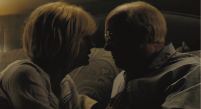
Image courtesy of Plan B Entertainment.
Although ostensibly based on real events, Vice cuts frequently between the past, present and future and employs meta-cinematic techniques such as fourth wall breaks, including the film’s final scene in which Dick turns to camera in a manner reminiscent of Frank Underwood, described by Abby Olcese as summarising the character’s “entire philosophy in a chilling monologue that could be paraphrased from Richard III. ‘I can feel your incriminations and your judgment,’ he growls at us, ‘and I am fine with that’” (2018). Olcese also argues that McKay “use[s] the same tricks Shakespeare used in his historical plays […] to make complex sociopolitical issues understandable to a broad audience […] and to get his audience to pay attention and retain information” (2018). The film’s title further indicates McKay’s debt to the theatrical past, with the word “vice” referring not only to Dick’s position in the Bush administration, but also to the popular stock character of medieval morality plays who, like Dick, spoke in asides to audiences and was represented as comic or absurd even when engaging in sin and temptation.
Although Lynne’s opening line refers to Dick’s by his unabridged forename, a possible reference to Vice’s debt to the character of Richard III – who explicitly connects himself to the figure of Vice in Shakespeare’s play – the exchange most closely resembles an amalgamation of conversations shared between the Macbeths in Act 1 Scene 7 and Act 3 Scene 2. The combination of persuasive techniques and language which combines physical images with those of power and lust implicitly evokes Macbeth. Building to this moment, McKay has framed Lynne as a willing accomplice in her husband’s ambition, despite being more capable in many respects. She is also prepared to make familial sacrifices, as illustrated by her ambiguous attitude towards their youngest daughter’s homosexuality and the problems that this could place in Dick’s path to becoming a Republican president. Dick is portrayed as a Machiavellian character and his relationship with George W. Bush is depicted by McKay as that of puppeteer and puppet. He achieves this by intercutting their negotiations about the far-reaching powers, which Dick hopes to enjoy as Vice-President, with footage of a fisherman reeling in his catch.
McKay’s decision to preface his Shakespearean scene with a narrator (Jesse Plemons) sarcastically lamenting that “there’s no real way to know exactly what was going on in the Cheneys at this history changing moment. We can’t just cut snap into a Shakespearean soliloquy that dramatizes every feeling and motivation” (Vice) suggests the satirical intent behind what might otherwise be a mere stylistic flourish. Indeed, Vice follows a tradition of satirical Macbeth adaptations which borrow from Shakespeare, such as MacBird, a 1967 stage parody by Barbara Garson, which comically maps the events following the assassination of John F. Kennedy onto Shakespeare’s plot, casting Kennedy’s successor, Lyndon B. Johnson and his wife, Lady Bird Johnson, as the titular couple, and Eugène Ionesco’s 1972 satirical play Macbett, which transforms the play from a tragedy into a comic farce. Macbird was itself parodied by Ronal Wilcox in 1998 in his play Macbill, which this time superimposes the same narrative onto Bill and Hillary Clinton.
Garber argues that “Lady Macbeth has become the modern-day macro for a powerful woman who scares men” (95) and by creating a scene which instead focuses on male manipulation of the female partner, McKay reminds the audience that such a representation of Lady Macbeth is a distortion which disregards Shakespeare’s more complex narrative development of the couple, thus revealing its sexist implications. Vice was first released in cinemas on December 25, 2018, around two months after the final episode of House of Cards aired. It is entirely plausible that McKay would have been aware of the series. Thus, the film’s close proximity to the show’s finale makes possible a reading of Vice’s Shakespearean scene as a specific satire of the way in which House of Cards traded on Lady Macbeth’s cultural reputation to produce a hyperbolic portrait of women in power. Clearly, House of Cards and Vice both demonstrate that contemporary directors and writers for screen, who portray marriages in politics that are fuelled by mutual absence and ambition, continue to mine Shakespeare’s power couple for inspiration, cultural prestige and audience recognition.
