
Khary Moye as the narrator, discovering bloody prints (U.S. production)

Photo: Julie Schuchard – Word for Word
Edward P. Jones called his 2006 short story “All Aunt Hagar’s Children” a “sort of a detective story.”1 This essay argues that its performance by the Word for Word Theatre Company simultaneously enlightens the interpretation of the short story and adds to the appreciation of the work as an aesthetic experience. In a first part, the plot of the short story will be briefly described and the Word for Word Company introduced. The point will be made that Jones’ short story is theatrical, but that the performance adds to the tale’s suspense. The second part will illustrate the ways in which the formal choices of the play, notably the intertextual cultural references to film noir, set off Jones’ meaning through the horizon of expectations that they establish. The director, Stephanie Hunt, said that “Emphasizing the film noir style helped focus the overall production, since the story has so many rich themes” (Hunt).2 The production in noir style presents the connecting themes in Jones’ story as elements in an overarching quest for meaning and what constitutes identity. The final part of this article will concern the sense of beauty and mystery that the performance imparts although it disambiguates the plot.3
The short-story “All Aunt Hagar’s Children” and the play All Aunt Hagar’s Children
In “All Aunt Hagar’s Children,” as in much of Jones’ work, analepses introduce apparently unrelated narrative threads, complicating the short story about a murder investigation. To sum up the plot, a black Korean War veteran, the unnamed narrator, has returned to Washington D.C. and works as a clerk in the office of a white Jewish lawyer, Sam Jaffe. The narrator’s mother, his aunt and their friend Miss Agatha, who fled to Washington as girls after they had knocked out a white man in self defense in Alabama, insist that the narrator investigate the murder of his childhood friend, Miss Agatha’s son Ike, as the police have been of no help in the two years since Ike’s murder. But the would-be sleuth is haunted by the death of a strange white woman and distracted by other private concerns: his imminent departure for Alaska to look for gold and avoiding an ex-girlfriend, Sheila Larkin, who he believes wants to throw acid in his face. The narrator goes to his mother’s for Sunday dinner and discusses the members of his family; he goes to the bar for drinks and information and comments on the patrons of the bar; he searches the apartment Ike shared with his wife Alona under Miss Agatha’s flat for clues; he questions Ike’s flirtatious neighbour and looks around the neighborhood. Meanwhile the puzzling last words of the dead white woman echo through his head, and remind him of the day he failed to save her as she came off a streetcar and collapsed, although he gave her mouth to mouth resuscitation. As he is repeating her last words out loud in the office, Dvera Jaffe, Sam’s wife, tells him that they are Yiddish words, and that the woman was a Jewish immigrant from Russia who had lost her mind. He learns, besides, that Ike was using drugs, and decides that Ike’s dealer, who has died of cancer, may be held responsible for his murder. However, after an encounter with Sheila Larkin, he returns to Ike’s flat and finds the real solution to the murder case—Miss Agatha’s beloved daughter-in-law killed her son. Yet the narrator wonders why he was asked to investigate and what he should divulge. He finally decides against going to Alaska, lays his personal ghosts to rest and finds a measure of peace.
The Word for Word Company performed All Aunt Hagar’s Children at ZSpace, their base in San Francisco, in November-December 2016, and in Angers, Nancy and Saint-Cloud in March 2017. Word for Word, which “believes in the power of the short story to provide solace, compassion and insight into our daily lives” (Saint-Cloud program), performs short stories by classic and contemporary writers without changing a word of the text, reading out descriptive passages as well as dialogue. Founded by JoAnne Winters and Susan Harloe in 1993, Word for Word has performed over seventy plays to date, first in libraries and schools, then in local theatres and at ZSpace, and the company takes shows on tour in California and France. In All Aunt Hagar’s Children, directed by Stephanie Hunt, eight actors played approximately thirty characters. With the exception of the narrator, the same cast played in California and France.4
The dramatization was something of a discovery for Jones himself, as he told interviewer Belva Davis after seeing his story enacted on stage. Having found the performance “very moving, stunning,” he wondered “if I was the guy who wrote all that stuff” (Davis).
Jones’ short-story is masterfully wrought and theatrical. Laurent Lepaludier, in his article “Theatricality in the Short Story: Staging the World,” states that short stories give the illusion of drama when the scenes evoked are “spectacular,” i.e., possess visual and oral qualities, dramatic action and vivid conversation that allow the reader to imagine the scene easily (Lepaludier: 5). Jones writes dialogue that is lifelike, and specifies accompanying gestures and actions, as in the bar scene: “‘Yall remember Ike?’ Blondelle nodded, and Mary drank some Coke. ‘Miss Agatha wants me to find out who did it.’
They laughed. It went on for a good minute” (J: 110).5 Many scenes are spectacular, as when an old lady rouses the drunken young man, the narrator, lying in the street at three in the morning (J: 122-123). Lepaludier mentions the versatility of the short story, and notes that intertextuality is a potential dramatic feature (Lepaludier: 4, 8). Jones’ story uses a filmic intertext: “Soldier man’s now a detective man. Like in the picture show” (J: 110); flashbacks, as in the cinema, make the reader “see” past events. The story’s association with other works of mystery fiction, written or filmic, make it dramatic as both the mystery genre and drama depend on suspense. Moreover, Lepaludier insists that condensation is a major factor in drama and in the short story, as “in drama information is passed on essentially through the characters’ discourses,” and the short story’s lack of space makes for compression (Lepaludier: 3, 8). What Jones’ characters do not say is important. As the story is told from the young man’s point of view, he does not explain what he is learning in his investigation, and a great deal is left for the reader to construe.
I would like to suggest that the Word for Word performance of All Aunt Hagar’s Children charges the tale with energy, interprets meaning and adds to the suspense. As semiologists point out, the conventions of theatre are not realistic, but a code that the audience has come to know; the subcode that every word of Jones’ text should be voiced is easily accepted by the spectator, as the full text provides valuable information, for example on breeding and character when Agatha removes her gloves, the narrator saying, “Flesh must meet flesh, my mother had taught her sons. Never shake hands with your gloves on” (J: 107). Moreover, as artistic director Susan Harloe told the audience after the performance in Saint-Cloud on March 28, 2017, voicing textual directions like “my mother said” with exasperation or “I got a chair for Miss Agatha” perfunctorily, reflecting ingrained manners, enabled the actors to add emotion and meaning to the text. Semiologists call the showing that distinguishes theatre from narrative “ostention” and Keir Elam, in Semiotics of the Theatre and Drama, remarks that “on stage […] the physical characteristics of the signs and signals are not only ostended for their own sakes […] but contribute directly to the production of meaning” (Elam: 41). Gestures and delivery (indicating emotion, intent, or character), costumes and sets, (denoting class or character), characters and objects on stage function in a synecdochic fashion, giving spectators a more exact idea of the dramatic world (Elam: 29, 41). Patrice Pavis, in “The State of Current Theatre Research,” argues that the spectator does not have a compartmentalized vision of performance. Citing Merleau-Ponty’s “it is impossible […] to decompose a perception,” he prefers to speak of “vectorisation” leading to a network of meaning rather than of signals and codes (Pavis: 10-12). The network of meaning produced on stage heightens the suspense of the short story. Sets like the narrator’s mother’s cozy “living room,” props like the orange and grape cool aid pitcher, convey respectability and a comfortable lifestyle, and the performance of the relations between family and friends comes across as tightly-knit, in tableaux out of a Norman Rockwell painting. The play insists on the all-American, patriotic fiber of the older women by having Miss Agatha delightedly echo the narrator’s mention of his soldier’s “uniform” (J: 104; H: 3). But it makes it clear that the narrator, though a product of their upbringing, is no longer of them. They smile at each other and are responsive, but he, haunted and preoccupied, well-mannered by rote, is grave throughout. This brings the quest motif to the fore: the audience feels that the mysteries that it is made aware of urgently need to be solved.
That the theatre ensures there are no interruptions channels the suspense, all the more so since, as Elam remarks, suspension is fundamental to drama where every act poses the question of purpose-success/purpose-failure (Elam: 124). Pavis speaks of the energy that the spectator perceives (Pavis: 19). In All Aunt Hagar’s Children, everything is related to the narrator’s purpose. In his encounter with Minnie Parsons, for example, he appears overpowered while this is not apparent in the short story. Thus the play’s unity and meaning are more readily perceived.
A crucial element in the making of meaning in the performance is the choice of film noir allusions. “The jazz music we used probably evoked some of the 50s era films, a noir tone of toughness. The costumes, especially the women’s hats and the man’s suit and hat, were important—affecting how the actors moved, evoking time period and a noir point of view” (Hunt). The young man, burly in his suit, is not quick in motion and is dumb before the women. This adds to the suspense: How can he succeed? Will the spectator get to the bottom of the mysteries? The lighting adds to the noir mood and provides unity and meaning. In the bar scene behind the friendly Mary and Blondelle, the barwoman, poker-faced in the darkness, links the investigation to the ominous memories that are ostended in altered light, and prepares for a visitation of the ghost. Flashback signals include lighting and the recorded voice of the dead woman, or the opening up of the space stage left. There appears the abandoned Sheila Larkin (J: 103; H: 1), or Miriam Sobel, the “white woman [who] had died right in front of [the narrator’s] eyes,” reaching out at the first mention of her name, then turning upstage (J: 104; H: 2); there the black women are shown as “girlhood versions of themselves” in Choctaw, Alabama, and attack the white man trying to rape Agatha (H: 6). After hearing Myriam’s ghostly voice, the audience learns from the narrator that his name (which is never mentioned) is that of a dead slave, a name his great-grandfather had taken in memory of his friend murdered by a patroller (J:118; H:22). The noir vectorization leads to the expectation that these dark secrets and mysteries all connect to the action taking place stage right, and pose the question of the McGuffin, Hitchcock’s term for the desired object that serves to advance the plot of the story. The object of the young man’s quest, it is clear, is greater than just finding out the identity of Ike’s murderer.
Noir codes—with variations
Jones says movies “helped him to see everything,”6 and certainly meant that intertext to inform the reading of the story, but it is far more muted in the written text. Stephanie Hunt remembers: “I did not immediately perceive it as a noir story. I saw the story many ways. At first I saw it as a story about men and women….” (Hunt). Eventually, she saw the elements common to the short story and film noir:
- The Reluctant Detective, who grows personally through the course of the story.
- The femme fatale who is dangerous and seductive and eccentric (Minnie Parsons).
- The Mynah Bird who gives him clues and yet may be a red herring (McGuffin?).
- A haunting past (Choctaw, Alabama) and Miriam Sobel’s death in his arms.
- A first person narrator who is stylish, has many girlfriends (Sheila Larkin), drinks, and hangs out at a bar.
- The story starts and ends in a law firm.
- The familiar changes shape right before the protagonist’s eyes.
- The main character, while surrounded by people, is somewhat lonely. There are no friends in the story really, and no other men.
- There are many secrets. (Hunt)
Intertextuality establishes a horizon of expectations (Erwartungshorizon) and, according to Elam, helps the theatregoer master the “rules of the game” (Elam: 92-94). The references to film noir help provide meaning in the worlds evoked by the flashbacks and the supposed present within the play, as expectations are met or countered.
The play shows how Jones used the form of detective fiction to explore the themes of identity and otherness. “All Aunt Hagar’s Children” presents elements of what Michael Cohen calls the two “worldviews” of the detective story in his 2000 book Murder Most Fair, the whodunit (of Agatha Christie fame) and hardboiled fiction (of the Raymond Chandler type) on which film noir is based. In the whodunit, people are generally law-abiding, and a deductive supersleuth tracks down one criminal as if trying to find the solution to a riddle; in the hardboiled novel, a rough and tumble incorruptible P.I. confronts a corrupt society (Cohen: 27-28). “All Aunt Hagar’s Children”’s protagonist is more of a hardboiled detective, as he has the makings of a rugged character as an unconscious exploiter of women, given to drink and inarticulate in conversation, and the actor in the French production, who is physically imposing, completes the picture by hardly ever smiling. Unlike in hardboiled fiction, the people in the story are basically good: the narrator’s employer is kind, sons respect their mothers, mothers provide Sunday dinners, family and friends provide support for each other; the costumes ostend their decency and the acting conveys their kindly warmth. However, the story refers to a society that is corrupt—at least, the police do not do anything to solve murders. The character of the white man in Alabama comes onstage in scenes that are either violent or show him speaking nonsense, highlighting the theme of injustice. Finally, Alona’s upbeat manner and the affection she shows for Miss Agatha reinforce the conclusion that nothing is what it seems, as in hardboiled fiction, where, according to John Cawelti, “Everything changes its meaning. […]The supposed victim turns out to be a villain; the lover ends up as the murderess and the faithful friend as the rotten betrayer” (Qtd. in Cohen: 33). The narrator’s voice over, a common device in film noir, created in the play by the actor’s reading the full text, suggests a private recollection. It leads the spectators to expect intimate developments, where they will be apprised of the hero’s personal experience, as well as of the particulars of a crime.
The production makes the pursuit of meaning a central motif, and shows how through his interaction with the female characters, the young man comes to see that things are not what they seem. Most literary commentators see a commonality of worldviews between noir films and hardboiled crime fiction. Mark Conard suggests that a mood, tone and sensibility link the literature and the films: a mood of alienation, a loss of the meaning of things that can be summed up as a “God is Dead” philosophy (Conard: 17, 19). Hunt recognizes that some episodes of All Aunt Hagar’s Children might recall hardboiled crime novels, but says, “[H]ardboiled suggests to me a tough and hardened attitude toward violence. There were scenes of women knitting and gossiping, and serving pie and drinking cokes” (Hunt). The production makes family life comfortable and sets off the narrator’s alienation to it. Yet the play both insists on the narrator’s experience of loss of meaning and suggests meaning, bringing home Jones’ significant departure from the noir and hardboiled genres by conveying the young man’s final sense of integration.
The play reveals the narrator’s quest for meaning to encompass the pursuit of justice for Ike and justice as concerns his relations to the other. In this regard, All Aunt Hagar’s Children manifests a characteristic feature of the mystery genre. Noting the racist stereotypes and misogyny in much of detective fiction, Cohen concludes that “mystery fiction is very fond of cultural difference,” and that although what he terms exophobia cannot be attributed to the writers themselves, “prejudice in their characters helps to drive their books” (Cohen: 102-103). Jones’ narrator has phallocentric views, stated when he links his plan to go to Alaska to his search for pleasure with women: he wants to find “gold and cars and clothes and more women than I could shake a dick at” (J: 105). The performance plays on his view of the world and on the cultural conditioning resulting from Hollywood films. As Laura Mulvey has argued, “cinematic codes create a [male] gaze” objectifying women (Mulvey: 847). The first character to intervene besides the young man is Sheila Larkin, in provocative undress. Familiar with movie shots, the audience shares his view of her as an object, then realizes she is saying that she resents being treated like one:
Man: […] This was two months since I’d told
Sheila L: Sheila Larkin
Man: as kindly as I could that she and I were finished.
Sheila L: “So, you have your way with this woman and now you tellin her to just disappear?” (J: 103; H: 1)
As in film noir, woman is subjected to the male gaze Jia Taylor as Sheila Larkin
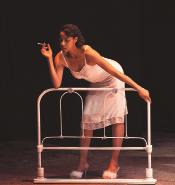
Photo: Julie Schuchard – Word for Word
The acting ostends the character’s development: by using body and voice, actors can “vary the presentation of content according to the degree and kind of attention required” (Elam: 80). Pavis uses the term “energy” to describe this process.
[I]ntonations, gazes, restrained rather than manifest gestures are so many fleeting moments where meaning is suggested, but difficult to read and scarcely externalised. […] [B]y his presence, movement, and phrasing, the actor or dancer releases an energy which directly reaches the spectator. Such a quality makes all the difference and contributes to the whole aesthetic experience as well as the development of meaning. […] Here we must read the body […] as that of a dancer… (Pavis: 19-20)
This energy makes the meaning of the short story more readily apparent and increases the suspense. The lead acts respectfully towards his “mother to beat all mothers” and her friends (J: 104), but shows distaste for females like his sister-in-law Joanne or the twin girls she is expecting. The actor stands at a distance from the solidarity of the older black women, and the loving relationship between the black mothers and daughters-in-law or Mary and Blondelle. Yet as his idea that a woman’s world necessarily revolves around men is challenged, the spectator watches the actor carefully for changes in his attitude. On the day the narrator cannot avoid his old girlfriend Sheila Larkin, he expects that she will unleash her fury at being left, but, walking with her sister, she pays him no notice. The physical and moral impact on Jones’ narrator, who finds himself “stumbling, struggling” (J: 129), is made visible as the actor’s motion and delivery gradually alter; although the actor is defensive before the women’s strength when he says “Forget all of them, I thought, forget Miss Agatha and Sheila and her billions of sisters and forget my mother and Joanne with her belly full of girls. Forget every bitch that ever lived. Forget em!” (J: 129), he makes change manifest when he sends away the male fantasy conductor offering him a drink onstage, and the emphasis with which he takes up the vocabulary of his mother and aunt for whom exile “was nothin but a little bitty old thing” after attempted rape (J: 125, 129), and shows that he is willing to give of himself in solving the crime, proves that he is not about to forget all of the women and leave for Alaska. He again proves that he is a changed man on discovering the murderer; he shows shock but understanding, too, for Alona, Ike’s widow, once “one of the smartest students Dunbar [High School] had ever known” (J: 114), who reacted to “all Ike’s crimes against her” (J: 130)—she is not just a “bitch” as are the women in his rant.
The play makes it clear that women make the narrator change his mind about the difference between blacks and whites as well. He believes he is haunted by “that dead white woman” (J: 105) because “[she] was the first woman I had ever seen die. I never saw one woman die in Korea. Not one” (J: 112). But as the players recreate the scene the day the Miriam Sobel got off the streetcar and collapsed, the young man’s mother’s presence and interruptions while he tries to save the woman suggests that he is haunted, too, by his transgression against his cultural conditioning. The effectiveness of her warning to her sons never to kiss a white woman, which comes back as he is giving Miriam the kiss of life, is shown in the play by his difficulty keeping his hands off the white woman, his look toward his mother and subsequent switch to less controversial compressions.
Man (Kneeling): I tilted her head back and tried to give her breath [Pencil indication: CPR breath] the way the army had taught me [Pencil indication: CPR breath]. [Pencil indication: remove hands] My mother had always told my brother and me that if she ever caught us kissing a white woman she would cut off our lips.
Bertha: “You ever try coolin soup with no lips? Try it and see. It won’t work. That soup will never cool and you’ll starve to death.” [Pencil indication: look at her; then start compressions]
Man: For a long time, I tried to help the woman, but I began to see that only the breath of God could help her. Would that white conductor show up and think that I was trying something untoward? Would he try to kill me for doing the right thing?
Bertha: Try coolin that tomato soup yall love with no lips. Try it and see what it gets you boys.
(J: 117; H: 20-21)
For J. P. Telotte, the flashback in film noir “points to problems of truth and objectivity and of our ability to know and understand reality” (qtd. in Conard 13). Bertha’s physical intervention shows the narrator’s attitudes to be the result of cultural conditioning, a form of xenophobia necessary in the racist society symbolized by the (invisible) white conductor, of whom the young man acts wary. In the play, the black women in the crowd go beyond Jones’ description, kneeling and singing when the white woman dies, implying their solidarity with the white woman and that life and death take precedence over race. The narrator’s distrust of whites surfaces again in the scene where Dvera cries on hearing the young man repeat the dead woman’s words. The actor stands cornered, phrasing the remark “This was all I needed before Alaska: a white woman crying and no witnesses to my innocence” (J: 127). It is the more evident that a gulf has been bridged when Dvera tells the narrator that she is crying because she remembers her father. Without overacting, the actor voices Jones’ lines “Sometimes one moment sweeps aside everything you ever thought about a person” (J: 127), ostending the realization that the other is human too; and the performance exhibits the link between two white women, Dvera and Miriam Sobel, Dvera slipping on her scarf to become Myriam (J: 127, H: 34).
Other bridges are established and made manifest, for example when the narrator says of Dvera’s office, with its samovar and Sabbath calendar, “The doilies on the couch reminded me of my mother’s living room” (J: 132), or when he surmises that the rabbi’s wife is probably the real topic of Sobel’s story (J: 132), showing his new realization of the similarities between whites and blacks, Jews and Christians, and of the strong part that women play in every culture. The actor’s tone on reading Myriam’s admonition, “Listen, children, remember […] what you’re learning here…” (J: 131) turns it into a metadiegetic comment on the significance of the play.
The ghost of Myriam Sobel, a white Jewish woman, accompanies the narrator on his quest for Ike’s killer; but she is not the only ghost. In the detective genre the supernatural, commentators say, ought to be explainable at least as one solution. Perhaps to keep up the noir tone, Stephanie Hunt “didn’t emphasize” Jones’ surrealist or magic realist tendency (“the blood on the fire escape being visible two years later, and earlier the dream visitation of Miriam Sobel and her two children” - Hunt). But film noir characters are typically haunted by the past, and Sarah Trott argues that “War is the subliminal psychological crisis troubling the protagonists of […] film noir” (Trott: xvi). As the veteran, alone in his room, remembers Miriam’s death, it appears as a screen for the deaths he saw in battle: “In Korea I had got used to dead men everywhere…” (J: 112). Another ghostly reminder of war is Miss Minnie’s legless husband, the veteran, “Just a nothing spiriting on down the street” (J: 121): he is not played by an actor but evoked out of thin air. Lisa Kroger and Melanie Anderson mention texts in which ghosts are “most likely brought about by a collective cultural guilt” (Kroger and Anderson: x). World War II is evoked by the legless veteran, the Korean War by the narrator, the Holocaust by Miriam Sobel, and today’s inner city crime and violence by Ike. And the unexplainable supernatural agency that helps the narrator solve Ike’s murder is made explicit in the actors’ mimics and tone—in the narrator’s wonder and his mother’s satisfaction. The narrator is about to pin the crime on Ike’s dealer, Fish Eyes, when he has a last look at the apartment. He realizes that the blood is still under the paint, and that there is a trail of “browned blood” leading up the fire escape to Miss Agatha’s: “[W]hat power was in that blood for it to hang on for nearly two years?” he wonders (J: 130).
Man: … Even after all the snow and sun and rain and time [it was] as if someone with bloody hands, just last night, had held on to [Miss Agatha’s window] to steady himself before entering the apartment.
Bertha: Blood spilled with violence never goes away,
Man: I remembered my mother teaching Freddy and me,
Bertha: and you can see it if you have a mind to. (J: 130; H: 37)
As in the streetcar scene, Bertha speaks the law. Her presence introduces with instancy the question that all the ghosts in the text pose—the question of justice. For Bertha it is triumphant. And suspense is built up through vectorization of meaning; the spectator is told that however much unassignable injustice Ike, like Myriam’s ghost and the legless veteran, may have been the victim of, one person spilled his blood, and is about to be identified.
Edris Cooper-Anifowoshe as Miss Agatha, Kehinde Koyejo as Alona
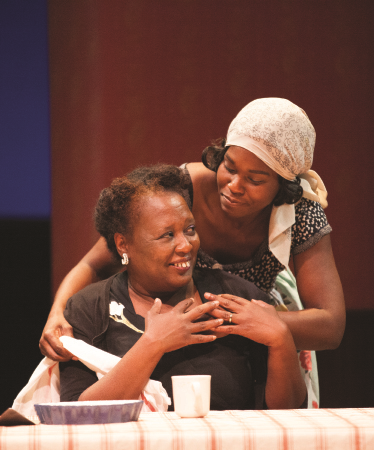
Photo: Julie Schuchard – Word for Word
The play shows the narrator following the clues: Ike’s blood leads the narrator up the fire escape to Ike’s widow, Alona, whom Miss Aggie loves like a daughter. Cohen believes that “the monstrous thing about evil” is that “only the lack of restraint separates the murderer from the nonmurderer,” “for of course many of the nonmurderers had a motive to kill but did not” (Cohen: 108). The energy between Alona and the narrator as he stares at her from the (imaginary) window emphasizes his fear at the possibility that, as a criminal other (Cohen: 108), Alona might kill him by pushing him down the stairs, as well as his relief at her (invisible) obstreperous little girl’s “hi hi”’s as she comes to the window and gives him her hand (J: 130; H: 37). The actor’s note reads: “Alona’s kid […] first a hindrance, then savior” (H: 40 overleaf). The child returns the young man to what Slavoj Zizek calls the necessary benevolent, innocent other without which noir plays on the spectator’s paranoia; he points out that the belief that one can depend on the community is fundamental to one’s feeling of security (Zizek: 5.1).
Sympathy for motives renders the killer less other. “Of all Ike’s crimes against her, what had been the final one?” (J: 130). The narrator is conscious of the evil in Alona’s male antagonist. Yet even Ike cannot be perceived as “the Devil hisself” (J: 115) for the narrator’s mother has already insisted that “he was troubled” and put his addiction on par with the narrator’s “drinkin and foolishness” (J: 124). Finally, the society in which Ike turned to drugs, and the veteran narrator to drink, is “the world the white people ha[ve] made for themselves,” an idea reinforced in the play by the vignette of the surviving white man in Alabama (J: 131). Just as the women’s “crime” in Choctaw was never found out, the narrator does not proclaim the truth and have the criminal locked up as in a whodunit, but, having perceived that the crime was committed by a person with whom he can sympathize, tells only his mother, who suggests that Miss Agatha already knows: “She knows what she knows. Maybe she needed someone like you in the world to know it, too” (J: 131). As in hardboiled fiction, where the putative victims are in on the crime, the investigator does not make public the information he has unearthed: “it needs no universal acceptance as in the classical mystery but only the detective’s own conviction” (Cohen: 33).
In the play, the revelation of the identity of Ike’s killer does not evoke justice triumphant but grievous news shared, suggesting the narrator’s disillusionment. Dashed dreams are a common theme in film noir, and his decision not to go to Alaska could be seen as the bitter knowledge that there is no justice on Earth, if it were not for his amazement at the mysterious strength of the blood which pointed the way for him as an amateur detective, or his return to community with Alona’s child: these do not indicate a “God is dead” philosophy. After conveying some of the alienation of film noir, the murder mystery ends on the positive doubt constituting the narrator’s respect and compassion for the other. The final scene in Dvera’s office, shot through with her laughter, has a sense of closure as the young man can now absorb and reflect the lighter mood. The women players make the ending particularly touching, convincingly becoming a group of schoolgirls going down the street. As the actor speaks his final lines, his quietly appreciative response to the wonder of the one dancing child he is watching shows him to perceive the interconnectedness and uniqueness of things: “Her long plaits swung with her in an almost miraculous way. It was good to watch her, because I had never seen anything like that in Washington in my whole life. I followed her until she disappeared. It would have been good to know what was on her mind” (J: 132). In deciding against going to Alaska, the young man opts for the community of others that he has discovered in Washington D.C., with people who are not what he had thought.
Mystery performed
Linda Hutcheon, author of A Theory of Adaptation, does not consider adaptation as secondary to the adapted text. The process of creation, she says, involves a “(re-)interpretation and then (re-)creation” (Hutcheon: 9). In what Hutcheon calls the “transcoding” from one medium to another, and with the aesthetically satisfying impression that meaning emerges out of a mystery, the performance of All Aunt Hagar’s Children reveals some of the beauty of the written text, and creates beauty, reinforcing a sense of mystery.
This is achieved firstly because the production conveys the density and richness of life that Jones’ analepses suggest. Changing their costumes and deportment, the characters are transformed into others, sometimes on the spot—even into a bird. The live medium is dynamic, with Sam waving from Israel, for example, Sheila popping up, and mature ladies acting as little girls, giggling about “Miz Minnie’s husband” (J: 121-122). Some effects, sets and gestures, and the final dancing, are striking. Moreover, Elam considers ostention in performance not just as “signal information” but as providing aesthetic pleasure, at what can be regarded, for example, as a phonic event (Elam: 83). The actors’ varied diction reflected the full register of the emotions and highlighted the author’s choice of language.
What disambiguation there is does not rule out mystery. Artistic director Harloe came onstage in a question and answer period after the final Saint-Cloud performance to make the clues proving that Ike had brutalized Alona clear to the audience, and perhaps because it was comprised largely of high school students, to make historical time clear as well, so that all might see that the story which had been presented to them in the noir tradition contained various themes. Many are recapitulated in director Stephanie Hunt’s recollection of her approach to the short story:
I did not immediately perceive it as a noir story. I saw the story many ways. At first I saw it as a story about men and women. […] It’s a coming-of-age story and he is looking for his place in the world, his destiny or purpose. For a while I saw it as an essentially American story, since immigrants, and migrations, rural and urban, north and south, even East and West (his dreams of Alaska) figure prominently. […] Then I saw it as a neighborhood story, because it is part of Jones’ entire collection of short stories about the Shaw District in Washington, D.C. […] Eventually with the help of the dramaturg, Nadine Mozon, I saw it as a story about diasporas—the title including Hagar refers to this. The overlapping of the Jewish holocaust (Miriam Sobel’s death on a D.C. street after surviving World War I […]) which Jones has resonate with the slaughter and suffering of African-Americans during slavery and after in the Jim Crow South. So in essence, it is a crime story on a much bigger historical scale, since the story references these historical crimes to whole populations. […] Jones’ use of noir conventions seems to handle these large deep themes in a buoyant way. (Hunt)
That template of wider allusions guides the performance in which the main actor’s place in the world and destiny are connected to the “real world,” i.e., to historical events. The story came across as an integrated whole with universal implications making a case for respect of the other as the basis of justice, yet in its speed and compression, the performance of All Aunt Hagar’s Children highlights the mystery and beauty of the written work’s layers of meaning.
Lastly, the play has an impact that can be described as mysterious. Giving life to Jones’ words with a beauty and energy of its own, the performance opens up an alternative world, eliciting an immediate empathy from the audience for the characters. The narrator’s story becomes the story of each one of us as we open ourselves to the other, sharing his feelings of discovery, growth and integration. Victor Turner has commented that theatre functions as a ritual; in its binding quality, and in the impression that it reveals a truth or mysterium, it recalls the Orphic mysteries. For Turner, theatre, which presents itself as false, gives access to the truth of Identity, necessarily linked to the world (Turner: 114-116). Word for Word’s varied and beautiful recreation of Jones’ work makes apparent both the mystery of the theatre and some of the mystery of existence.
