
On the 3rd of May 2015, Sheku Bayoh, a 31-year-old Black Scottish engineer, died following a confrontation with law enforcement in the town of Kirkcaldy (Fife, East Coast Scotland). In November 2019, as Bayoh’s family launched a campaign seeking justice, the Scottish Government Justice Secretary, Humza Yousaf, requested a public inquiry into the circumstances of Sheku Bayoh’s death. By June 2024, the inquiry was still ongoing1 with repeated mass vigils organised over the last years. Following the death of George Floyd and the surge of the Black Lives Matter movement in 2020, Sheku Bayoh has been called “Scotland’s George Floyd” (Gilmour) and this case epitomises one of the main anti-racist battles Scotland has seen in the last decades.
Hannah Lavery is a playwright, poet, performer, and director. She was appointed poet laureate, or "Makar", of Edinburgh in 2021 and is an associate artist with the National Theatre of Scotland where she creates intermedial works at the crossroads of theatre, spoken word and performance, addressing issues around identity, race, and belonging. Lament for Sheku Bayoh2 (2020) is her artistic response to this event. It was co-produced by the Lyceum Theatre in Edinburgh, the National Theatre of Scotland, and the Edinburgh International festival. The play was first introduced as a work-in-progress at the Lyceum Theatre in 2019 and subsequently recorded as a film during the Covid-19 pandemic in 2020. It resumed live performance for the Edinburgh International Festival in 2021. The performance was led by an all-female cast of three Black performers (Courtney Stoddart, Scottish-Caribbean poet and performer, Scottish actress Saskia Ashdown, and Glaswegian composer, singer, and performer Patricia Panther) and one singer: Beldina Odenyo, Kenyan-born Scottish musician and poet. This “lament” is built in the tradition of “keenings” or “caoineadh”– defined by Angela Bourke as a collective graveside vocal lamentation for the dead typically performed by women in the Celtic Gaelic tradition, and sometimes also including invective (1395-96). As such, it occupies a public space to perform the pain of the bereaved. “Lament” in its verbal form, also means “to complain”, and many complaints are indeed levelled in the play as the use of documentary and verbatim techniques unveil the shortcomings of the approach adopted by the police, the failure to bring criminal charges, the lack of closure in the case, as well as the nation’s inability to have a conversation about racial tensions. The legal complaint merges with the elegiac lament in a play structurally and aesthetically inspired both by verbatim or documentary theatre and by spoken word performance.
In her foreword, Hannah Lavery described the play as a “provocation”: “we’re not the country we promote to others and more importantly to ourselves (…). The provocation within this play is a challenge to that devastating lie we tell ourselves – there’s nae problem here. There is and we all deserve better, Sheku Bayoh deserved better” (6). “There’s nae problem here” echoes the title of Neil Davidson’s recent publication No Problem Here: Understanding Racism in Scotland (2018), which questions the common assumption that Scotland is relatively free of structural and institutional racism and contends that, for decades, the lack of public discussion around the structuring power of racism and the resulting silence have come to “be interpreted as an indication of its absence” and helped “consolidat[e] a now powerful myth that there is no problem here” (10). Hannah Lavery’s play seeks to confront the construction and legacy of this collective Scottish national representation by performatively giving voice and visibility to the Black Scottish experiences.
Characterised by its generic hybridity, Lament is a variation around the mourning of a Scots engineer. In an act of re-iteration, reconstruction, and re-mediation, it occupies an aesthetically and politically confrontational space for a performative recognition of a personal and national injustice. Various structures and movements of repetition are crucial to the performance’s poetical and political claims. Repetition is at the heart of the play through the theme addressed, as it echoes a too-long list of names of people of colour killed during confrontations with the police. The chronic reiteration of these cases over the last decades is often left with no resolution. In the play, the repetition trope is used thematically, poetically, and structurally to both re-humanize the victim and performatively seek a way out of this tragic iterative loop.
When it comes to addressing theatre’s capacity to transform and be transformed, performance and performativity are paradoxically at the crossroads of repetition and difference, of iterability and variation. As Colbert points out, “repetition is axiomatic in performance studies” (2020: 6), and “performance” accounts for the repetition embedded in action and the power such repetition wields” (2022: 22). Indeed, repetition is inscribed in the conception of performance as Schechner defines it: performance is “never for the first time. It means: for the second to the nth time. Performance is ‘twice-behaved behavior’” (29). He calls such a process of re-iteration “restored behavior” (28). Drawing on this definition, Colbert argues that performance can also be informed by another meaning of restore: to make amends for, to repair, to give back. Hence performance can be analysed “not only as restored behavior but also as behaved restoration” (2020: 5). This understanding of behaved restoration shows that beyond the repetition of familiar or dominant narratives and states of being, performance also has the capacity to twist these very discourses through restorations (as mending) of what has been forgotten, misremembered or misrepresented (Colbert 2020: 8). This productive tension between repetition and difference is crucial – both structurally and poetically – in Lament.
Indeed, the play, the curatorial practice of the performance includes verbatim and documentary elements and thus relies on the structural and performative power of repetition as it re-cycles testimonies, newspapers, pictures and judicial reports about the case on stage. One of the functions of the performance is to review the available evidence and bring forward as repetition the elements that seem more relevant to the case. Additional emphasis through repetition of this documentary material is part of the creative method and performative efficiency.
However, rather than adopting a linear structure, or a realistic framework, often present in verbatim and documentary theatre, the performance adopts a more fluid approach in which the re-cycled elements are one dramaturgical element amongst others. In Lament, the testimonies and documents are used rather like an orchestral score. They emerge as one of many other performative elements of the play, combining and dialoguing with the body and voice of the performers on stage as well as literary rewritings, poetic refrains, and musical elements. Through a “behaved restoration”, this oratorio attests to the visceral experience of grief on stage.
Lastly as Lament was turned into an intermedial filmed version the ephemeral and “live” quality of the performance was paradoxically lost in the process: the performance being turned into a reproducible, mediated work. However, the intermedial film questions the ethical and relational quality of the play with a focus on re-mediation, recovery, and reception.
History of Repetitions: Documentary/Verbatim Re-iteration
For the creative process of the play, Hannah Lavery borrows from two dramaturgical aesthetics (verbatim and documentary theatre). To clarify the distinction between documentary and verbatim theatre, Derek Paget points out that in verbatim theatre an interview and more generally, an “aural testimony constitutes the basis for theatrical representation” (234), whereas documentary theatre is more broadly based on archive documents, as it is “created from a specific body of archived material: interviews, documents, hearings, records, video, film, photographs, and the like” (Martin 2015: 17). In both cases, this type of theatre revises and reinvents a specific event as it strategically deploys a degree of facticity, while inventing its own performative narrative, through elaborate structural and aesthetic devices. Such practices fall under the category of a “dramaturgy of the real”, which, according to Carol Martin, questions “the ways in which “the real”, a category that is both asserted and challenged in relation to claims of verisimilitude and truth, is being theatricalized on world stages” (Martin 2015: 1). The performance becomes an additional repetition, narrative, and trace of the original event, since “how events are remembered, written, archived, staged and performed helps determine the history they become” (Martin 2015: 17).
Image from Lament for Sheku Bayoh, A National Theatre of Scotland, Edinburgh International Festival and Royal Lyceum Theatre co-production, 2020. (31:17)
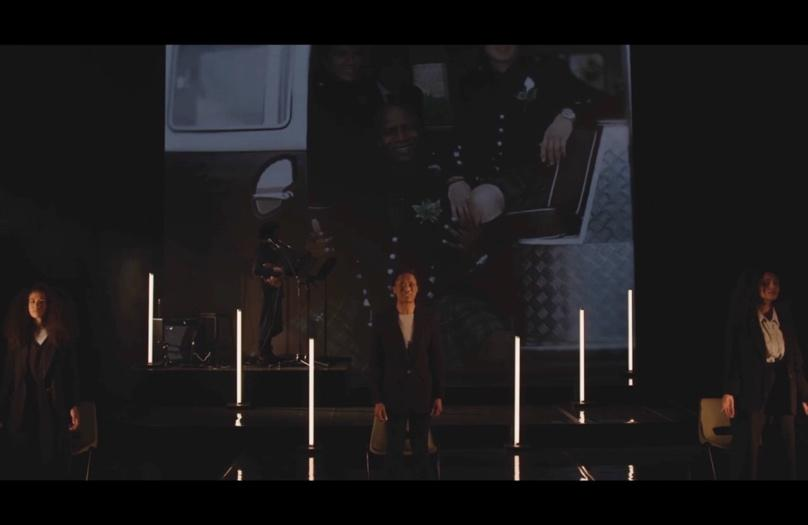
In Lament, pictures of Sheku Bayoh and his family, excerpts from interviews and newspapers, footage from television news programmes that covered the tragedy and the investigation that followed are used as material for the play. At the end of the published script, Hannah Lavery lists the sources she used, ranging from The BBC, The Fife Courier, The Daily Record, The Guardian to excerpts from official documents from hearings at the Scottish Court of Justice. The exact words from various protagonists of the tragedy are thus quoted in the play: we can hear excerpts from the testimonies of Eric Baskind (a leading authority on police restraint and use of force of Liverpool John Moore University), Aamer Anwar (the lawyer of Sheku Bayoh’s family, who is in charge of the investigation), PC Short (Police Constable Nicole Short – who claims Sheku was about to assault her) as well as a witness to the assault. The play thus partly falls under “practices and styles that recycle reality, whether that reality is personal, social, political, or historical” (Martin 2013: 5), in a type of representation which fosters alternative or revised versions of an event for its own record and survival. In Lament, the use of archived documents as dramaturgic material is the result of a process that reveals a desire to expose, repeat and reprocess the available narration and evidence surrounding the tragedy as well as the lack of coherence and justice. Hannah Lavery states in her foreword to the play “The lament comes out of all that research and all those silences too – all that turning away” (6). The re-production of the documents on stage, whether through verbatim re-iteration voiced out by the performers or through the projection onto the screen in the backstage cannot be taken for signals of an unmediated access to truth, however, as Janelle Reinelt argues in her chapter “The promise of the documentary”, they reinforce facticity: “the indexical value of the documents is the corroboration that something happened, that events took place” (10). Participating in the creation of such a factual frame for the narrative, photos from Sheku Bayoh's family archives (also published in the press), as well as videos of the town of Kirkcaldy, of the victim’s funeral and of the demonstrations that followed his death, are projected against the backdrop of the stage. Drawing on Schechner’s definition of performance, such a creative process falls under the category of restoration of behaviour: “documentary theatre takes the archive and turns it into repertory, following a sequence from behavior to archived records of behavior to the restoration of behavior as public performance” (Martin 2015: 17).
In the play, additional emphasis through repetition of this documentary material is part of the creative method and performative efficiency. Indeed, the curatorial process and creative editing of the material are key to the precarious epistemology of the play. Janelle Reinelt contends that “the tension between objective shards or fragments of reality and subjective treatments of it forms a structuring fault-line of all such representations” (8). Hannah Lavery breaks away from a more conventional dramaturgy of realism that characterised the theatre of the real in the late twentieth century (Martin 2015: 1) as she adopts a cyclical rather than linear narrative structure and re-iterates the fragments of documentary material in loops. The scenes are entitled either “Lament” (One to Nine), “The Photograph” (One to Three) or “Thirty Seconds” (One and Two). The short fragments alternate and resurface in the general structure of the play. Most of the “laments” contain verbatim excerpts from newspapers and testimonies, fragments of which are redistributed between the three performers (referred to as FIRST, SECOND, THIRD in the script), who share the "official" words like a musical score, gradually deconstructing it through repetition and re-arrangement:
The Three are playing the BBC unless otherwise indicated.
(…)
SECOND. A leading authority on police restraint and use of force, Eric Baskind, of Liverpool John Moore University says –
FIRST. (playing Eric Baskind) What strikes me from the evidence of the officers is that they approach the scene with the intention of using force. He’s not running away, he’s not, at that moment in time, creating a danger to anyone. They get there, they screech to a halt, they get out of the cars with irritant sprays and batons. That to me doesn’t seem measured. That is not best practice. And all of those actions were very escalatory.
SECOND. The BBC understands at least four and up to six officers were immediately involved in the encounter. That CS spray and police batons were used and within about thirty seconds Mr Bayoh was brought to the ground, face down. Handcuffs and leg restraints were applied.
THIRD. The BBC understands PC Paton and a colleague known as officer B – who were two of the first on the scene – had a combined weight of about 43 stones.
FIRST. Eyewitnesses understand that the officers were kneeling and lying on Mr Bayoh in order to restrain him.
SECOND. A civilian witness told investigators, officers were lying across Mr Bayoh for several minutes.
FIRST. (playing civilian witness) I heard him screaming. It sent chills through me. I heard the man shout to get the police off him. They never moved. (14-15)
This example, taken from “Lament, Part Two”, is then reproduced and scattered again throughout other scenes of “Laments”. The words of the civilian witness, for example, are repeated identically on pages 15, 16, 51 and then atomised in various fragments throughout in the “Thirty Second, Part One”. These loops of repetition and echoes in the discourse, and more generally in the structure of the play, mimic the flow of 24-hour news that tirelessly repeats the accounts of the same facts, but they also create a form of ostinato, a specific pace, rhythm and repetition which generates a distance from the initial reference. For instance, the connotative words and phrases used by PC Short are repeated several times in the first sections of the play to account for the police’s intervention: “Mr Bayoh’s muscles were bulging and he looked aggressive” is repeated on pages 18, 21, 22 and 54; “he looked very intimidating” (18, 21, 22); “he was like a zombie” (19, 21); “he appeared out of control and dangerous” (19, 21), “given the reports of him chasing people with a knife” (20). These opening statements are then meticulously debunked through the repetition of an alternative narrative of the event portraying a different man. Aamer Anwar’s and the BBC’s iterative accounts spread like a refrain throughout the rest of the play: “It is said that no knife was found in his possession (13), “The BBC understands the pictures show he did not have a knife” (15, 18); “He wasn’t brandishing a knife at a police officer. (…) In fact, he wasn’t carrying a knife when the police officers attended”. (18, 19, 47). These repetitions of the elements that seem more relevant to the case also underline the way a certain version of the truth can artificially be built through aesthetic choices and iterative narration.
Orchestrated like a dissonant polyphonic funeral, with fragmented, non-linear scenes, the process of repetition and reorganisation of the verbatim/documentary material thus productively combines verbatim aesthetic with the structure of a musical score. Cyrielle Garson argues that in such hybrid creations of verbatim theatre, “the documentary component tends to be disavowed and evaporates into a complex and constant dispossessing aesthetic reformulation, as if driven by an unabating and roaring compulsion to exceed verbatim reality, to deconstruct once and for all the very last emanations of the referent” (420). The referent is indeed gradually estranged in a dramatic play text interspersed with poetic fragments, fictional scenes, and music. However, this practice of fragmenting, atomizing and repeating the verbatim or documentary testimony does not diminish its place or scope, but rather invites the audience to engage in a more active reception. Spectators listen more attentively to find meaning in this repetitive loop of similar-sounding statements, where fragments overlap, are superimposed, and are shared by the three performers. This gives the audience the impetus to want to make sense of the dissonances, and somehow, find closure. Their experience as spectators echoes the family’s struggle during the investigation and prosecution process as they are left without closure. Indeed, Hannah Lavery wrote the play as the trial was still ongoing, and it is mentioned in those terms at the end of the play:
VOICE OVER. In November 2019, The Scottish Government confirmed a public enquiry will be held into the death of Sheku Bayoh after the Lord Advocate’s announcement in 2018 that none of the police officers involved in Sheku’s death will be prosecuted. (…)
SECOND. In 2020, a Scottish Government advert for a media manager to handle the hearing’s press inquiries, says the inquiry “will be based in central Edinburgh and is expected to last around three to four years”.
THIRD. Sheku’s sister Kadi, forty-two, a nurse, in Edinburgh, said the predicted length of the inquiry had dismayed his family. (64)
In the case of Lament, arguably, choosing verbatim and documentary aesthetics as one of the formal frameworks for the representation of police violence against Black citizens becomes an act in which structural recycling emphasises thematic repetition: the performance, repeating repetition, amplifies its historical resonance in the echo chamber of the auditorium. The performance however adopts a fluid approach of a “dramaturgy of the real”. In Lament, the testimonies and documents are used rather like an orchestral score that emerge as one of many other performative elements of the play, combining and dialoguing with the bodily presence of the performers, other literary rewritings and palimpsestic echoes to the Scottish canon, poetic refrains, and live music on stage. The resulting hybrid aesthetic confers its performative efficiency to the play as a “Lament”, “a behaved restoration” (Colbert 2020, 5): a voice that simultaneously sings the trauma of loss and attests to a visceral grief and anger on the stage of the National Theatre of Scotland.
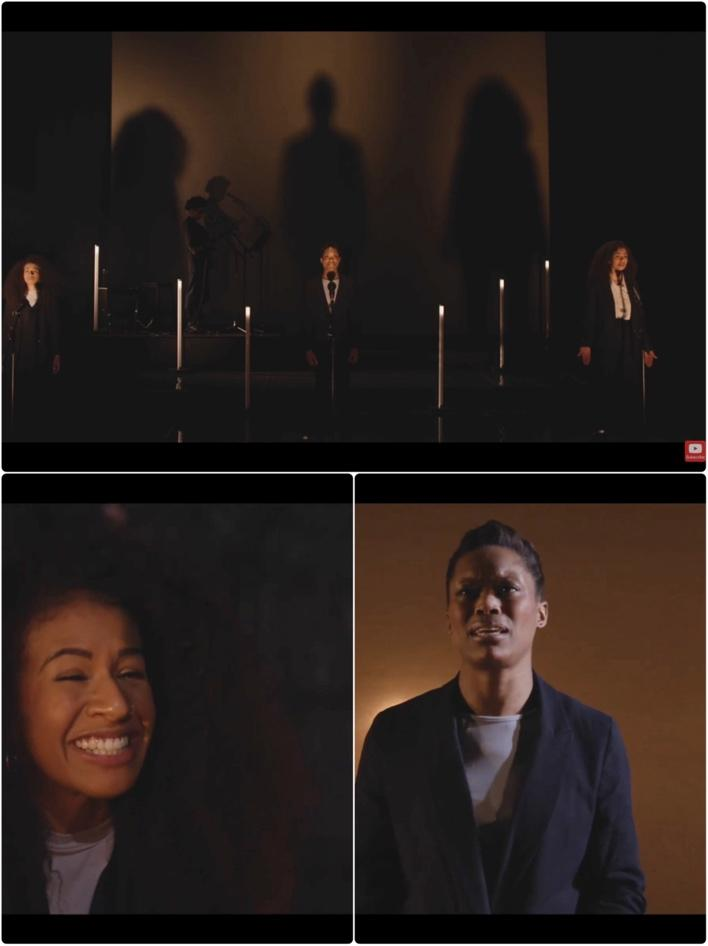
Figure SEQ Figure \* ARABIC 3 Dir by Hannah Lavery, still images from Lament for Sheku Bayoh, a National Theatre of Scotland, Edinburgh International Festival, and Royal Lyceum Theatre co-production, 2020. (26:18/36:10/46:50)
Visceral Experience of Loss: Rewritings, Repetitions and Musicality
The play is not a mere retrieval of a past event through a renewed dramatic form, instead, the documentary quality is interwoven with fictional scenes and more importantly with the presence of the performer’s body: all elements dialogically work together to explore the issue of the experience of racism for Black Scots. In her recent book Performing the Testimonial, Rethink Verbatim Dramaturgies, Amanda Stuart Fisher analyses new forms of testimonial theatre foregrounding identity politics in which, according to her, the incorporation of music and song generates a new “corporeal witnessing” where the presence of actors’ bodies combines with the story being told to performatively account for the experience of the subject on stage (180). Indeed, in the play the verbatim accounts and the technology of backstage projections operate with the performers’ bodily and vocal presence on stage. Besides, the cast and the approach to embodiment in Lament play a key role in the performative power. The dismantling of the linear narration of the verbatim account is further amplified by the fact that their re-iteration is not allocated to one actress embodying a specific character, but rather they circulate through the three Black performers whose voices and presence in space are in focus rather than their personification of a single character. The three women, plunged in semi-darkness, dressed in black, stand or sit statically as they recite the verbatim testimonies. The accounts of the facts and the different family members’ grief are shared, swapped and repeated by the performers, therefore, for the audience there is no possible empathic identification. This could be read as a focus on the perceived interchangeability of Black bodies within a history of miscarriage of justice. In other sections of the play, the words of the performers are made up of fictional scenes in which they embody different fictional characters. Throughout the play, their presence is characterised by their emotionally resonant vocal performance, reminiscent of a Greek chorus when their statements are spoken simultaneously.
In her book Performing Remains: Art and War in Times of Theatrical Reenactment, Rebecca Schneider questions the dialectical opposition between the performance (usually perceived as that which disappears in its ephemeral quality) and the “remains” (usually conceived as the document or the object). She considers instead that performance is “the act of remaining and a means of re-appearance and ‘reparticipation’” (102). She argues that the body given to performance is thus engaged “chiasmically – not only disappearing but resiliently eruptive, remaining through performance” (102). As such she concludes that “approached in this way, performance challenges loss” (102). The ephemeral embodied performance of the three actresses and one singer is superimposed on the material and ghostly presence (through photography) of Sheku Bayoh. To quote from Schneider, “the performance plays ‘the sedimented acts’ and spectral meanings that haunt material” and the remains of such performance are the “immaterial of live embodied acts” (102). Key to the performative power of the lament is this dialectical interaction between facts, document, archive with fiction, poetry, presence and voice; all aspects constitute the new testimony, the multilayered account of racial injustice.
In whole sections of the play, the verbatim re-iteration of facts is immediately followed by an alternative re-writing of the statement characterised by its highly poetic quality. Hannah Lavery claims a renewed authority over the narrative of the events, as her own poetic voice enters into dialogue with the archived documents. For instance, in this evocative excerpt where the imagery is built around the metaphor of poison, the author reflects on the time that was allocated to the police involved in the incident before they had to share a statement:
FIRST. (Playing Fife Courier with notebook) The police involved were left alone, immediately after the incident, for eight hours together in the police canteen. They were given thirty-two days to make any formal statements. They had one lawyer representing them.
SECOND. Was it? Was it like this?
THIRD. Poison sipped in the police canteen – for eight hours – the nine drank from the same urn. Truth brewing to dust in their mouths. A dog whistle blown to bring the paddy vans to circle. Poison seeping out – sliding past the brass – button holing – shaping the story for thirty-two days. Lies leaking out and staining the front pages. Knocking insistent – hack – ratta tat – on the closed front door – knocking at the window wi its blinds pulled down in mourning. Pulling at the pain to shed more blood to be washed from their front step. Och what do I know? What do I know? (Pause.) And this not a new story – it’s an old one. We would do well to hear it this time. No? Is it no time after all? (28)
The initial verbatim account of the Fife Courier is doubled or echoed with a poetic and political account of the consequences of such a procedure on the emergence of the truth. The language and words exchanged in the span of a few hours during this reunion held in-camera become a shared liquid poison in the rewriting process, seeping into and contaminating the narrative until they drown out the truth, which has now turned to dust. The political image of the dog whistle (understood as a coded or suggestive image used to garner support without opposition) stresses the extent to which a given narrative is framed to be heard a certain way by certain people: the liquid poison is also the “dog whistle” catered to racist ears. The ongoing, irreparable character of this machine is represented by the succession of verbs in their present continuous form as well as the prepositions “in”, “from”, “out”, “past” mimicking the active contamination of “the front pages”. The tragic iterative quality of history is also rendered by the repetition of the question “Och what do I know?” translating the feeling of powerlessness in the face of a story that’s “an old one”.
This palimpsest-like layering of meaning through strong images and sounds is also found in several other poetic scenes which borrow their aural and rhythmic quality from the tradition of spoken word poetry or performance. Indeed, beyond the plain, almost automated iteration of media language, the display of a poetic language stands in contrast, perhaps even in rivalry, providing an alternative and more imaginative style and scope to the narration of the event. In this example taken from “Lament, Part Three”, language is punctuated by repetitions, interruptions and assonances that make it explosive in rhythm and delivery on stage. The harrowing metaphors conjure up the imagery of slavery and its violence:
THIRD. Broken bones – in broken system –
FIRST. – make safe space –
SECOND. – make that ol cage – made of rope.
THIRD. Rope of twisted threads-twisted.
FIRST. Twisting thread. Twisting of truth bound wi – we work to make rope.
SECOND. Hold the line for the good drying day.
THIRD. Hanging out to dry. Turning. Blowing in.
FIRST. Blow in.
SECOND. Blow in. Wind ye neck in pal.
FIRST. It’s a good drying day. Get the rope out.
SECOND. Hang it all out to dry. The white wash – on twisting truth. Twisted fibres make rope –
THIRD. noose – (Pause – Break.)
FIRST. – to hang.
SECOND. Let’s just hang here. (Pause.) Till they’re dried out. Till they’re tired out.
THIRD. Tired. Dried out – twisting.
FIRST. Twisted. Making space. Made out of broken bone. Dark memory heart. Beating that old drum to bring them out wi white wash. Hang it out – it’s a good day for drying. But the sun is too bright. It shows the marks. Burns through the magnifying glass – that wi have to look out for what is crawling beneath – the rocks we’re gathering for him. Gathered by those that marched for him. Stood for two minutes in silence for him. The light through magnification creates a fire to burn – to set a light and we cannae bring in the wash now. It’s full of smoke. The neighbours have been burning and we’re all choking. Blind to it. Until you’re not.
THIRD. Aye. (Pause – Break.)
ALL. Until we’re not. (23, 24)
The violence of slavery, lynching, and the invisibility of the Black experience in a White-dominated society are obvious in this excerpt, and they reach far beyond the reference to a specifically Scottish experience, towards a shared global history of racism. The central metaphor is built around the image of a rope – the thread of a truth woven and twisted from lies – a truth whose neck is wrung by this very rope. The words – like the rope – are arranged with a series of repetitions and polyptotons which mimic the web of lies being woven “twisted threads-twisted. Twisting thread”. Echoing history repeating itself and stumbling, the excerpt reads like a sad refrain of a tragic song, like the beat of a “dark memory heart [...] Beating that old drum” with the proliferation of dashes marking both the rhythm and the incapacity to articulate language in the face of injustice. The image of blindness is also central to these lines. “The sun is too bright”, “the light through magnification creates a fire to burn”, “blind to it”: these quotes evoke the shared global Black experience of the failure of a fair system, even in the Scottish nation that sees itself as tolerant. Light is conceived as an oxymoron: it makes things visible, reveals scandal and ignites debate, or it blinds. Hence, this extended metaphor may also refer to the representation of the news story on stage, making it visible and audible, and in a way igniting the powder keg of social anger. The image of the “magnifying glass” becomes a metaphor for the theatrical stage which dissects an individual story to show its universal resonance, thus revealing the flaws in the narrative of national history. This stage poem is delivered collectively by the performers to the sound of live singing of Beldina Odenyo - turning the performance into a form of oratorio.
With its series of repetitive echoes and overlapping statements like a canon, an inner rhythm or beat is created by the poetic excerpts and their spoken word-like orality. The contrapuntal logic of the musical canon therefore allows the introduction of new alternative voices to the allegedly univocal literary canon. As live singing is part of the performance, in the tradition of keeners, it participates in the expression of pain as well as the affirmation of a political power of creation and possible remediation. Providing a palimpsestic layer of intertextuality, the play convokes a national poetic heritage and canon on stage, with a selection of Robert Burns' poems that are revisited by composer and musician Beldina Odenyo and turned into live songs with gospel overtones. The play opens with a sung version of Robert Burns' poem “A Man's A Man For A’ That” (also known as “Is There for Honest Poverty”) written in 1795. This poem was instrumental in shaping a national literary canon on the political stage as it was sung by Sheena Wellington on July the 1st 1999 at the opening ceremony of the Scottish parliament. Although Nigel Leaks points to some possible ambivalent interpretations of the poem in his chapter “Burns and the Poetics of Abolition” (47-60) it is seen as a celebration of the universal values of equality and fraternity, in which the final stanza appeals to the audience in a prayer that all men “shall brothers be for a' that.” On stage, as the opening note of Lament, the poem in its sung version sounds like the death knell of a Scottish national ideal of tolerance and inclusiveness. The rewriting with a gospel-tinged vocal score also brings a whole new layer of meaning to the poem, as it resonates with a revised musical influence, and a supranational melody of the Black experience of suffering. Two other poems by Robert Burns inspire the musical score of the play (“Ae fond kiss” and “Auld Lang Syne”): the process of rewriting and re-adaptation inscribes the play in the Scottish national myth to better deconstruct it. In their sung versions, the poems add a semantic layer to the narrative: the hybrid voice brings back ghosts of the past to mourn the present tragedy. Through the intricate game of echoes, repetitions and variations, Lament shines a spotlight on the blank spaces, dark areas and silences that are often overlooked in a patriotic narrative of national tolerance.
To move from mimesis to historical recovery all aspects of the performance are shaped by necessary layers of repetition and exhumed past. The superimposition of personal and political narrative scales, as well as the use of various modes of expression and representation, allow the inherited national vision to be performatively updated and re-imagined.
Forms of Re-mediation: Intermediality and Reception
Do we have to be on the right side
of every story we tell of ourselves
– is that belonging?
What would it cost us
to lift him broken from a Kirkcaldy street
to cradle him as our own? (Lavery 2020: 9)
This quote epitomises the desire for re-mediation and recovery that lies at the heart of the performance. In various addresses to the audience, the play takes the spectators to task and raises the question of collective responsibility and spectatorial ethics. This ambition is part of a wider movement in the humanities and social sciences, the ethical or relational turn, characterised by an increasing focus on relationality: the notion that as relational beings we are part of a larger community in which we are involved and share a responsibility towards the others. To define the relational quality of art Nicolas Bourriaud considers the artwork as “social interstice” (14), in which the work is “taking as its theoretical horizon the realm of social interactions and its social context, rather than the assertion of an independent and private symbolic space” (14).
In an act of strong indictment, “Lament, Part Five” (40) lists all the members of a community who say racist things and the exact same list is reproduced in “Lament, Part Eight” (56) with a slight modification: the verb is no longer to say, but to do.
THIRD. The black cab driver says racist things.
The kids on the street are saying racist things.
The men on the train say racist things.(…)
My prime minister is saying racist things.
My police are saying racist things.
My friends are saying racist things.
My family are saying racist things.
My lover is saying racist things.
FIRST. (…) The fog so thick –
it slips under the mat – under my door – into my home.
Comes to me at the bathroom mirror – where I stand looking for myself
and seeing nothing of myself there. I walk out of my home,
increasingly at odds with myself here. (40)
The rhythm of the epiphora together with the movement from distance to proximity from “the black cab driver” to “my lover” mimic the all-encompassing and pervading scope of racist comments issued by everyone. This bleak depiction of a society fractured by racist statements and actions results in the blurring of one’s sense of belonging and identity (“seeing nothing of myself there”, “at odds with myself here”.) Through the repetition of this assessment, the play thus urges the audience to hear and see this reality and to become first witnesses and then actors for social and political change.
Beyond the thematic confrontation with collective and common responsibility, the intermedial quality of the play accentuates its relational ambition, specifically regarding reception. The shift in medium – illustrating the re-iterability of theatre turned into a film – raises questions of accessibility, distribution, and reception. The play, originally intended to be performed live before an audience was turned into an online video because of the Covid 19 pandemic. Therefore, the reception of the resulting digital object is no longer akin to that of a theatre audience. It changes the way we look at the initial theatrical object, as our gaze as spectator is mediated through the camera’s action and editing choices. For instance, there are framing effects that direct the viewer’s gaze, altering the vision of the chorus formed by the actresses and the singer as an “ensemble”. By framing on the face or focusing on certain actresses, the video assigns speech to “a subject”, whereas the original script and staging made speech almost anonymous, like a material that is attributed to no one in particular, that emanates from no specific source but floods and invades the stage. The camera work modifies this aspect by visually identifying the speaker, and thus giving a new embodied “authority” to the discourse, as if the enunciator was responsible for their part of the speech, while the staging seemed to favour a collective, shared lament. However, those close-ups, through an increased sense of proximity, possibly amplify the identification and empathy of the viewer, who is put face to face with the performer’s emotional delivery, gazing into their gaze in a way the theatre stage cannot reproduce.
Figure SEQ Figure \* ARABIC 3 Dir by Hannah Lavery, still images from Lament for Sheku Bayoh, a National Theatre of Scotland, Edinburgh International Festival and Royal Lyceum Theatre co-production, 2020. (57:50)
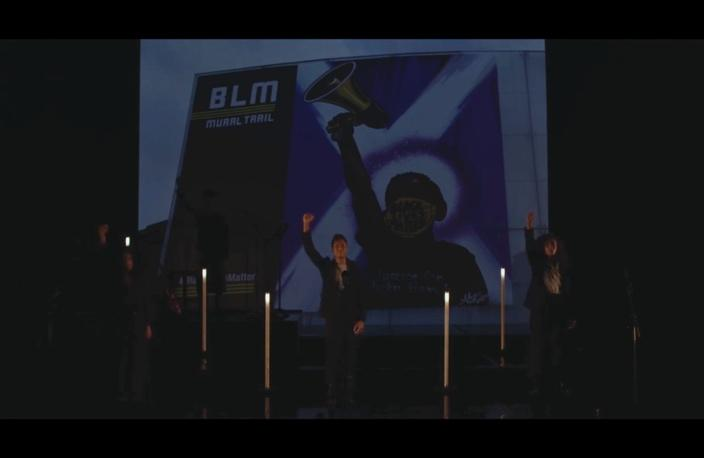
The final scene was originally played against a backdrop of archive photos and video extracts (from Sheku Bayoh, and from the protests after his death) scrolling across the background behind the three actresses and the singer in the foreground. In the film version, however, after a few seconds, the camera zooms in and fades out, so that the actresses are no longer visible, and the screen is gradually invaded by photos and videos of the actual events. It is as if the theatre were being contaminated, absorbed, or dissolved by the video medium on the one hand, and by the real events on the other. These two minutes of the film towards the end, if viewed on their own, are no longer identifiable as theatre and resemble news footage or a documentary homage. The performers are back in the frame only for the last image where they raise their fists in salute in front of a backstage image of a BLM banner on Usher Hall Edinburgh. These slight modifications do not alter radically the object, yet they question the “live” essence of the theatrical object when subjected to a form of mediation. The recording of the play indeed implies a radical change in the paradigms of presence, in the 'live' aspect of the (theatrical) performance, and in the relationship between immediacy and mediation3 on stage – a series of formal mutations that Cormac Power sums up as follows:
To suggest that theatre is “live” and distinct from performances mediated by technology is to ignore the fact that much theatre explores today’s technological landscape, both in form and content. (…) The question here however, is whether notions of making-present, having-present, and being-present (or a play between all three), are in a way bypassed by the technologies of reproduction and more generally the way in which these technologies mediate and colour all our experiences and interactions within a “mediatized” frame. (159)
Lament for Sheku Bayoh bears witness to the way Scottish theatre is seizing on the relationship between theatre and digital culture to deploy new possibilities for increased participation and reception, in a transformation of theatricality which dissociates un-mediated ephemeral presence and representation. Therefore, it seems possible to no longer think of theatricality as the physical and ephemeral presence of actors and spectators in the same place. What makes for theatre could possibly lie in the “construction of objects of attention”, and in the devices for “presenting” these objects. This is what Cormac Power defends:
a discussion on presence in the theatre should focus on the particular ways in which the theatrical medium constructs objects of attention, and how these objects of attention are presented to an audience. In other words, presence may best be seen as a function of theatre—theatre is a place where different levels of presence are manipulated and played with—rather than an (essential) attribute. (175)
The interplay of different layers of presence/absence of body and voice in the play create an “object of attention” whose political resonance and impact is multiplied.
In his review of the show, entitled “A stark critique of Scotland's self-image”, Mark Fisher writes that “as a production, it is too static, caught uncertainly between theatre and film, but as a voice in the dark it is impassioned, poetic and alive with political import.” Indeed, the filmed version of the play serves its relational and political ambition of remediation and recovery as it radically alters the conditions of its distribution and reception. Instead of being limited to a specific space/time of representation in a theatre – thereby limiting access to a restricted audience – the digital object has been distributed much more widely. For example, it has been shown in cinemas in Edinburgh and Leven, reaching an audience that is sociologically different from theatregoers. The filmed version is also available online on the NTS website, in the “educational portal”, for free access in schools, along with a “Teacher’s resource” dossier analysing the issues raised by the play and suggesting activities around key facts and figures of the History of Black Scots. The description reads: “Discussions of racism and racial violence when handled sensitively can lead to shifts in understanding. The material in this resource aims to support educators to “more safely explore in mixed racial groups the wider social, historical and political aspects of Scottish identity” (NTS website). While the play might not initially have reached such a wide audience, through its reiterative quality, the filmed version goes one step further in addressing the social problem it seeks to denounce. The multi-media version of Lament for Sheku Bayoh embraces the notion of cultural connectivity, echoing the ways digital technologies open up pathways and reach out to a generation who belong to a primarily visual age.
Conclusion
In their “Editorial: On Repetition”, Schmidt and Kartsaki state that:
We might think of performance as the art of the ‘re’: from the labour of rehearsal and systems for remembering to the broad spectrum of restored behaviours that are ‘not for the first time’; from tragic scenes of recognition and reversal to conventions of citation and recitation; from the dream of representation without reproduction to the ethics of reenactment and the care for what remains. (1)
In the play, repetition indeed plays a vital role in staging the tragic event and its resonance with racial injustice in Scotland. The thematic and structural explorations around the repetitive words, images, or sounds and the return to and rewriting of past references revived on stage serve a purpose of recovery, reparation, and remediation. Through its intermedial quality and hybridity, the play “remains” as a new archived version of the story and addresses the transformative power of this work. Re-shaping preconceived or essentialist conceptions of the theatrical genre, it exemplifies the mutation of a dramaturgy in which the re-iterability seeks to actively produce social and political change. In her review of the streamed performance for The Scotsman, Joyce MacMillan states that “Lavery’s production, (…) is both painfully familiar, and new in its insistence that here too, in bonnie Scotland, Black people sometimes cannot breathe, purely because of the colour of their skin.” The play is also part of a wider racial awakening in Scotland in which other cultural productions participate in changing conceptions of the Scottish canon and addressing key questions around the representation of race throughout Scottish history. Plays like Jackie Kay’s The Lamplighter (initially a radio play for BBC Radio in 2007, published in 2020), or May Sumbwanyambe’s Enough of Him (2022), or Rona Munro’s James IV: Queen of the Fight (2022) have similar encoded messages as they address the history of slave trade or systemic racism no longer as “Black history” but as history of Scotland, and even a post-national history of the western world – calling for a reconsideration of how questions of identity, race and belonging should be recognized, represented, restored or remembered to avert tragic repetitions.
