
Founded in 2000, Punchdrunk is considered to be among the pioneers of first wave 21st Century immersive theatre in Britain. Once a nomadic collective, Punchdrunk has evolved to become a highly regarded, nationally funded organisation. Punchdrunk Enrichment, its outreach arm, is a leading force for community-centred, educational work, while Punchdrunk International names its commercially financed global operation. From 2000-2015, Punchdrunk became renowned for large-scale interdisciplinary events that merged installation, performance, film, live music and club-nights in vast disused sites. Audiences were masked and roamed the building, encountering uncanny worlds that played out as they discovered the stories it had to tell.
In charting the mainstream rise of the company since 2003, much scholarly analysis has both celebrated and problematised Punchdrunk’s practice. My discussion here attends solely to the aesthetics of Punchdrunk’s masked events and its broad philosophy of practice to show how, following the “scale of immersivity” proposed in Immersive Theatres, these productions are quintessentially immersive in form (Machon 2013: 70-102). Focusing on Punchdrunk’s The Drowned Man: A Hollywood Fable (2013-14),1 devised with the ensemble and co-directed by Felix Barrett and Maxine Doyle, I foreground some key forms and techniques that have come to define Punchdrunk’s practice. I consider the significance of literary texts within Punchdrunk’s intertextualised dramaturgy and the creative agency in interpretation this offers to audiences. Across the interactive journeys they forge, Punchdrunk audiences are encouraged to make sense/sense through a fusion of immediate corporeal perception and consequent critical reflection. In this regard, I do not propose a definitive or homogenous interpretation of how TDM was or should be interpreted; indeed, Punchdrunk productions in form and intention frustrate the option of doing so as no two audience members’ experiences can ever be wholly alike (as is the case with any encounters with interdisciplinary and abstracted art). My analysis of form as theme presented below draws on my own embodied recollections that have been filtered through time and social agenda in this reading of the work.
Punchdrunk’s Masked Events
“The Mask.”
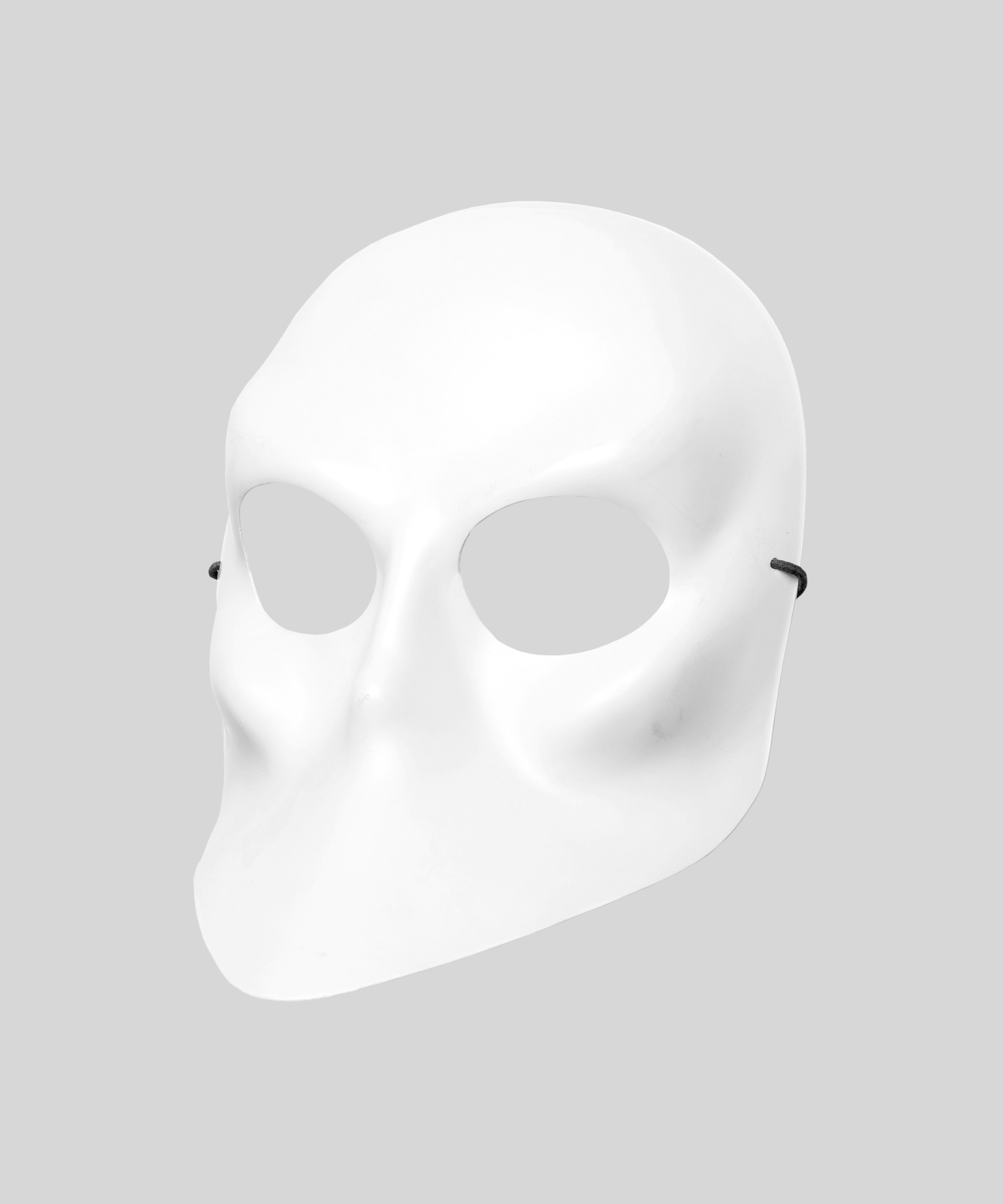
Photo credit: Stephen Dobbie. Image courtesy of Punchdrunk.
In Punchdrunk’s large-scale shows it is the audience that is required to wear masks, rather than performers. For Barrett, the mask is a critical device that, for some, instils “a sense of character,” serving as the mechanism that adapts behaviour to the aesthetic and logic of the masked world, while for others it engenders ghostlike anonymity, preventing communication and sculpting audience into “scenography…walls to frame the action” (Machon 2013: 160-1). The masks and the spectre-torial bodies to which they are attached thus take on architectural qualities within the space. Correlatedly, although audience experience is at the heart of the concept for any masked show, it is the found building which defines what that show will be. For TDM, this was a vast decommissioned postal sorting office, abandoned and adjacent to London’s bustling Paddington Train Station. An impressive overhaul saw the internal structure of this building reinvented as “Temple Studios,” the 1962 outpost for the fabled Republic Pictures.
Across the years Punchdrunk has employed site-sympathetic to label its work, defining the activity of responding to the feeling as much as the aesthetic of an uninhabited space. Rather than a site-specific literal retelling of a building’s history, site-sympathetic offers an “impressionistic response” establishing dream world experiences within the space; an impulse that gives as much weight to the temperature of a room and the cracks in its wall, as to the walls themselves, “building a story around a broken pane of glass” (Barrett in Machon with Punchdrunk 251). The building and consequent journey through it defines where, what Punchdrunk refer to as, “the crescendo,” the event’s emotional peak, will occur. Crescendos as formal finales evolved from Punchdrunk’s 2007-8 production, The Masque of the Red Death; created to ensure the hundreds of individuals who had been roaming the building as they chose, were brought together to experience as a collective the final ensemble set piece. Prior to 2007, the buildings that housed masked shows were gradually closed, room by room, the bar being the last to shut and audience ushered out. The implication for audience members being that the world left behind continued without them.
The initial response to the architectural footprint of the building, which takes in both the shape and flow of existing walls, stairs, levels and features alongside their corresponding emotional tones and textures, influences the way Punchdrunk’s design team will interpret the source text through a combination of touch-real representational settings and more abstract installation. Only once this scenographic response has taken form is it then fully populated by performers. A rules-set among the core production team, led by Barrett along with Creative Producer, Colin Nightingale and Design Director, Livi Vaughan, is that no one area of production is considered to be more important in finding a form for the ideas within a masked show. This rules-set is understood and choreographically translated by Doyle with the ensemble, dancers who are expert at duetting with space, light and fixtures as much as each other, and can improvise effortlessly around the audience. It is also carried through the sound-design of Stephen Dobbie, resulting in precisely set, sonic collages that blur and blend across each space to add texture to installations and support or direct performers and audience alike. Audience members may choose to create a hierarchy by prioritising the narratives the dancers communicate over and above the stories revealed by the rooms, objects, and sound with which all the performers are in league. Equally instinct and curiosity may be driven by installation, piecing narrative together solely from one room to the next.
Punchdrunk’s approach here relates to my general definition of the anti-hierarchical “in-its-own-world-ness” of immersive practice (Machon 2013: 93), where space, scenography and duration are equally palpable forces that comprise the world, within which performers and audience interact. The sound-design of TDM illustrates how audience experience and interpretation might be led by Punchdrunk’s sonic-scenography. Omnipresent abstracted soundscapes manifested an expressionist audio-plane, eliciting an imagining beyond, a sensation of location and situation. Conjuring the edges of the world, beyond the touchable surfaces and inhabitable spaces, it evoked the hazy rhythmic toil of oil derricks pumping. The whole-body perception of organic sounds (such as the crunch of the wood underfoot in the forest) added to the sensual grounding of the audience. Movie soundtrack samples in the mix ensured a noir-esque sensibility hung in the air. In certain spaces, popular songs or live-performed music indicated historical period and geographical setting. As with film soundtracks, these played out through set sequences, providing tempo and emotional resonance for choreography while tapping into a darkly saccharine nostalgia for the illusion of a time past. Where localised through a transistor in a bedroom, at set points the music would expand, bleed into the wider soundscore, reverberate against the walls as much as through the body, enveloping an individual, swelling out of the room and drawing audiences to locations and experiences elsewhere. As with filmscores, sound in TDM heavily influenced emotional response, a constant ominous indicator that something wicked this way comes, unequivocally defining setting, character and events encountered within the world.
Punchdrunk’s Cinematic Aesthetic
This focus on the cinematic in relation to sound-design signals the broader significance of this in Punchdrunk’s process. “Cinematic” is a threefold description, encompassing, aesthetic influences, practice-led terminology and the quality of experience to be had in audience appreciation. Punchdrunk’s aesthetic response to any source material when creating public works, “is always of a film persuasion” (Barrett in Barrett and Machon 2007). Punchdrunk’s dramaturgical approach adopts and adapts cinematic techniques, indicated primarily through use of terms, such as “cross-fade,” “lens,” “close-up” and “long shot,” in defining process.
“Long-shot,” for Punchdrunk, names the approach to responding to larger spaces within a building. Equally, it pertains to the first view the audience will have of the world:
The process is much like zooming in on the detail, a letter on a table, first established from a tracking shot of the full expanse from above. […] [T]he opening shot, the world that you’d see from above, then the specific town, where you zoom in and see its structures, then you end up going inside the hotel, inside [a] bedroom, into the bathroom, zoom into the bath, to see a letter floating. […] The detail is there but initially it’s a bird’s-eye-view that then becomes micro (Barrett in Machon with Punchdrunk 83).
Vaughan emphasises that, with this macro to micro approach in mind, she and Design Associate, Beatrice Minns, “filter the focus” within each room: “We always know that we’re working with a 360-design but we prioritise a certain shot, focus an impact within the space” (Vaughan in Machon with Punchdrunk 83). As this suggests, “close-up” describes the close-range intimate detail installed in each space, encouraging the audience to become the camera, to zoom-in on the narrative clues and nuanced themes that exist therein. In TDM, this forensic attention to design ensured the long-shot of any space enabled an immediate visual scene setting, while the close-up texture and solidity of objects in space made the world palpably present, supported and accentuated by lighting. The forest was full of shadows, while bedside or office lamps and candles cast film noir pools of light. Dense installations lured audience members to home in on detail in tactile close-up; sift through drawers for clues, inhale bottled scents in bedrooms; attend to characters’ moods and back-stories from the manner in which clothes are slung over chairs or hung in wardrobes. Whole-body attention to detail—where hands, nose and ears worked as much as the eyes—made sense/sense of the world. In larger spaces one could pan across, adjust to its temperature, ground oneself directly through the dusty soil underfoot, note sensations shift with each surface; feeling as much as seeing the desolation of this world, the dirt that literally surrounds it. TDM’s scenographic experience cast audience as both camera and actor in a continuous and embodied tracking shot, taking in:
[T]he sweltering small-town with its porches and its fountain on the outskirts of the Californian desert, the trailer park, the Diva’s abstracted, multiple-mirrored boudoir, the detritus of the fledgling actresses’ dressing room, shooting stages, a desert, The Last Chance Saloon, a wrecked Stu-de-baker wagon (Machon 2017: 226).
Continuing the cinematic shorthand, for Punchdrunk the “cross-fade” defines the mechanisms that encourage the audience-participant to cross, physically and imaginatively, from the everyday world into the world of the event. For masked events this always involves the acceptance of the mask. TDM’s cross-fade began six months before when the strange appearance of a 1960s trailer-van on the thoroughfare of Paddington Station captured the curiosity of passers-by. A clipboard with a shooting-script attached to its locked door intrigued those who drew close to read:
A bustling city station. Crowds of passengers, tourists, commuters pass through the central concourse. (Camera pans in)…something captures the stranger’s eye… (Cut to close up).They glimpse a clipboard hanging from the trailer and carefully read a page of script. It dawns on them this trailer may contain a secret waiting to be discovered (Polden n.p.).
Weeks before the previews opened both selected and unsuspecting audience members, descended through a narrow basement corridor of an East London shop to discover Andrez, an old man sitting in the shadows, who played them a reel of film before sending them off, urging them to seek out Temple Studios. For the six-hundred people per night who entered Temple Studios the on-site cross-fade began as a mazelike grid from the box office which channelled scheduled groupings, staggered across a three-hour run. This maze functioned as a method of crowd control as well as decompression from the outside world. Influencing the senses by modulating rhythms of movement, dimming light, increasing awareness of soundscape and scent, in order to acclimatise the audience to the world of Temple Studios. Turning a final corner where masks were provided and donned, codes of conduct were layered into the final fade, alerting each group to ways of behaving and being with/in the world.
My memory of this final step over the threshold recalls a hostess (gold sequined dress, glamorous up-do) who ushered us into a lift, bade us look at the headshots that covered its walls, dramatis personae styled with Hollywood allure. She hinted at troubled back-stories then clarified studio rules (keep your mask on, split up from your friends, look for clues, follow your own path, find the bar), pulled open the cantilevered door, delivering us directly into the centre of a dusty small-town at the periphery of Temple Studios.
Dance, Performers and Audience-participants
Since 2003 dance, choreographed by Doyle with the ensemble, has been vital to Punchdrunk’s masked shows:
[F]inally, there was a performance language that matched the impact of the building. When you stumbled across a scene, instead of [speech] diluting the experience, [dance] accentuated it… dancers approach from the body… a natural affinity with the way I wanted the audience to read it; not right-hand brain processing intellectually but the body absorbing it, an instinctual emotional impact that happens before your head’s had a chance to catch up. That synergy, that’s the way dancers make stuff (Barrett in Machon with Punchdrunk 254)
Dance frees the audience from needing to wait to let a speech play out in order to understand a scene. It offers a constant and abstracted revealing of narratives, a fluidity in experience and interpretation that supports individual journeys through the event. Dance allows access to an understanding of theme and character psychology in a deeply embodied manner; a fusion of emotional, kinaesthetic, proprioceptive and subconscious interpretations. The choreography is initiated over a long process of research and improvisation in the studio between Doyle and the ensemble, unpacking the source texts and building character narratives. This is then elaborated through the dancers’ early explorations across the site, responding to specific locations. Once the audience becomes part of the event, the performers play in relation to the audience’s presence and participation in each live moment; deftly improvising according to each intuitive interchange, shaped by the close proximity of individual and collective bodies. In turn, audiences have to attune to the shifting movement around them in order to forge their journey and move around the high-energy sequences. “Long-shot” and “close-up” are here deployed as choreographic terms and techniques. Performers are highly trained in understanding how to enter, have presence and pull focus when in long-shot, as well as how to control the intimacy of the 360-degree close-up demanded by the close proximity of audience.
The audience-participants’ direct insertion in, and interaction with, the world shapes and transforms potential outcomes of the event. As the cross-fade example earlier indicates, an important feature of Punchdrunk’s work is that certain codes of conduct are understood and respected. Once inside the Punchdrunk world, tacit codes are prioritised to assist the audience in editing together their experience. Punchdrunk employ light and sound as signposts to beckon participants to central points of action; attendants (masked and clothed in black) silently signal pathways one way, deny access another; performers ignore, involve, navigate or lead, expertly handling the conventions and consent for participation, trained in the principles behind the Punchdrunk invitation to interact.
This skill particularly comes to bear in the infamous one-on-one experiences, a prototypical Punchdrunk form. Within the masked shows these are carefully designed, clandestine moments created for one member of the crowd, that occur at specific times. These scenarios are composed of pre-planned, carefully scored action, designed by speaking performers who are adept in these methods, with audience and performer alike invisibly chaperoned by crew members who are hidden from sight. For these precisely timed sequences, the performer chooses an audience-participant to be permitted behind a closed door, away from the rest of the action. Here the audience member’s mask is removed, and the audience-participant is spoken to directly, as a brief scenario is played out, usually lasting no more than five minutes and after which time they are sent on their way. Katy Balfour, venerable creator of such encounters, argues that where one-on-ones within masked events are sought out by experienced (and often repeat) Punchdrunk fans, this is not necessarily in an urgent need to “win” or beat everyone else to them, but because they are “drawn to that search for meaning” in the work (Machon with Punchdrunk 207). The deliberate seeking out of a one-on-one is usually related to a desire to piece together all the hidden moments and secrets that exist within the world of the event.
Text and the Intertextualised in Punchdrunk worlds
Extending the cinematic lexicon of the process, “lens” is Punchdrunk’s shorthand for the interpretation of a textual source through the reference frame of comparable works to establish a complex, multilayered world. A written source always provides the backbone, forming the thematic thread and narrative arc, of a masked show. Classic texts are interwoven with, and interpreted through, additional sources from film, art and music, as well as wider literary texts. Textual sources become the critical anchor, tethering the audience to themes. The deconstructed, intertexualised and non-linear form of the world can be experientially challenging “so the source becomes a navigational tool,” the baseline from which the space can be triangulated in order to, “pinpoint” oneself “on the map” of that world (Barrett in Machon with Punchdrunk 273). In this way, source texts become a cryptograph that both encipher then decipher that world’s puzzles and reimagined plots.
Since 2000 Punchdrunk has returned to certain texts as stimulus including, Georg Büchner’s Woyzeck, Anton Chekhov’s work, Shakespeare’s plays, Goethe’s Faust, the writings of Edgar Allan Poe, primarily because of the “humanity at their core,” while driven by “a sense of ‘the other’, an inherent magic or ambiguity… the uncanny, unheimlich… a sense of disorientation is implicit within the narratives” (Barrett in Machon with Punchdrunk 273). This highlights Punchdrunk’s intuitive connection to the mythical, gothic or expressionist tendency in form and narrative of chosen texts. Fusing sources together to establish new plotlines, Punchdrunk remains true to the human themes at their core; connecting emotional and psychological narratives to ways in which wider society impacts, for better or worse, on individual and collective consciousness.
TDM was based on Büchner’s Woyzeck, with its fragmentation, “poetry…abstraction and economy,” lending itself to a Punchdrunk adaptation (Barrett in Machon with Punchdrunk 273). This in turn was filtered through the kaleidoscopic lens of Nathanael West’s novel The Day of the Locust, Ray Bradbury’s 1962 novel Something Wicked This Way Comes, David Lynch’s Mulholland Drive (2001) and Twin Peaks: Fire Walk With Me (1992), shot through with Edward Hopper imagery. Textual sources and cinematic references turned in on themselves, forming new patterns and perspectives, reinvented narratives and themes, all coloured by the hues of the originals. TDM accentuates the cinematic in theme and form through these sources; cleverly playing with doublings, doppelgängers and liminal states that merge fantasy with ‘reality’. Visual and cinematic references were not employed merely as a knowing comparison but to emphasise visceral forms and disturbing undercurrents in theme.
West’s Day of the Locust, set in Depression Era L.A., a time where the Hollywood film industry grew rich in stark contrast to the extreme poverty of the masses, paralleled the military social and economic injustices in Büchner’s play for Barrett and Doyle (Machon 2017: 223). This setting was then transposed to the early 1960s (cue Bradbury’s sinister, carnivalesque town) and the brink of the demise of the all-powerful Hollywood studio system. Where Woyzeck was driven insane by the struggle between social and moral obligation, frantic to escape his reality, in TDM all of the characters are held in this same moral vacuum, desperate to escape personal relationships and societal constraints, manifested in the studio politics with its perpetration of power-abuse. Although not intended at the time, how prescient this interpretation becomes in the wake of Harvey Weinstein, #TimesUp and #MeToo.
Plotting the audience’s interpretative journey through these abusive Hollywood eras, TDM exposes the sinister underbelly of Temple Studios. Rather than foreseeing the #MeToo or #TimesUp movement, or explicitly critiquing these current and ongoing inequalities, it is by drawing Büchner’s pitting of the individual against society and its unfair economic forces through West’s, Bradbury’s and Lynch’s 20th Century counterparts, that the audience can identify the representations of these abuses of power that are clear within the co-directors’ shared vision, the design team’s installations and each performer’s interpretations of their roles. Punchdrunk’s textual layering of Hollywood’s historical periods, from the 1930s to the 1960s (with the additional application of a retrospective reading of their stark repercussions today) emphasises the repeated existential condition at the heart of these sources; their allegorical (hence fable) implications. By reinventing characters, plots and narratives that resonate with these original texts, and locating these within a touch-real film studio setting—the sole purpose of which is to produce fantasies that require everyone escape their realities—it in turn reveals the reality of that fantasy; that the glorious Technicolor dream is a dangerous lie.
Punchdrunk’s subtextual landscapes unpack existing dreamworlds that lie within each source. With the deliberate intention of undercutting a feeling of security and coherence for the audience. Punchdrunk avoid the functional when interpreting a text, aiming instead to be “unreliable with the source,” to ensure the experience is unpredictable, simultaneously delightful and unnerving:
[W]hen you’re dealing with a text…which speaks to a world that we don’t quite understand, your head isn’t able to solve it initially, so you have to trust your gut. It relies on instinct and returns to that fundamental building block of Punchdrunk; this is theatre to be experienced by our bodies before our minds (Barrett in Machon with Punchdrunk 273).
Centred around an image that interconnects textual stories and themes across floors, scenographic ‘specials’ are employed (Machon with Punchdrunk 267). These are, miniature or large-scale objects that work on a narrative level and simultaneously provide symbolic clues to the world, born from source texts. In TDM, the life-size, lifelike-yet-dead fake horse was a “special,” deployed alongside repeated statues and pictures of horses in various rooms and the menacing sugar-sculpting of a horse by Mr. Stanford, the studio boss. These foregrounded West’s, simultaneously pedestrian and symbolic references to horses in The Day of the Locust alongside the repeated horse motif in the Bradbury novel, while evoking Büchner’s uncanny, circus soothsaying “astronomical horse” (Büchner 15).
Another defining Punchdrunk technique in masked events, which influences interpretation, is the looped composition. A “loop” is the unit of time that completes one full narrative cycle, involving every character within the building. Approximately 50 minutes in length, these are run three times until each final narrative sequence is drawn through to the crescendo, bringing cast and audience together for a rousing dénouement. Loops, adapted from textual sources, are broken down into twelve scenes for every character. These plot each stage of that character’s narrative, fluidly resetting from scene twelve back to scene one as the cycle plays out. Within these loops, characters share transitory meeting points as their stories, literally, shift across each other’s paths. The composition of the omnipresent soundscore runs on these 50-minute cycles and provides the reset signal, functioning as a cue for performers to begin again.
These loops accentuate the tracking shot experience for the audience as they travel with characters or pause to close-in, in close-up, on spaces. It is possible to chart the narrative of individual characters by sticking with them, equally, one might lose them behind closed doors, pick up a different lead, before reaching the final sequence of the third loop, which precipitates the crescendo, the finale and the audience being led to the bar by performers. Within these loops—like the stuff of dreams—plots, subplots and multilayered interpretations abound as focus is shifted away from one protagonist and storylines and themes are fused. Lead characters that own the main narrative arcs from which all others are developed have stories that chart a journey across locations throughout the building. These enable overlapping narratives to ricochet off them throughout the building. Minor characters from the original sources are adapted and elaborated, fused with parallel characters from different sources, expanded across a one-hour storyboard, repeated across a three-hour cyclical run. This looped composition of TDM physically marks out Büchner’s, West’s and Bradbury’s themes; the cyclical turn (the begin-again) of brutal systems that nurture self-destruction in the powerless, while allowing the sordid proclivities of tyrants at large.
As captured by the Hermann Rorschach ink-blot-esque visual layout of dramatis personae, roles are under psychological examination and mirrored or blurred.
TDM “dramatis personae” (Punchdrunk & National Theatre, 4-5).
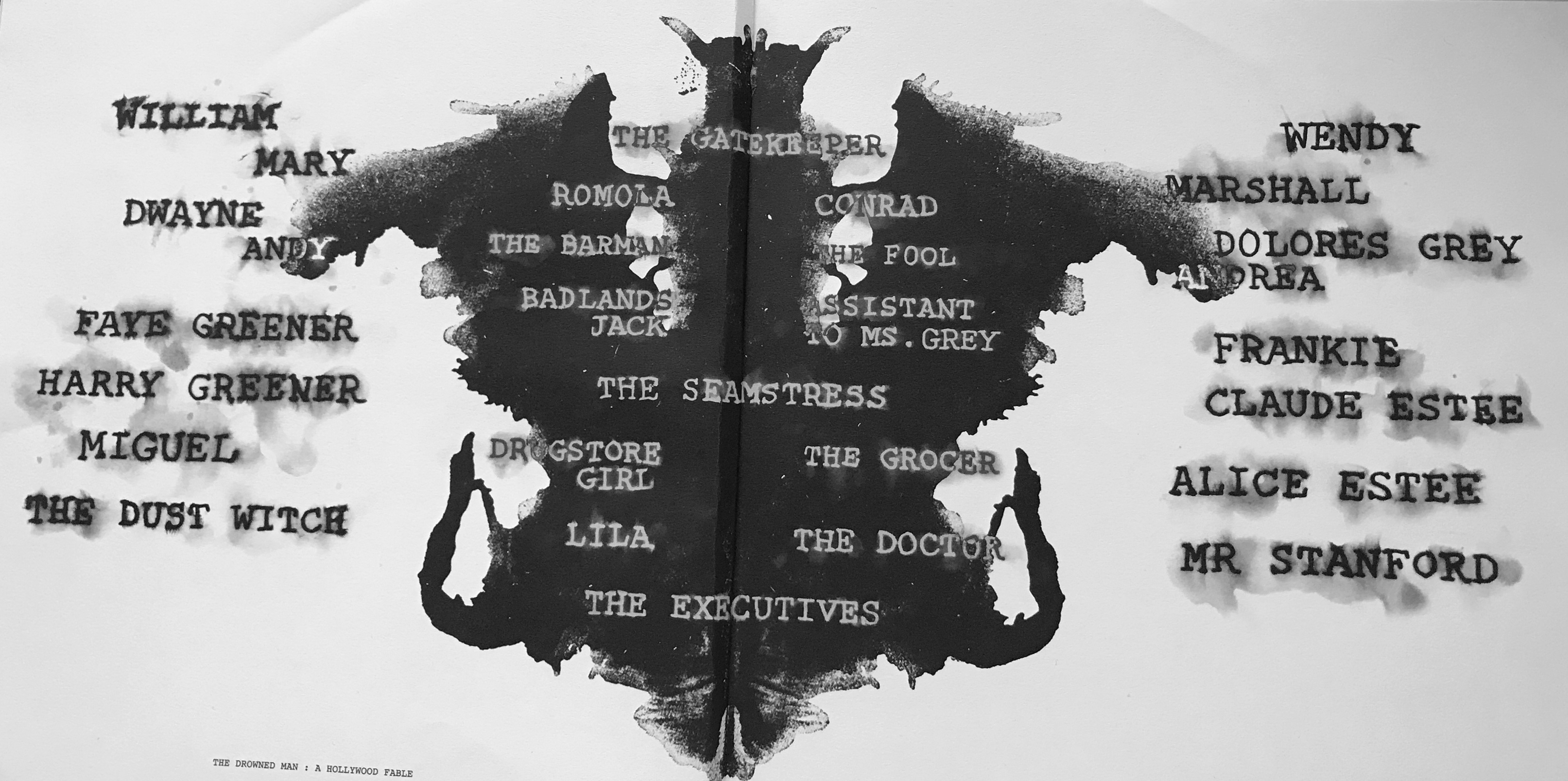
Image used with permission of Punchdrunk.
The image indicates the overarching reflected and refracted storylines of William and Mary vs Wendy and Marshall. Once within the world, audiences may become cognisant to those characters that live on the outside of Temple Studios, entering as temporary staff or film extras, those that move from inside to outside as permanent staff, B-list wannabes, PAs and executives, all patrolled by “The Gatekeeper,” and those such as Mr. Stanford or Dolores the studio Diva that are bound by Temple Studios, unable to break free.
This manifestation of dreamlike doublings and replications, lifted from the meta tropes of its sources, permeates the metatheatrical form of TDM. These are present in installations that play with repetition and abstraction and are accentuated by the complex interweaving of character narratives via the looped composition. TDM consciously plays with the (con) fusion of the real and the illusory, communicated by the trappings of film itself. Film sets, offices, executive suites, dressing rooms, seamstress wardrobes, the desert, the forest, are situated in a way that intentionally cause locational boundaries to blur, ensuring certainty about “faked” film-set vs “real” setting becomes unfixed. The audience travels between the shooting sets and the implied “real” locations outside of the studios (which also become themselves locations used by the studio). Inhabiting spaces that are both “real” and “fake,” invites a double-reading of any events in that space and extends the ideas of the world as an unreal-reality, a place of unhappily-lived-everafters.
The otherworldly juxtaposition of the real in the fake is exemplified in The Encino Cinema, a fully functioning, movie-theatre where screenings of 16mm original versions of movies (The Day of the Locust, Sunset Boulevard, Touch of Evil and Wozzeck) were presented prior to certain performances. This world-within-a-world idea is further encapsulated by “Studio 3,” the bar area that lies betwixt-and-between Temple Studios and the external, everyday worlds of the audience. In Studio 3 audience members can remove their masks, attune to a different tempo and mood, remain all night should they choose, enjoying the entertainment and interactions that run solely within this realm on their own individual loops. It is this liminal studio-bar to which audiences are led by cast members at the close of the performance, to mark the space between Punchdrunk fantasy and audience reality and from which they exit back into “real life.”
Fact and fiction are fused throughout, merging the corporeal, live(d) experience of the audience, within a fictional framework that is in this constant process of blurring realities and fantasies, truth and lies. TDM reconfigures cinematic ways of interpreting the experience in close-up, long and tracking shots to a whole-body inhabiting and editing of narrative and theme. Touch-real engagement with all spaces within the building inject an oxymoronic authenticity into the fantasy world, inviting a constant questioning of situations and scenarios; are these “real” settings or is this a film location? Is this a “real” character or is the performer playing the character of an actor playing out a fictionalised role?
As this suggests, individual interpretative agency is underscored as a vital (albeit frustrating for some) element of the work. The suggestion of creative freedom and sense of audience liberation in Punchdrunk’s masked shows is aligned to the ways in which audience members can compose their own experience; yet this is always also carefully constructed by the company. For the crescendo of TDM the audience was brought together from across the building to witness the doomed Wendy perform a violent murder, only for it to be immediately followed by the tannoyed announcement of Mr Stanford calling, “that’s a wrap” suggesting that this had all been the make-believe workings of a film-shoot and we were all invited to the wrap party. Yet the whirling hoedown finale culminates with a mirrored revelation of the murdered bodies of Mary and Marshall in the arms of William and Wendy. Standing in shallow pools into which they sink, as rain sleets on their broken bodies, this image denies that Hollywood ending and throws easy resolution into doubt. The creative/critical agency offered in this show is purely one of narrative construction and interpretation. Creative license is allowed only within a highly constructed format and according to rules of control and consent. Audience freedom is entirely simulated within this world. As with all Punchdrunk masked shows, the suggestion of freedom is a crucial part of the fantasy in which the audience is immersed.
Conclusion
Punchdrunk was a pivotal force across the first wave of 21st Century immersive practice. It rides the crest of the second wave with a generation of devisers and directors, writers and dramaturgs, performers and spectators, influenced by its aesthetics. Punchdrunk’s practice has seen to the evolution of a particular type of audience that is attracted to inventive approaches to involvement and “knows” how “to do” immersive theatre. I say this with caution for such “knowing” is demonstrated in those who can force themselves upon a performance within a space in a manner which may disregard other audience members and disrespect the makers of the work. A “knowing,” then, that ignores how intuition, invitation and shared codes of conduct and consent among artists and audiences are essential in all immersive work. In light of its influence on audiences and interactive practice, Punchdrunk has been at the centre of its own controversies and debates about safety, consent, roleplay and responsibility in immersive work. The philosophy and techniques of safeguarding for audience and performer remain an ongoing concern for Punchdrunk (Machon with Punchdrunk 45-6, 207-8). Correspondingly, performer and audience interactivity is now held under close scrutiny in public, journalistic and academic circles.
Punchdrunk’s work to date has opened up theatrical expression and experiences of intimacy and immediacy, evolving new approaches to audience interaction and appreciation. The Punchdrunk Encyclopaedia records and celebrates the history and significance of the masked shows, yet it also tantalises with Punchdrunk’s ambitions to reinvent approaches to interactive practice for future audiences. Punchdrunk’s masked shows are likely to become a rare thing as it prioritises experimentation with new forms (Machon with Punchdrunk 12). Uncertainty, curiosity, discovery and imagination remain vital to the dramaturgy, aesthetic and experience of Punchdrunk’s work. Given this, knowing “how to do” as an audience member must also always involve an un-knowing, a re-discovering of how one is tacitly enticed “to do” in any new Punchdrunk world. Barrett’s own curiosity continues to flame Punchdrunk’s stove of ambition: “I’m fascinated by that murky hinterland that is the space between the show and real life and how we can theatricalise that. There’s a lot more in there for the future” (Machon 2013, 164). Cross-platform adventures, involving deeper, durational immersion for audiences might provide the spark to ignite those future flames:
[C]ross-fertilisation and melding disciplines always produce sparks that you’re never anticipating, and it only takes a spark. We always want to ask our audience to take huge risks and if we’re asking them to take risks, we should take risks too. An audience has seen a lot now, we have to be more inventive, and that’s so exciting because there’s so much more work to make (James 2020a, n.p.).
