
Introduction
Over the last decades, the inclusion of the spectator in the sacred frame of art has become a common feature of non-traditional theatre and contemporary art, with the result that participatory strategies can be identified neither exclusively with one nor with the other. Nevertheless, the collaborative and participatory tendency of immersive theatre and participatory art is not a recent phenomenon. The activation of the audience as well as the collapsing distance between performer and spectator have been a crucial concern of artistic productions since the early Romantic era, when poets, artists and theatre directors expressed the need to involve the spectator to transform—or even to eliminate—the fundamental condition of art, that is to say the separation of artists and their public. Richard Wagner, for example, affirmed that the artist had to abandon his/her individuality and egotism in order to promote the establishment of a participatory community to forge an ideal society (78).
It should be noted that the Wagnerian theory is part of a larger narrative on participation that traverses the nineteenth and twentieth centuries and continues to the present day, preserving both revolutionary significance and ambiguities. If on the one hand, the emphasis over the decades on participation in visual arts and in theatre has proved to be a privileged way to introduce socially-oriented projects, as well as to rethink the artistic traditions, on the other hand it appears to be a precarious and uncertain medium that, as Claire Bishop points out, “needs continually to be performed and tested in every specific context” (2012b: 45). Indeed, the aesthetic of participation and immersive theatre do not necessarily imply a social or political engagement (62-3).
In some participatory and immersive projects, the principal artistic goal appears to be the manipulation and overexposure of the spectator, or rather his/her self-exploitation. With respect to this, the purpose of this paper is to trace the ingrained paradox of spectatorial activation in participatory art and immersive theatre, and therefore its Janus-like nature: the relational function on one side, the radical subjectification of spectator on the other. Indeed, its intrinsically political nature—which especially during the 1960s aspired to produce new social realities as a reaction to the alienating effects of capitalism—now seems to have more to do “with the populist agendas of neoliberal government” (Bishop 2012a: 277).
In this vein, by analyzing some historical performances, we will first consider the most crucial aesthetic and political motivations behind some artistic events and theatre productions. In the second part, by avoiding the unproductive binary of active/passive spectatorship, we will aim to trace some ambiguities related to the presumed reduction of artistic power and the transformation of the spectator into a participant or co-producer. Finally, we will evaluate the radicalization of the process of reception, by analyzing the spectator’s self-exploitation.
Historical Background: The Social Dimension of Participation against the Traditional Notion of Art and the Divisive Effects of Capitalism
The necessary precondition of art is to be seen, experienced, and reflected upon by a spectator. The same can be said for theatre, given that a performance can only take place through the encounter between spectators and actors, through their bodily co-presence.
As Erika Fischer-Lichte maintains, performance is an autopoietic process, since “whatever the performers do has an effect on the audience, and whatever the audience does has an effect on the performers” (2014: 19). To put it differently, both theatre and visual arts are the results of the dialogue between “two poles”: on one side, the creator of the work, on the other, the person who experiences that work. It follows that the creative act, as Marcel Duchamp pointed out in his polemic text, The Creative Act (1957), is performed also by the spectator, since they he/she contribute to determine “the weight of the work on the aesthetic scale, by bringing it in contact with the external world by deciphering and interpreting its inner qualifications” (138). Therefore, if the act of interpretation is a form of participation par excellence, spectatorship can never be passive or totally autonomous in the aesthetic process. Similarly, Jacques Rancière has debunked the binary of active/passive spectatorship, describing the emancipated spectator as one who is viewing, but also acting, by comparing, interpreting, selecting and observing. The philosopher maintains, indeed, that it is the distance between performers and spectators that allows one to experience the freedom of interpretation and to make connections between real life and staged reality. Nevertheless, Rancière acknowledges that the paradox of the spectator—“there is no theatre without a spectator, being a spectator is a bad thing”—, which prevailed among the critics of theatrical mimesis, is an anti-theatrical presupposition that paradoxically has provided theatre with the stimulus to re-examine itself (2). It is, indeed, undeniable that the changing identity of the audience over the past century has stemmed from the need to question the traditional systems of production and reception. During the 1960s, for instance, the experimentation of new opportunities for physically engaging the viewer in works of art represented a revolutionary tool for questioning the common sense of authorship and the specificity of medium—that is to say, the idea that each art form has, by virtue of its medium, its exclusive domain of development. The trajectory was moving from producing art works for spectators to creating experiential events for spectators. It was the case of “happeners,” who introduced the audience into the sacred frame of the event in order to express their reluctance towards the conventions that ruled the art world and to show their willingness to eradicate them. Allan Kaprow, in his seven principles collected in Assemblage, Environments, and Happenings (1966), stated that “for anyone once involved in the painter’s problems of unifying a field of divergent phenomena, a group of inactive people in the space of Happening is just dead space” (Huxley, Witts, 264). In other words, for Kaprow, the integration of audiences in the space of action implied their entire elimination.
Moreover, the progressive refusal of narrative, interpretative, and aesthetic closure, for example, has made the contribution of the spectator necessary in the construction of meaning, thus paving the way for new aesthetic approaches. Michael Fried, in a polemical tone, recognized that the “presentment of endlessness,” the blankness as well as the physical extension in space of minimal art throw back at the beholder the awareness of his/her presence or rather of his/her role in the meaning-making process (1967: 15). According to the Modernist art critic, this intrusion threatened the autonomy of art because whenever a self-consciousness of viewing exists, art ceases to be self-referential and self-sufficient, falling thus into theatricality—that is to say, into the lack of differentiation between the work of art and the experience of viewing it. Fried’s critique of Minimalism exemplifies how the spectator’s heightened consciousness of being a constitutive element of the aesthetic process is one of the main aspects of the evolution of spectatorship as an art form. Nevertheless, it is essential to underline that at the beginning of the genealogy of participatory aesthetics, the recognition of the importance of spectatorship subscribed, first and foremost, to a sociopolitical goal.
In the mid-19th century, the collectivization of performances aimed essentially at achieving the democratic and liberal political ambitions of the 1848 Revolution through aesthetic means. In this sense, the anarchist idea of Richard Wagner is a representative example. His firm intention to depart from established buildings to new spaces, by transforming the theatre into a festival, was an attempt to forge an egalitarian community. To fulfill this goal, the artist had to abandon his/her social isolation, overcome the boundaries between different artistic media and recognize that “Folk”—that is, the community—was the only true artist. In other words, artistic talents had to satisfy and express the artistic desire of the people (Kunstwollen) and the subjective authorial power had to be reduced in the name of common good – or, as Wagner puts it in his seminal work, “The Artwork of the Future,” of a communist society.
Although the Wagnerian theory is rooted in the Revolution of 1848, the principal aspects of its socially oriented projects—authorship, sense of community, and participation—are part of a larger narrative on the activation of the spectator. In fact, at the beginning of the twentieth century, many radical avant-garde movements followed the path taken by Wagner, with the aim of creating a new synthesis between politics and art, and activating the concealed energy of the masses. The Italian Futurists, the Zurich Dadaists and the Surrealists adopted the dissolution of artistic authority and the activation of the audience as their principal aesthetic and political concerns. Among the most representative manifestations that anticipated the collective projects in a public sphere there is Dada-Season 1921, a series of visits to selected spots throughout Paris, starting from the church of Saint-Julien-Le-Pauvre. In the early twentieth century, therefore, for many artists and practitioners, discovering spectatorship represented a significant move towards a decisive artistic revolution that was supposed to cure the ills of Western culture of the time, that is to say, rationalism, individualism, and logocentrism. With the arrival of the 1960s, the social dimension of participation, the changing identity of the audience, the intermediality of art, and the supposed self-sacrifice of the artist became the central aspects of a new aesthetic movement aimed at offering a repertoire of alternative responses to consumerist capitalism in Europe, or at proposing participatory actions as a reaction to the rising tide of authoritarianism, especially in South America (Bishop 2012a: 4). Although geographically distant from each other, Guy Debord, the French philosopher and co-founder of the Situationist International, and the Brazilian artist Hélio Oiticica had very similar aims in different cultural contexts. Debord usually resorted to the concepts of resistance, community, and activation to express his critique of the subjugation resulting from capitalism and to invite the spectators to reconsider their position towards society. In his opinion, the construction of situations and the transformation of the spectator in viveur represented a way to move beyond the dehumanizing and alienating effects of capitalism and consequently to realize a renewed society. The interest which Brazilian artist Hélio Oiticica took in interactive art is generally understood in the context of the increasing political repression in Brazil. In 1964, the year the Brazilian military launched a coup d’état with the support of the United States government, Oiticica developed Parangolés, taken from the Brazilian slang for an agitated situation and sudden confusion or excitement. The artistic project consisted of capes of different materials and colors that were intended to be worn by dancing participants. Some of these “experiential garments” contained poetic or political statements, such as I Embody Revolt (Incorporo La Revolta, 1967), which would enable the wearers to become aware of their capacity to rebel against the repressive military regime. Although different in their artistic approaches, Oiticica and Debord both resorted to the combination of ethics and aesthetics to engage the audience as collaborators, to forge a co-authoring social body in the creative process.
The Reversal of Roles and the Distribution of Power. The Spectator as Participant or Co-author?
The social dimension of participation adopted by many visual artists and theatre directors—especially in the 1960s—was focused on the creation of temporary communities, through the fusion of the aesthetic (performers) and the social (spectators). In fact, the fulcrum of this social and political trajectory was the experience of a work of art resulting from collective involvement. In other words, the work of art was no longer conceived as an abstract aesthetic expression and commodifiable object but rather as an engine for social and political change. Considering the continuities between the participatory impulse of the 1960s and today, we would like to draw the reader’s attention to two crucial interrelated elements that represent two critical issues of the aesthetic of participation. The first is the presumed reduction of authorial power, or rather the merging of the artist’s individualism into a heterogeneous group with the spectators, as a means by which to empower audience participation. The second is the transformation of the viewer or spectator into a participant or co-producer through the reversal of his/her traditional role.
Both elements stemmed from the need to encourage the recuperation and reconstruction of social ties through art and to overcome the traditional relationship between performers and spectators. The relinquishing of authorship was indeed conceived as a positively democratic and non-hierarchical model that would create, even temporarily, a dynamic and elastic community of equal co-subjects, through a continuous redefinition and redistribution of power and roles. In this respect, Erika Fischer-Lichte maintains that the role reversal is “a process that transforms the conventional subject-object relationship”– that is, the traditional binary of spectator-performer opposition—making the exchange between these two poles more complicated than the one who acts and the one who watches (2008: 40). In other words, the shift of roles creates an elastic interdependence between performer/artist and spectator/beholder since both operate as co-creators of the event (Carlson 2004). Consequently, it is possible to affirm that the redefinition of roles occurs when subjects and objects are no longer clearly defined and distinguished. In fact, throughout the performance the distinction between the members of the temporary community may appear shifting and vague as they react constantly to each other, opening up to the possibility of a “collective action” with unpredictable results (Fischer-Lichte 2008: 55). According to the German theoretician, it is “an interplay of disempowerment and empowerment which applies to both artists and spectators” (Fischer-Lichte 2008: 50). In other words, it is a democratic power-sharing process that enables the spectator to use the authority that the artists have relinquished to control the progress of performance, to become the producer of his/her aesthetic experience. Fischer-Lichte describes this process by taking as an example Dionysus in 69, the first performance created collectively by Richard Schechner’s the Performance Group, which was played in 1968 and 1969. As Schechner himself affirmed in his Environmental Theatre, the performance—based on The Bacchae by Euripides—was essentially realized by using the entire space of a converted garage in New York City’s Soho, furnished only with a high platform made of wooden boards, so as to create an organic spatial entity. The purpose was to forge a charged atmosphere that recalls a religious rite and to facilitate the interaction and proximity between the players and the audience. With regard to the transformation of the spectator into co-subject, Schechner made two observations. Firstly, the participation occurred when the performance “stopped being a play and became a social event” (Fischer-Lichte 2008: 44) and the spectator felt free to enter into the play like the performers, that is to say as equals. Secondly, the involvement of the spectator in the performance occurred democratically since the people could move freely in the whole space and act in the same way as the performers. This allowed the performance to advance spontaneously through the free flow of actions, instead of following Euripides’ text. As Fischer-Lichte points out, the free interaction between subject and object made the demarcation line between performers and spectator indiscernible, turning the latter into an essential component of the creative process, and the former into a collaborator.
Nevertheless, as a result of protests and disrespectful behavior towards one of the actresses, Schechner revised some details in Dionysus in 69, trying probably not only to control the development of the play but also to foresee and manipulate the actions and reactions of spectators. Thus, equality was broken, and the hierarchic control re-established. In this vein, the attempt to stem and contain the empowerment of the audience looks like a contradiction in terms that belie and question the concept itself of role reversal and democratic co-authorship. This perspective induces us to think that the artist’s decision to be part of an egalitarian group does not necessarily imply the death of the artist or the relinquishment of his/her creative power. It is, indeed, always the artist’s authority that preordains his/her demise and abdication, with a view to controlling and using the audience participation-collaboration as new aesthetic material. Seen from this perspective, the redefinition of roles appears to be an extension of authorial power; paradoxically, the harder the author tries to reduce his/her creative role, the more his/her myth imposes itself. Therefore, the question that Fischer-Lichte herself poses remains open, which is to ask “whether role reversal establishes a community of co-subjects or merely recreates the old relationship in a new guise” (2008: 40). The repositioning of the spectator as co-producer or participant and his/her subsequent presumed empowerment appear to be more “powerful as ideals than as actualized realities” (Bishop 2012a: 2). Indeed, over the years, the belief in a close connection between audience participation and political emancipation has become an orthodoxy in theatre as well as in the visual arts. Behind this sort of dogma, there is a explicit judgement attributing a positive connotation to the active spectator/viewer and a negative value to the passive one. From this perspective, participatory performances propose a romantic perception of their democratic and emancipatory potential, which inevitably opens itself up to observations and objections. First of all, it should be stressed that the spectator’s mobility and interaction with the performers do not necessarily imply activation, or rather, do not exclude passivity. In this regard, Martin Barker says that the term activity “actually includes a great deal that is definitively not active in literal senses” (124). Indeed, performances may imply various degrees of participation, not all of which are emancipatory in the same way. It follows that a distinction between collaborator and participant must be made since they represent two very different conditions. The first implies working with someone to create something, the second merely assistance. The socially engaged collective performances and installations that Franco Vaccari developed in the mid-1960s exemplify the vagueness of the spectator’s role. Using a functioning photo booth as a social and democratic device in a context of increasing social tension and general disaffection towards the Italian government and state institutions, Vaccari tried to involve his spectators/beholders in communicative and civic action. In Esposizioni in Tempo Reale (Exhibitions in Real Time, 1972), for example, visitors freely took their photo strips and displayed them on the walls, apparently exercising total control over their identity as citizens. However, although the Italian artist saw in the détournement of technology the possibility for a critical collective reflection upon the crisis of the very notion of subjectivity, as well as an instrument for a temporary emancipation of the individual, the people involved in these collective projects can hardly be considered co-creators. The reason lies in the twofold nature of Vaccari’s “exhibitions in real-time.” With these projects, the Italian artist is, on the one hand, the precursor of relational and interactive work in progress, and on the other, an unintentional narrator of what we could define today as a society of show, that is to say a society based on media control and addiction. From this perspective, Vaccari’s collective photography could be read as a symptomatic landscape of society’s expectations in the communication age, or rather as people’s desire to be recognizable and recognized, to be protagonists. But being a protagonist is a very different condition from collaboration since being a co-creator does not necessarily imply visibility, but rather awareness of taking part in a project, a clear understanding of and adherence to the purposes at its base. It is the combination of all these factors that breaks down the conventional sense of individual authorship, thus overcoming the distance between the “creator” and the “beholder.” The black-and-white unknown faces in Vaccari’s works appear, indeed, less as conscious co-authors than as participants involved in an anthropological experiment, eager to honor the “here-and-now” moment.
Franco Vaccari, Photomatic d’Italia, 1972-1974
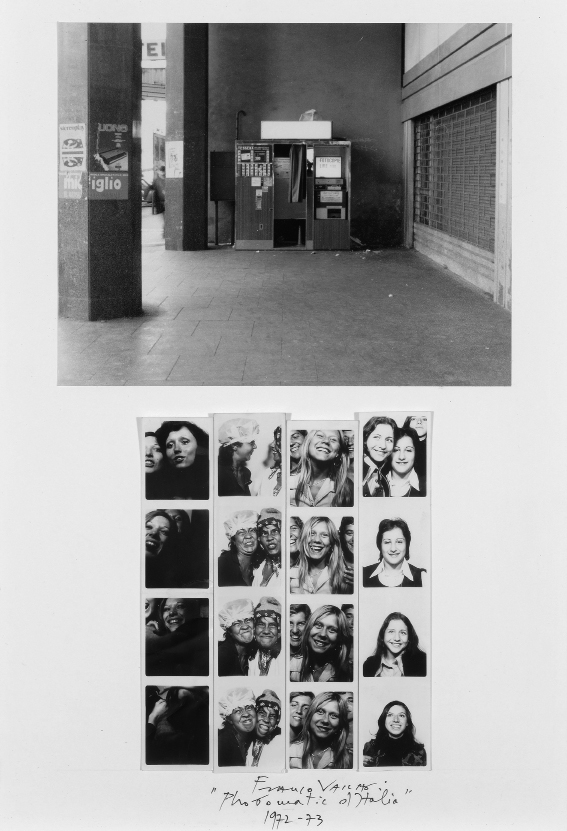
Photo credit: The Artist & Galleria Mazzoli, Modena
The Radical Subjectification of Reception and the Narcissistic Self-exploitation of Spectator
The trajectory of audience involvement in visual arts projects and theatre performances, considered here, shows two crucial points: firstly, the strategies of participation that were consolidated in the 1960s—inclusion, interaction, cooperation—are not enough to undermine individual authorship and actualize political and sociological emancipation. Secondly, as we will discuss in a moment, the belief according to which everyone is the creator and producer of his/her own aesthetic experience risks turning participatory art and immersive theatre into a promotion of the narcissistic presentism or rather, into what we would define as the radical subjectification of reception.
As many scholars and researchers have remarked over these last years, the questioning of individual authorial power as a means by which to criticize capitalism and enhance social consciousness can assume the form of a fashion trend deprived of any subversive or revolutionary potential. In other words, participatory art and immersive theatre have to deal with the specter of recuperation, a term that Guy Debord and Situationist International (SI) used to identify the strategies that capitalism deploys to sterilize subversive discoveries. Likewise, Rosalind Krauss pointed out that even art that tries to subvert capitalism may end up serving it. Indeed, according to the American art critic, “the master of detournement (subversive appropriation) turns out to be capitalism itself, which can appropriate and reprogram anything to serve its own end” (33). It is a perspective shared even by Claire Bishop, who points out an emerging paradox in participatory art: even if many artists claim to be against neoliberal capitalism, their projects show many elements in common with the “populist agenda of neoliberal governments and its forms (networks, project work, affective labour)” (2012b, 39). Indeed, the principal core of many participatory and immersive projects is the promise to position the participant as a co-subject of the experience and as a co-creator of transient spaces into which he/she can be immersed by stepping beyond conventional rules of behavior. The tendency in both participatory art and theatre to offer to the spectator a radical subjectification of his/her reception is, indeed, a point that deserves consideration. It is undeniable that whenever the spectator crosses the threshold of the stage or the sacred frame of visual arts, a disjuncture may occur between the figure of the audience as a collective entity and that of the spectator as a narcissistic “consumer.” Being aware of this demarcation allows us to evaluate the profound difference between the notion of community—considered here as a group of people who share something that is happening—and that of individuals willing to participate and expose themselves with the aim of experiencing momentary pleasure.
The spatial organization of performance can undoubtedly be considered as an aesthetic element affecting the process of perception as well as the dynamic of participation. Indeed, the possibility of moving freely through space allows the spectator to rediscover his/her subjectivity and consequently amplify his/her own individual sphere by establishing a personal relationship with the space and the performance. In cognitive science and in neuroscience, for instance, the same principle—which is defined as spatial thinking—is recognized as the foundation of abstract thought, since mental concepts arise from the experience of the body in the world. According to Barbara Tversky, Professor Emerita of Psychology at Stanford University, thinking is nothing but finding relations between things, reasoning with the body in space. From this perspective, the immersive theatrical events and participatory projects that imply an ambulatory audience might be described as a meeting between material and sensation, that is to say, thinking through matter, thinking through space.
The radical subjectification of the process of reception, therefore, can be considered as a result of the deviation from the conventional theatrical as well as artistic norms and semiotic systems, such as the conventional use of language and space: the fluctuating spatial conception and the discontinuous sequence of moments replacing the continuity of time invite spectators to wander between different points in space so as to produce their own performance or theatrical reality (Fischer-Lichte, 1997: 69). In this way, the spectator becomes physically and actively present and central to the very existence of the performance (Aronson 204). Such a productive participation entails the introduction of two crucial principles for the reconfiguration of the role of spectatorship in immersive theatrical events, which are the autonomy and absorption of the spectator. A sense of this subjective creativity is clearly evoked in YOU-The City, a walking performance created by Fiona Templeton—the Scottish artist and co-founder of the Theatre of Mistakes—in New York in 1988 and subsequently held in Ljubljana, London, the Hague, Zurich, and Munich. The project entailed a private experience, or rather a solo tour of over two hours in which one person at a time was guided through multiple locations of Manhattan—such as a church, an apartment, a basketball court—meeting about fifteen individuals along the way, who each seemed to know something about the spectator, or rather the client, as he/she was called. This work seems to be a further development of The Street, the performance created in 1975 by the Theatre of Mistakes, which took place on Ascham Street in London with the participation and collaboration of residents. But unlike this trigger-based pedestrian choreography, YOU-The City allowed more interactive associations among actors, audience, settings, and text. During his/her walking experience, the solo spectator/participant underwent a series of encounters that explored the line between the personal and the anonymous in everyday urban interactions, as well as the ambiguity of the self and the other, the internal and the external (Fuchs, Chaudhuri 105). Templeton’s piece placed an emphasis on the existing environment and foregrounded the individual’s engagement with that network of relations (Aronson 206). In other words, by extending the stage and the play into the living urban surroundings and by appropriating the city itself as a theatrical milieu, Templeton’s play sought to defamiliarize the cityscape, so as to make the audience-member client explicitly self-reflective about everyday “urban encounters and journeys he would probably make without particular notice” (Harvie 1993: 54). The client was thus invited to reconsider his/her relationship to the city and reflect on how his/her responses and actions might affect the perception of the urban environment.
From this perspective, therefore, Templeton’s project could be defined as an experiment in consciousness-raising. Indeed, the artist’s aim was to stimulate awareness of one’s collaborative engagement in a network of beings, so as to help society understand the interrelated conditions of the planet threatened by climate change. YOU-The City entails becoming engaged in a community, or rather being involved not as spectators but as performers in events that provide tools to address social or political issues. However, although Templeton reworked the shape of theatre through the audience member’s autonomy of action and an absorptive theatrical/spatial experience, it should be noted that the spectator/client actually had few opportunities to intervene in the performance’s textuality. Indeed, the spatial journey the spectator undertook was both choreographed and in large measure scripted. In this case, it is possible to assume that YOU-The City hinged, finally, on voyeurism and simulated experience (Kershaw 1999: 195).
It follows that in participatory performance the spectator’s agency could be superficial or even illusory. Consequently, if on the one hand the aesthetic of total immersion—defined by Josephine Machon as “a total engagement in an activity that engrosses […] the participant in its very form, a transportation of the audience to the otherworldly-world”—makes new sources of collective empowerment possible, on the other hand it also has the potential to manipulate and disempower spectators, to shape their responses by emphasizing the principium individuationis, which is to say the sense of the self or rather narcissistic participation (62-63). This twofold aspect is identifiable within Punchdrunk’s aesthetic. Their main feature is the “empowerment” of the audience, which is—to use their words—the creation of “a raw and physical response in spectators, in order to make their mind and body fully present in a way which is in antithesis to the conventional theatre.” Indeed, according to Felix Barrett, the founder of the company, in order for theatre to make an impact, audiences must be at the heart of a narrative and have agency over what they experience. The use of masks during some productions—such as Sleep no More (2003), for instance, offered spectators both liberation and empowerment, anonymity and a sense of role-play. But, by Barrett’s own admission, these spectators remain watchers, or rather ambulatory readers who cannot manipulate the trajectory of the show. Therefore, the use of masks seems to give the audience a sense of uniformity onto the audience and restore a certain hierarchical relationship between performer and spectator. Indeed, the homogenization of the spectator’s identity makes him/her easily recognizable and thus manipulable by the performers.
As Gareth White points out, it cannot be denied that the feeling of making choices within their performances can be important to spectators’ overall sensations, but the question is whether any apparent agency is real (37). The impression is that an audience-centered aesthetic approach entails “compulsory conduct as primary pleasures of performance and self-absorption as a primary mode of experience for spectators” (Zaiontz 407). The possibility and the implicit promise of physical contact or interaction with a performer and being assigned certain tasks or roles could encourage a narcissistic approach, and justify a sort of voracity of feelings. In other words, the desire for an intense experience and the spectator’s self-preoccupation with his/her reception and intense emotions could overshadow the importance of the performance experience itself. Yet, such a productive engagement in Punchdrunk’s productions seems to recall neoliberalism’s political and economic structures; the more productive you are, the more you gain from the performance. Punchdrunk’s invitation to take your own path allows you to not only experience scenes the way you prefer but also to gain or discover some other aspects and situations that are not generally accessible to everybody. Some spectators, for example, seek out user-guides, bloggers, and useful tips to take the most advantage of the performance (Alston 137). From this perspective, as Jen Harvie explains, the audience member seems more like a “prosumer,” to use the term coined by the sociologist Alvin Toffler, referring to a combination of “consumer” and “producer” (2013: 50). Moreover, in these participatory performances, the use of unusual and disused locations—such as railway arches for Tunnel (2008), and a warehouse for The Tempest (2003) and Faust (2006)—seems to be a strategy to satisfy the desire to be inside the drama and have the feeling of being behind the scenes. Indeed, their performances are not based on a dialectical relationship with the site. There is no activation of or engagement with the narrative of the site, which is a significant component in the creation of performance meaning (Pearson 35). On the contrary, together performance and space seem to restore a sort of narrative interdependence, again transforming the space into a by-product of theatre and into a fictional world that the spectator crosses, losing sight of the everyday world. The aim, therefore, is not to develop modes of thinking and models of action within the existing reality—as Fiona Templeton in YOU-The City tried to do – but rather to let the audience disappear into the work.
YOU-The City, 1988
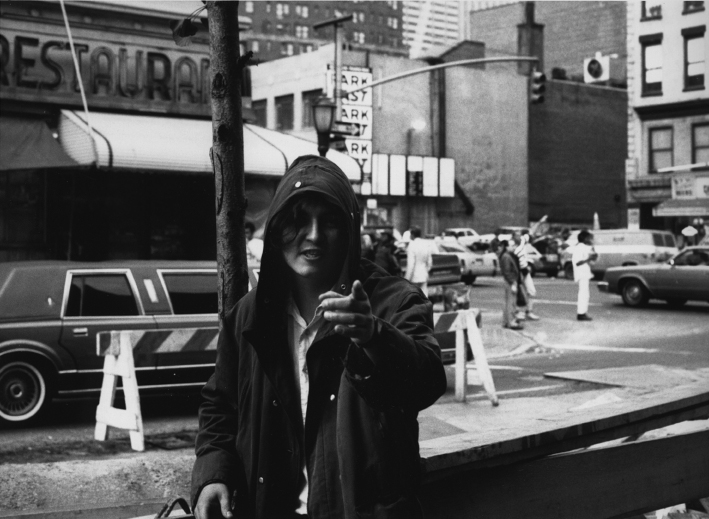
Photo credit: Zoe Beloff, Fiona Templeton
It is what Rancière defines as a form of consumerist hyper-activism or rather as the triumph of capitalism (21). The audience members, totally immersed in the performance, are no longer able to critically approach the performance. They imagine having choice and power while in reality they are manipulated to the point of surrendering their freedom, participating in an experience without conflicts and divergences, turning the momentary pleasure into consensual contact. The oscillation of spectatorship between a sense of community and narcissistic participation that has been considered here shows that the destruction of frames does not always succeed in absorbing the spectator (Aronson 212), making him/her an independent agent. To put it differently, the separation between performers and spectators cannot be abolished by getting rid of the traditional topology of theatre, that is to say by collapsing the distance between the stage and the assigned seats. Even if the space of performance can be contorted, modified, or compressed, spectators and performers can never be totally isolated or merged into one (Fischer-Lichte, Wihstutz 2015: 4).
Conclusion
As each case mentioned here shows, the elastic relationship between subject and object—in both theatre and visual arts—is exposed to contradictions as it lacks any fixed rules. Indeed, the false dichotomy according to which participating is associated with active agency and spectating with passivity—which over these last decades has infiltrated many aesthetic discourses on participatory events—does not seem to offer an effective critical perspective. The promise of temporary deep immersion in a new different reality is not necessarily synonymous with democratic participation and even less with the guarantee of critical emancipation. Art that obliterates spectatorship as it is conventionally understood requires a new understanding and a new critical approach that allows us to see the difference between the participatory performance that resorts to audience engagement as a means—not as an end in itself—and those promoting the consumption of the self as a primary pleasure.
In addition, we should not forget that the ambiguity of participation is also due to its extra-aesthetic nature; although audience involvement has been an important concern in art since Romanticism, the answers cannot be found exclusively in orthodox aesthetics. The challenge is, therefore, to stress new ways of critiquing that are able to reveal possible implications with the new liberal economy that do not make any difference between art and entertainment; to elaborate an inter-artistic and transdisciplinary perspective capable of thinking of Participatory Art and Immersive Theatre as a sensitive measurement of social feeling and political action instead of as a form of art exclusively linked to visuality or textuality. The challenge is to refocus attention on the quality and meaning of what participatory aesthetic produces and on the critical thinking it inspires.