
In their article on Performing Translocal Memory: Testament and Testimony in Contemporary Theatre and Performance, Donia Mounsef and Mai Hussein identified a “memorialist turn” in contemporary productions that deal with trauma and migrancy (Mounsef and Hussein 140). Reflecting on Marvin Carlson’s concept of “memory machine,” the authors position theatre, and arguably theatres of migration, as “a space of exploration between living and telling, memory and forgetting, ‘speech and survival’” (144-145).
Indeed, recent works by migrant theatre makers in the UK and beyond reverberate such renewed engagement with memory, especially in the context of ongoing war(s), displacement and difficult journeys. Recent examples include the National Theatre Wales’ Tide Whisperer (2018), a large-scale immersive and site-specific performance staged on the shores of Tenby (Wales, UK) that tackled experiences of refugeedom; Nick Makoha’s The Dark (2019), produced by Fuel and Ovalhouse theatre centred on the author’s and his mother’s migration journey fleeing dictatorship and conflict in Uganda; and British-Rwandan Dorothée Munyaneza’s Unwanted (2019, UK premiere) that focused on the stories of the survivors of the genocide in Rwanda (especially raped women) and their forced displacement.
In this article, I hope to map new aesthetics created through immersive dramaturgical practices and explore the ways in which such aesthetics might challenge and shape existing testimonial narratives of migration. In particular, I will discuss some of the dramaturgical practices that address issues of “witnessing of trauma” and the “trauma of witnessing” (Mounsef and Hussein 157) in Caroline Williams and Reem Karssli’s Now is the Time to Say Nothing, a recent immersive performance installation developed in the UK. How can we perform traumatic memories of war and difficult migration journeys in ways that would enable a sense of shared recognition and collective embodied memory? Or—as the production I am about to discuss asks—“How do you make a story where everyone thinks [it] is about them?!”
Caroline Williams and Reem Karssli’s Now is the Time to Say Nothing is an instruction-based performance installation originally developed at the Young Vic Theatre (London) as part of the Young Vic Taking Part programme (2015). The installation is currently produced by MAYK, having been reworked for Mayfest Bristol in 2018, and recently presented at the Victoria and Albert Museum (June 2019) and Battersea Arts Centre (October 2019) as part of extensive touring in the UK and Ireland.
Created over a five-year period and co-authored by theatre director Williams and Syrian film maker Karssli, the performance builds on interactive video and immersive soundscape and is usually staged in studio spaces involving a small number of audiences of around fifteen people at any given time, audience groups changing hourly throughout the day. For Williams, the production analyses the “semantics of screens in relation to the war in Syria” (n.p.), exploring how we observe and connect to representations of war and refugee experiences. Against the backdrop of increasingly polarised debates on migration, this production makes space for both reflection—creating “an experience which attempts to connect a UK audience to the human story behind the news”—and action as a “provocation against armchair passivity” (MAYK 2019). Key to both is the audience’s participation. In fact, this performance installation is produced in close collaboration with audience-participants and meaning is forged through interaction and dialogue between individual audience members and the work.
Participation and dialogue are central in Williams’ previous theatre works as well, forming the base for social and environmental activism through artistic means in dialogue with ongoing political issues. Her You Do Not Have to Say Anything (The Yard Theatre, 2018) for instance was a collaboration with residents of Tower Hamlets and looked at issues of policing after several deaths in police custody in East London. Can You Hear Me Now? (2017) was a translocal live performance that took place in Bristol (UK), Kampala (Uganda) and Kigali (Rwanda) simultaneously and featured teenagers from each location exploring digital connectivity and their relationship to it. In Make Yourself At Home (Nuit Blanche Brussels, 2016), Williams offered yet another immersive experience with migration, in this case via a one-on-one performance installation inside a cardboard box, bringing together audience members with migrant performers.
All three productions mentioned here seem to build on immersive dramaturgy for mapping important socio-political and cultural issues. Beyond their focus on creating a unique, individual encounter with the performance work and the issues they present, Williams’ works aim to reach beyond the individual and towards collective solidarity. Certainly, in the case of Now is the Time to Say Nothing, an intimate exploration of connectedness among destruction—as young Londoners connect with Karssli via Skype—is expanded towards a more collective exploration of the politics and representations of memories.
As I will argue in the following part of this article, Now is the Time to Say Nothing is a powerful work that fosters activist aesthetics through the elaborate use of visual, immersive and participatory practices, forms that are increasingly important in challenging dominant media portrayals and in facilitating a re-evaluation of complex identities and ideologies amidst recent shifts in global politics and economics.
“A Way Not to See”: Capturing Memories
Now Is The Time To Say Nothing at Mayfest 2018
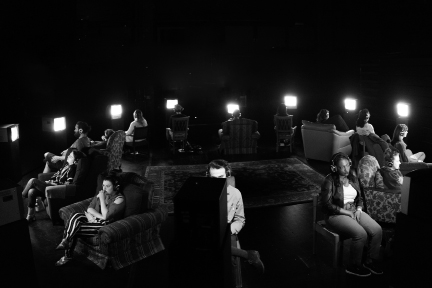
Photo by Paul Blakemore
The audience follows Reem Karssli’s life from the comfort of armchairs set in front of television screens equipped with headphones. Each audience member is isolated within his/hers armchair during most of the fifty minutes running time, almost solely focusing on fragmented images as Karssli captures her everyday life on camera amidst war, and then in Germany after a difficult sea crossing. As Aphra Evans observes: “this arrangement fragments and isolates each audience member as if they were alone in their own front rooms” (n.p.). The screening starts with untuned TV images then moves on to raptured news footages, extracts from parliamentary debates, images of streets, and aerial bombings. We are reminded of the strange physicality of video footage via instructions to touch the screen in front of us and feel the tingling sensation of electrons interacting with our fingers. References to the materiality of television broadcasting interweaves the performance installation as audiences are invited to reflect on the physicality of screens and screening, for example through imagining the photons criss-crossing the air in the studio space. Clearly, the production is (self)aware of the complexities around connecting or disconnecting to difficult experiences. As Williams explains:
Disconnection to global conflicts through screens was part of the fabric of being in the West and in the modern world. We look after screens as if they are toddlers, never out of our sight, and yet they often leave us feeling distant from the very thing we’ve just been shown. (n.p.)
Karssli’s video-captured memories of everyday life in war-time Damascus are presented here as almost tangible flashbacks due to the high-quality soundscapes created for this performance. Williams explains in an interview for the Ministry of Counterculture that she was deeply inspired by Reem Karssli’s documentary film, Every Day, Every Day (2013), a video diary documenting the life of her family in Syria during the period when the revolution turned into a civil war. Excerpts from the documentary—characterised by Williams as “so quiet and yet full of acute restlessness and claustrophobia” (Healey 2015)—form the dramaturgical spine of this production. As a carrier and diffuser of memories Karssli’s video merges the personal and the collective.
Memory, as Mounsef and Hussein remind us, is constructed as “a dual process of retrospective spatio-temporal narrative accounts, combined with physically re-enacted mnemonic flashbacks” (141). Indeed, Karssli often returns to feelings, smells and to “things that used to be”: the family home, the family-owned shop—things that no longer exists, but are very much alive in her memory. She also forgets things, like her “fantasy world,” her inner thoughts, drawings, project plans. This is an ongoing war and she reflects on the chaotic nature of remembering. In fact, the creators of the production are conscious of the incompleteness of memories and the importance of forgetting.
Khalid Amine gives an important analysis on how painful personal memories can(not) be performed and/or conveyed publicly. He looked at public testimonies as performative acts and performing memories in Moroccan theatre after the so-called “Years of Lead” (from around the 1960s until the late 1990s), pointing out that: “[M]emory narratives of trauma, as manifested in testimonies and other representational forms, are never complete entities […] in so far as they are full of gaps and silences, edited in and out” (126). Reflecting on the limits of representing testimonies, he concludes: “Testimony is inhabited by the impossibility of telling, as it is mostly composed of bits and pieces of an overwhelmed and disrupted memory and acts that can by no means be articulated as knowledge per se” (126).
Now Is The Time To Say Nothing at Mayfest 2018
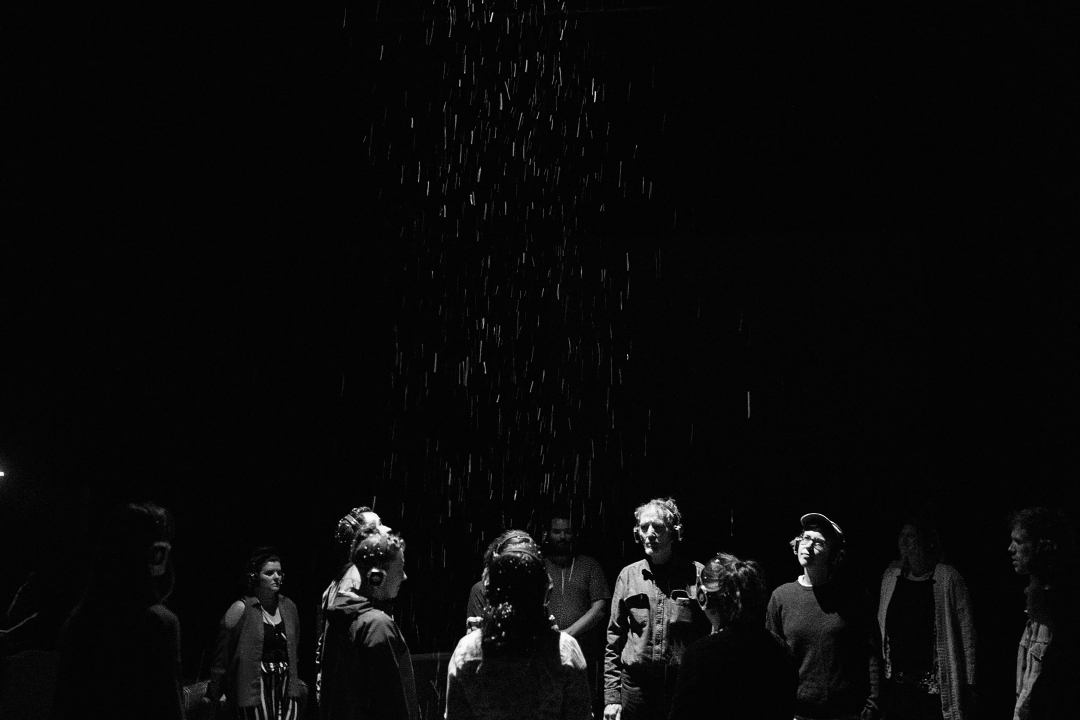
Photo by Paul Blakemore
For Karssli forgetting is survival, echoing Theodule Ribot’s observation—from his late 19th century Les maladies de la mémoire—that forgetting is “not a sign of malady, but of health of memory” (in Mounsef and Hussein 142). In this context, Karssli’s filming everything was a desperate attempt to hold on to her personal memories, but also a way to critically distance herself from reality. As she puts it in the production: “It was a way not to see how the world is cruel. To see things from outside, to be like a viewer.”
The wartime reality that transpires from Karssli’s story positions the young Londoners—connected with her via Skype—not only as viewers, but as witnesses. Part of the Young Vic’s youth programme, the original production (2015) involved London-based teenagers reaching out to Karssli, trying to understand the nature of the conflict beyond the news footage. Their connection evolved over time and the conversations prompted the group to organise a public intervention in Hyde Park, London, to raise public awareness about the Syrian conflict, however this moment of activism vanished as passers-by were reluctant to engage. In fact, the performance can be read as a response to this failed attempt to challenge public narratives. Occasionally, recordings of the Skype conversations intervene in the screening, shaping our perception further and away from the news and the screens. As Lyn Gardner remarks in her review, the performance “reminds how sitting in the dark watching a screen only distances us, and actively tries to bring us together to reach out to the real people, just like us, whose lives are blighted by war” (n.p.).
A few times during the screening, we hear instructions through the headphones to stand up and look around us, make eye contact with our fellow audience members, close our eyes and listen to the Lebanese singer Fairuz’s 1970s song Habbaytak Bissayf about a girl waiting for her love who never arrived. This moment came as a welcomed interruption. Karssli’s footage shows snowing on the streets of Damascus, and inhabitants of the city venture out joyfully after a long period sheltering indoors. Snow is also falling over our heads, in the form of white confetti, interrupting the solitary performance experience. Our reconstruction of the event is often interrupted just as the conflict in Syria interrupts everyday life. The performance accepts the “impossibility of reconstructing the totality of truth” (Mounsef and Hussein 150). The artists give up on constructing a well-defined narrative. Instead the production focuses on affect and with that, questions meaning making.
As Cathy Turner and Synne K. Behrndt’s analysis on interactivity and new technologies show us, setting “the audience as ‘witness’ rather than spectator implicates the audience members in the making of the meaning” (198). Indeed, as mentioned earlier in the article, meaning, in this performance, is developed in interaction with the audience through close observation, participation and reflection. Hence, witnessing also allows for a practice of critical engagement by “mak[ing] the audience aware of the unfolding process of making meaning through performance” (203). This of course goes beyond the performance work itself. It also challenges our reliance on media representations of war and displacement in line with Mounsef and Hussein’s argument on theatres of trauma, which they consider a powerful tool to expose the ideological frames of media production and the devices that construct the illusion of the “real” (146).
In this sense, Williams and Karssli’s installation critically intervenes in meaning making and disrupts mainstream media narratives on migration, at least at specific places and regional geo-cultural contexts where the performance installation is set up while on tour. Arguably, the direct contact with the audience (via the instructions, for instance) enables a dramaturgy that interrupts fiction, confronts audience-participants with experiences of war and displacement, and brings audience members together in building common narratives (Amine 134-138). Williams explains: “We knew we wanted the audience to have a journey from the normal screen where you might sit and watch the news to then being in the space, connecting with each other, with this war and with someone in Syria” (n.p.). Besides offering a visual and sonic encounter that aims to transforms a distant conflict into an experience easier to relate to, the creators also draw attention to our involvement, “challenging us to examine the ways in which we identify, produce, and respond to circumstances as ‘real’” (Turner and Behrndt 202).
What are the ethics and the aesthetics that emerge from such an engagement? How does digital technology—at the “meeting point in-between the performers, observers, and the confluence of media involved in a performance at a particular moment in time” (Chappel and Kattenbelt 12)—enable a political responsiveness and an ethics of recognition moving beyond the performance?
I will now turn to the immersive dramaturgy employed by Williams and Karssli in the key part of their performance installation to think about representation, political agency and the possibilities as well as the limits of activism.
Sharing Memories: Immersive Dramaturgy towards Activist Aesthetics
Karssli’s film stops abruptly as she prepares for the crossing through the Mediterranean. We are asked to move away from our screens and take a seat on a rug in the middle of the circle delimited by our armchairs in the studio space. Then, moving closer to each other, to sit together facing the same direction in the dark performance space. Through an elaborate sound montage, we hear people rushing through pebbles, then the loud sound of a boat engine shaking the floor beneath us, the dramatic sound of the sea, waves, different voices and shouting. We soon realise that we are on the boat, taking part and witnessing this particular refugee journey. Later, images appear—projected to a large screen in front of us—of a crowded dinghy followed by close-ups of refugee arrivals at the shores of Europe.
“The experience becomes visceral,” as Aphra Evans rightly observes (n.p.). The visceral nature of the experience—demonstrated by Gareth White’s analysis on the concepts of immersive theatre—is the result of a combination of proximity to and interaction with the “multi-sensory” mechanisms of the performance. White reflects on Josephine Machon’s concepts of “(syn)aesthetics” and “visceral performance” explaining that the spectatorial experience “entails that the subject that makes sense of its experience is constituted by those bodily senses, rather than distinct from them” (229). He argues—through the works of Punchdrunk and Shunt—that “bodily sensing is vital to sense making” in immersive theatre productions (229). The “corporeal character of [the] audience experience” allows for an immersive encounter, establishing “a space that is replete with associations and which becomes performative in new ways in consequence of the audience’s presence within it” (230, 225).
In the present case, the immersive soundscape and participatory dramaturgy of the performance allowed for a quasi-lived experience and a close encounter with displacement and dispossession through an almost tangible digital “reality” built up throughout the performance, but especially in the approximative ten minutes-long “scene” detailed earlier. Immersive works, as White shows, have “a special capacity to create this kind of deep involvement” with the performance, but can this be extended towards a sustained and meaningful engagement with issues of refugeedom beyond the performance? Or can such immersive performances engender an ethical engagement that would act on the “political potential inherent in the reordering of audience–performer relationships” (225, 222).
In an interview for the Irish RTÉ Radio, Williams and Karssli assert that the performance is not a reconstruction of her or any other particular refugee’s journey, for that would be abusive. The audience needs to imagine their own journey, they add (RTÉ Radio 1 2019). Indeed, in this core moment of the performance, just before the sea crossing, Karssli asks us: “I would like you to come with me on a journey, if you can, if you can imagine it.” Her decision to share this refugee sea crossing that keeps only a loose referential connection with her own journey, echoes Mounsef and Hussein’s important statement that “direct re-telling runs the risk of re-traumatizing the ‘other’” (152). In the same vein, Karssli also acknowledges the audience’s position as witnesses of such a traumatic journey, saying: “Thank you for taking this journey with me. I know you didn’t really have a choice, but sometimes in life we don’t.”
Reflecting on the Moroccan context, Khalid Amine contemplates the transformational capacity of publicly shared testimonies as sites of “participation, transmission, production, and reproduction of knowledge” that “require[s] the presence of both the ‘I’ located in the space of trauma and the ‘we’, at the scene of narrative performance” (127). In this performance installation fragmented refugee memories are not only retold and listened to by the audience, but they are (re)imagined and “re-enacted.” The communal “re-enactment” of the sea crossing forms the basis of a shared collective recognition and memory of the thousands and thousands of sea crossings during the ongoing refugee crisis in Europe. The creators are clear that this is not a re-living of a refugee journey, but rather an “imagining” of our own journey. The “pedagogical and liberating premise” (127)—to use Amine’s wording—stems from the immersive practice employed here by the performance makers. Mounsef and Hussein quote Karen Malpede’s observation that:
[A] theatre of witness increases the individual’s and the society’s capacity to bear witness. […] provides its audience with the knowledge, the courage, the time and the community in which to contemplate and affirm its engagement in actual, private and public acts of witness. (155)
Now is the Time to Say Nothing recognised what Mounsef and Hussein describe as the problematic “relationship of performance to language and its insufficient expression” to capture the “effect of violence on shattered people” (140)—hence the title of the production. In this key scene of the performance Williams and Karrsli moved away from language to activate an audience experience beyond words and (story)telling. Immersion as a dramaturgical and aesthetic practice—based on the audience’s close interaction with the space, Karssli’s story, and each other—serves an affective political goal: to facilitate a shared embodied understanding of displacement and refugeedom.
This is of course in stark contrast with recent, and indeed current political narratives and media portrayals of refugee arrivals in the UK (Malik 2014). As Emma Cox shows, when looking at processional aesthetics in the context of the so-called European “refugee crisis,” we often see that “the aestheticization and narrativization of arrival feed a contemporary politics that places the volitional subject […] within a condemnatory frame” (485). Her examination also demonstrates how, by lacking political agency “refugees remain most acceptable within contemporary paradigms of humanitarianism when they appear passive and recipient” (485). Karssli refuses such a positioning of her story as the performance switches focus away from her and on to us audience-participants.
In light of the above, what this performance offers is an intervention in public representation of migration, triggering a rethinking of societal dichotomies of hostility versus hospitality. It merges the personal and the collective in order to counter political and media strategies of “othering.” As I discussed elsewhere (Musca and Corrêa), such dramaturgies of suspension and re-appropriation of otherness may prove useful in fostering “political transformation through subversive performative practice” (Amine 125). Khalid Amine writes that Moroccan testimonial performances often acted as “counter-agents to official historiography” intervening into public memory formation (127). Alongside this formative approach, Karssli’s of sharing her narrative is also a means for resistance and agency.
Throughout the performance she is in control of the representation of her memories and her journey from Syria to Germany. She takes ownership over her own narrative on and off stage. As in publicly shared testimonies of trauma, her narrative “become[s] a means of empowerment when other forms of power are denied or are beyond reach” (Amine 133). Notwithstanding the “profound political violence” (Cox 485) of refugees across the globe, this performance remains an “important means for regaining agency” (Amine 139).
In the first part of this article I discussed how, by moving away from a metaphorical treatment of migration, Williams and Karssli created a multi-sensory exploration of the refugee experience in performance. I have argued that the immersive practice the performance makers employed formed the basis of an ethical-political engagement. Firstly, this provided agency to Karssli to assert her identity and her own narrative vis-à-vis dominant media portrayals; secondly, it cultivated an empathy driven encounter that encouraged audiences to re-evaluate their own perception of what it means to be a refugee.
I would argue that the aesthetic emerging from this immersive engagement is an activist one. Reflecting on migrant activism in Paris, Emine Fişek points out two key aspects of what she calls “immigrant aesthetics”: resistance against stigmatisation and rendering migrant experiences visible (42). She defines activism through theatre and performance as “building new aesthetic categories around the performing immigrant body, while nonetheless participating in the wider world of cultural resistance” (42).
It is reasonable to claim that Williams and Karssli’s performance fostered political responsiveness through its activist aesthetics, while promoting a representation forged by and with a Syrian refugee rather than different media outlets. However, the production remained limited in exposing the economic, political and socio-cultural legacies and contexts that contribute to forced migration and displacement. This is because of the performance close focus on sharing a human story beyond the headlines. As Evans formulates:
Now Is The Time To Say Nothing explores the many ways in which screens might be used to meaningfully connect audiences across the globe with the suffering of everyday Syrians—and, in doing so, highlights how little they succeed in achieving this today. (n.p.)
Arguably, screens and media representation reflect the established “power hierarchies that maintain injustice” and precarity (Zaroulia 187). In order to understand migratory identities and to cultivate a collective recognition, we would need to engage with ideologies and cultural legacies (e.g., colonialism) beyond the performance. According to Marilena Zaroulia: “If migration exceeds our limits of rationality and reason, it follows that performances that engage with migration should also interrupt the logic or expectations of the European sovereign I” (187). Zaroulia proposes a “spatial reorientation, new ways of mapping the shifting hierarchies of our world” (190). Perhaps building solidarity could be one of the first steps in addressing systemic failures, and this is what Williams and Karssli’s immersive practice engenders. The performance creates a forum for audiences to ethically encounter, explore and discuss migrancy. As Stefan Bläske et al. write: “[S]paces of art can be places where we pre-enact, where we can search for and rehearse alternatives […] speaking is a social action and language never only describes the world, but also creates one” (11).
By connecting to the political potential of immersive theatre, and by “function[ing] as a site for public discourse rather than spectacle” (Marschall 161), this performance installation not only moves its audience to reach out, but it also fosters alternative imaginaries that are inclusive of migrants and migrant cultures.
Acknowledgements: I would like to thank Caroline Williams for kindly sharing the documentation of the performance installation with me. Thanks also goes to Clare Finburgh Delijani (Goldsmith, University of London), Catarina Firmo (University of Lisbon), and Mark Robson (University of Dundee) for their valuable remarks and feedback on an early version of this paper presented at the II. EASTAP Conference: Shared Memory(ies): Creation, Research and Politics on the European Contemporary Stage (Lisbon, September 2019).
