
In London in 2013, as two freelance theatre and performance-makers, we formed Hush Hush Hoopla to make small-scale immersive theatrical events with food, focusing on producing narrative and character-driven content and intimate experiences. Companies producing immersive experiences seemed to be multiplying but we saw a gap in the landscape: events that provided the audience with an affordable theatrical experience created for an unusual space, including a satisfying story and enough food to sustain them over the course of an evening. In 2014, we were commissioned by Russian supper club Russian Revels and Pushkin House to create The Spies Came in from the Cold and in 2015, we made Eating for Victory for the Tea House Theatre.
This paper offers an overview of the dramaturgical challenges posed by making small-scale immersive theatre by sharing the processes and strategies we as co-directors devised while creating Eating for Victory. We chart each step in the creation of this show against the backdrop of other companies offering a range of immersive experiences with varying levels of narrative content, original material, scope for audience interaction and the integration of dining.
Eating for Victory poster
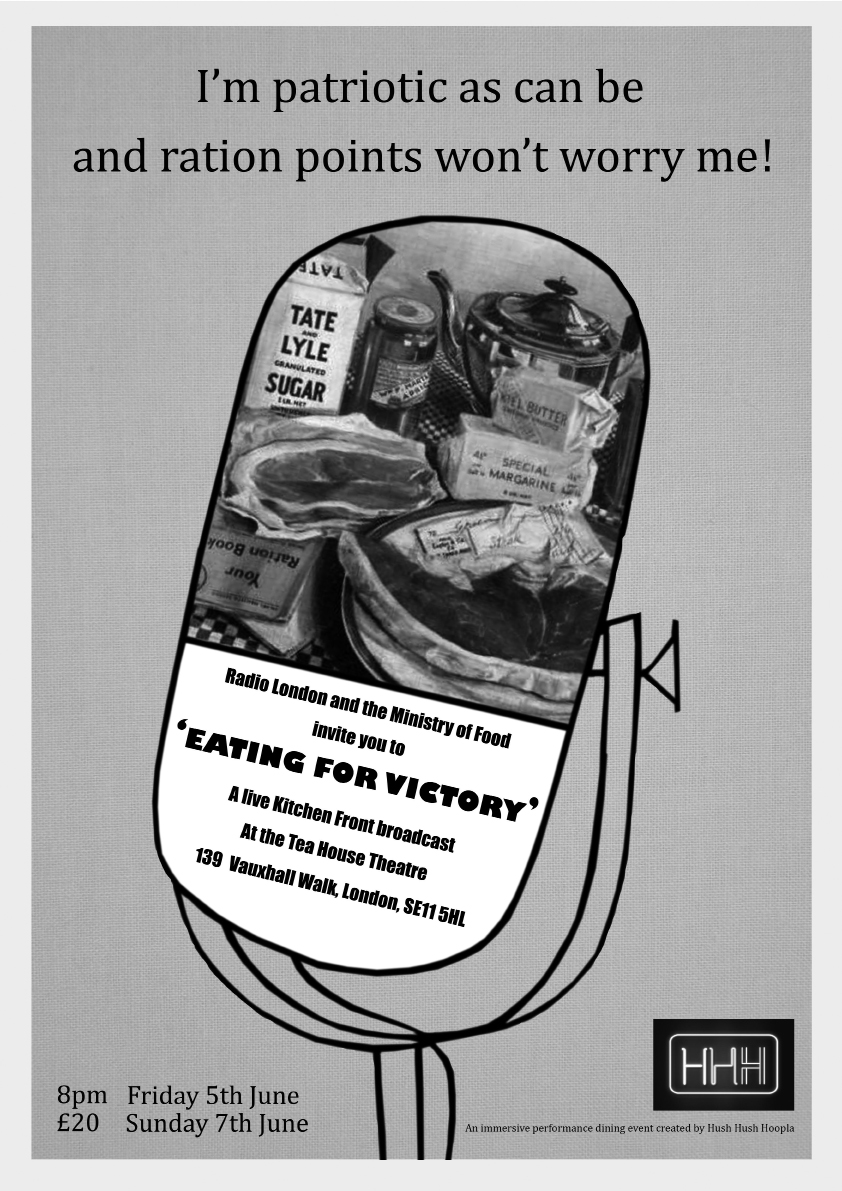
Designed by K. Fry and S. Sigal
Immersive Theatre in London
While establishing Hush Hush Hoopla, we were inspired by the variety of immersive work being made at the time. As both artists and as audience members, we analysed the various choices each production made concerning space, proxemics, design, performance, audience experience and dramaturgy. Looking back from 2021, it seemed the field of immersive and interactive theatre reached a peak in terms of popularity, visibility and innovation in the UK in 2015, when we were conceiving and making Eating for Victory. The rise of experimental theatre and performance converged with the rise of the “experience economy,” providing the right conditions for the expansion (in terms of scale, vision and budget) of immersive companies such as Punchdrunk, Secret Cinema, dreamthinkspeak, Coney, Shunt, Les Enfants Terribles and Teatro Vivo (Pine and Gilmore).
When considering what kind of process of performance and event-making we wanted to adopt as Hush Hush Hoopla, we considered the number of models used by contemporary immersive companies which revolved around a distinctive central element. Leading companies include Punchdrunk who focused on creating large-scale, highly-designed, detailed world-building; while Secret Cinema centred film screenings and built the performance experience around the themes in the film; Coney foregrounds immersive technologies as an essential element of their performances. However, we also felt it was important to consider the socio-political implications of these decisions and how the companies positioned themselves as a major part of what Adam Alston terms the “experience economy” (16). Companies like Punchdrunk and Secret Cinema came to depend on a model of using well-known classical literature, popular film or other canonical stories, as the basis for the creation of detailed, immersive worlds. We felt these works had become increasingly expensive for audiences while making merely passing reference to their chosen source, sacrificing the meaningful content of narrative and character development, in spite of their reliance on these works to give their work a raison d’être, in the service of what seemed like merely a memorable atmosphere. In Beyond Immersive Theatre: Aesthetics, Politics and Productive Participation, Alston attributes this trend in immersive theatre production to the adaptation of companies “to an emerging neoliberal paradigm” and a “neoliberal consumer increasingly offered personalised and experiential forms of consumption in an expanding ‘experience economy’” (16). He notes that immersive theatre is “preoccupied with the provision of stimulating and memorable experiences, and an objectification of audience experiences according to a logic that chimes with the commodification of experience elsewhere in the experience economy” (16). In Immersive Theatre: Intimacy and Immediacy in Contemporary Performance, Josephine Machon writes that the Punchdrunk approach “plunders” and “opens up” the “themes, forms and narratives in classic literary, cinematic and visual art forms,” using choreography and scenography in order to construct elaborate and multiple audience experiences (3). However, we felt that Punchdrunk and Secret Cinema had become so oriented around the ephemerally visual and the allusive that they missed an opportunity to draw more deeply from and build on the rich narratives and characters within their source material. In this way, we felt inspired as makers to create immersive experiences that provided audiences with detailed, extensive stories and characters.
As Hush Hush Hoopla, we wanted to create a distinctive event that was intimate and affordable and incorporated food into the performance. We looked to companies that created immersive dining events to understand how they worked with scenography, performance and narrative. Established in 2010 by Suz Mountford and Kerry Adamson, Gingerline HQ credits itself as having invented the “immersive dining” experience. Though the format has been adjusted and embellished over their decade in operation, the emphasis is on themed multi-course dining. Their early outings sat firmly within the emerging dining club scene in London—groups of people booked for a sit-down meal, often sharing larger communal tables with strangers to create a convivial atmosphere (Cooper n.p.). Until 2014/15, Gingerline HQ experiences were mostly embellished atmospheres for static diners. Tickets cost £45-£50 for a four-course meal in a themed environment and a limited edition print which also functioned as the evening’s menu. In HMS Gingerline (2011), the audience dined in a constructed mess hall, on a naval submarine conjured using custom film projections through portholes. Gingerline HQ launched The Lost Gardens of Gingerline in 2014/15 with a much greater narrative component than previous works. Guests were invited to a gala celebrating the centenary of the disappearance of Lionel Stirling Grey, first Earl of Gingerline, gardener, explorer, and flavourologist. The show featured headphones with stories, a performance ensemble and, for the first time, story and performance development were credited roles on the production team (Gingerline Group).
Hush Hush Hoopla Mission: From Russia to Rations
We took these critical observations and applied them to our own projects as we developed the ethos for Hush Hush Hoopla. Our mission was to fuse site-responsive physicality with text-based work and integrated dining, creating engaging characters and narratives that provided our audience with an intimate and memorable experience in which they were invited to explore different approaches to participation and collaboration. We made work that engaged with and responded to contemporary society and the current political climate, using research, drawing parallels between present issues and historical events, avoiding didacticism through a method of association rather than direct representation. Katharine comes from a background in live art, video art and choreography; her process is site-responsive, generating symbolic imagery, performance scores and structures through improvising with an environment or set of objects. Sarah’s practice is rooted in text-based work; her process is oriented around collaborative practice that combines text and devised material to produce story and character-driven performance.
The Spies Came in from the Cold (2014) was commissioned by Russian cultural centre Pushkin House in collaboration with chefs Russian Revels. During the event, guests were trained by actors as undercover agents by the KGB and CIA before being sent to gather secrets in agricultural production and food technologies at a 1950s international food expo. We drew inspiration from The Exhibition of Achievements of National Economy (a permanent general-purpose trade show and amusement park in Moscow, built in 1939) and two 1959 exhibitions to increase “cultural contact” between the USA and the USSR following years of tension and an escalating arms race, the American National Exhibition in Moscow and the Soviet Exhibition at the New York Coliseum. Though the event was rooted in history, we were cognisant that 2014 was the year of the Winter Olympics in Sochi and the Crimean Crisis, the latter resulting in the US imposing sanctions on Russia, and were curious to explore subtle parallels between the two time periods. The audience moved through six areas of Pushkin House. Upon arrival they were either given Russian names and missions relating to uncovering Soviet secrets for CIA, or American names and missions relating to uncovering American secrets for the KGB. Audience members were paired and encouraged to find their spy counterparts through mingling. For example, Nikitichna Yefimova, actually an American PA at Coca-Cola, looking to sell the stolen recipe to the highest bidder, might have met Bobby O’Dell, actually a Soviet factory owner who wanted to launch a Soviet version. The mission began with training. The two groups watched propaganda videos, one series focusing on the crumbling East, the other on the decadent West. The Soviet group met KGB Spymaster Tatiana and Spyrunner Yury to be trained in food traditions and toast-giving in the US, while the American group received similar training in Soviet customs from CIA Spymaster Charles and Spyrunner Rose, with both scenes playing on cultural stereotypes. The trained groups were released into the food expo to sample the wares and gather secrets. Their trainers also appeared, now as their undercover identities running the food stands. The event climaxed in the Valyut Nyj Soviet currency exchange bar where double agent Alice was identified and executed in a choreographed sequence. Her body was dragged away while the audience took to the dance floor.
With an audience of 50 people, a cast of five performers and six rooms to navigate, the Spies experience was intimate and involved. With a ratio 1:10, each performer was available to each audience member through the training, food expo, bar finale and their transitional interludes. There was time for 1:1 improvisations where performers could fully disclose their character background while the audience could experiment with their new identities, being as active or passive as they felt comfortable. Each audience member could engage with narrative content through group scenes and personalised 1:1 content. Through the Spies, we established our format and method to realise our mission: making affordable, inclusive, narrative-driven immersive performance with integrated dining that resonates with contemporary social concerns; a total event where everything from initial ticket purchase to the end of the night was part of the experience.
Eating for Victory, pictured (left to right): Annamaria Adams, Hayley Thompson, Oscar Blend, Erin Hutching
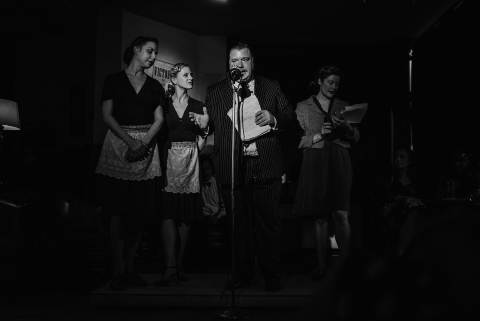
Photo by David Monteith-Hodge.
Eating for Victory
We developed Eating for Victory in line with our mission and following our established method and format. We wanted to create a politically relevant and thought-provoking experiential and intimate work that was inclusive and accessible, factually-based and story-led with ties between the narrative and the site’s history, that gave agency to our collaborators and to the audience, that was connected to the local community and did public good.
Eating for Victory was created for and staged in a former pub, set during the London Blitz where the performers taught the audience how to use their rations through the guise of a popular BBC radio programme “The Kitchen Front,” a real BBC programme broadcast during the war where two comedians gave their listeners tips for making the most of their rations. This was our starting point for a flexible and porous storyline that allowed for the insertion of fictional characters, played by professional performers and inspired by real people. The Tea House Theatre, a Victorian pub which had been turned into a cafe, served as a World War II-era BBC recording studio.
The narrative was as follows: Gert and Daisy, two famous comedians who normally hosted “The Kitchen Front,” were unavailable for the broadcast, so the BBC and the Ministry of Food (the purported sponsors of the evening) brought in two actors with no previous knowledge of the show or of cooking. As the new actors tried to host the show by improvising recipes, conflicts played out backstage with the alcoholic newscaster, the government minister making money on the black market, his wife secretly having an affair, and his assistant, trying to pull the evening together for the audience. Compounding the drama were the issues Londoners faced during wartime, such as rationing, blackouts, bombing raids and the threat of German invasion. While blackout curtains formed part of the set, wartime issues were discussed in announcements and through characters’ dialogue. When they signed up for the event, the audience were given identity cards of wartime Londoners and were invited to dress up in 1940s fashion. Throughout the event, the audience had opportunities to interact with the performers, watch the chorus of servers execute choreographed dances and try the recipes promoted on the radio programme in the form of canapés served in between scenes.
Responding to Contemporary Politics through Immersive Performance
The research and development for what became Eating for Victory started with a central question which framed the concept, content and logistics of making the work: how do we respond to contemporary politics in a “fun” and affordable immersive performance dining event?
We began by establishing a possible ticket price and audience capacity that would allow for the maximum number of people to have an intimate experience, while also providing an affordable ticket price for local residents of the borough of Lambeth, the 8th most deprived borough in London and 22nd most deprived in England. Having felt alienated by the Punchdrunk / Secret Cinema £50 basic ticket model (not including add-ons like food, drinks or VIP treatment), we wanted our show to be accessible to a wide audience while also paying our performers, chef and design team. We settled on £20 for the performance and a small plates meal with a reasonably-priced pay bar. This made the total spend for the full experience less than the cost of food and drink add-ons at larger immersive events, and the cost per head double the price of a value meal deal plus drink at the local Wetherspoons, one of UK’s cheapest pub chains. Our pricing was part of our strategy to build an inclusive event, to attract a diverse audience from the local community, encouraging people who might not normally spend on such events to engage with the arts. Next, we looked for a venue with capacity for 30 to 50 people. It was part of our ethos and rationale to let the venue suggest a theme. Creatively, this allowed us to work truly site responsively, unlocking the site’s histories through performance rather than fully transposing a completely new world onto an existing space. Practically, this reduced our costs as, by using what was already in the venue, we had less to design, build, install and strike, keeping both our production and hire budgets low.
We chose the Tea House Theatre, previously the Queen Anne pub built in 1886 next to Vauxhall Pleasure Gardens that survived WWII, bomb damage and slum clearance to become London’s oldest striptease venue before reincarnating itself as a cafe and arts venue. When we visited the Tea House Theatre and saw its Union Jack flag bunting, chintzy tea cups and cake stands and ‘Best of British’ vibe (ironic or otherwise), we instantly felt it an appropriate backdrop for a WWII-themed show while resonating with a pressing concern of the moment. 2015 saw the election of a Conservative majority government led by David Cameron, which followed five years of a Conservative-Liberal Democrat coalition government, also led by David Cameron. Following the 2007/08 global financial crisis, like much of the world, the UK was in a period of economic recession. Austerity measures were introduced as an apparent remedy, to balance the budget deficit and to reduce national debt as a percentage of GDP. Cameron declared that “the age of irresponsibility is giving way to the age of austerity (2009a: n.p.). As a direct result of budget cuts, the Conservative Party also introduced and set in motion the “Big Society,” a political ideology that involved reducing government intervention, to be replaced by grass-roots organisations, charities and private sector companies delivering public services more efficiently (“Government Launches Big Society Programme”). It became clear that the government had no intention of increasing public spending once the structural deficit had been eliminated and that the public spending reduction would be permanent (Watt). By 2015, five years into these programmes, the number of children living in “relative poverty” had increased and those accessing food banks had tripled, with over one million people in the UK using a food bank in 2014/15 (Mueller, Butler).
Against this backdrop of real suffering and deprivation, much like the nostalgic décor of the Tea House Theatre, the rhetoric of austerity and the Big Society harkened back to the “Blitz Spirit” of World War II. In the face of widening social, economic and geographic inequality, Cameron declared: “We are all in this together” (Cameron 2009b). The term Blitz Spirit has no concrete definition, rather suggesting a collective resilience and shared bond between people facing common adversity (Hatherley). It has been invoked by British politicians on both the Left and Right since the late 1970s, evoking memories of the 1940s when “hard choices” had to be made and everyone had to “muddle through” to legitimate claims that, despite appearances to the contrary, resources were scarce and sacrifices had to be made (Hatherley). The turn to the Blitz Spirit is epitomised by the “Keep Calm and Carry On” poster which resurfaced in 2008 and, together with its innumerable parodies, imitations and co-options which also appeared, was a notable meme in 2015. Though produced by the Ministry of Information in 1939, the poster was never actually part of the war propaganda machine; it was only to be used in the event of a German invasion to keep the public from panicking (Keep Calm and Carry On—The Compromise Behind the Slogan—History of Government).
Instead, its popularity was linked to the fallout from the credit crunch and an attempt in that moment of crisis to tap into a pre-established narrative about Britain’s “finest hour.” It is an example of what Douglas Coupland termed “legislated nostalgia” in 1991, something that “forces a body of people to have memories they do not actually possess” (Hatherley). However, much as the poster is a kind of fiction, so too is the “Blitz Spirit,” acting as a weak concealer for the awful reality of being bombed, so the “Big Society” conceals an unequal distribution of suffering. The introduction of “egalitarian rationing during and after the Blitz improved the diet of the poorest while the middle class saw a drastic decline in the quality and quantity of their food, the rationing rules could be sidestepped by the wealthy altogether. Drawing parallels between 2015 and the 1940s regarding austerity and inequality, we used our research into Britain and the Vauxhall area of London during WWII to inform our menu, sound, set and costume design, and the characters’ and audience members’ names, professions and storylines.
The political parallels we drew were intended to be subtle rather than didactic; we highlighted the similar social divisions and inequalities of both eras. This came starkly into focus with food inequality, from contemporary preventable illness caused by food poverty, poor diets and malnutrition to the historic loopholes used by the wealthy to maintain their pre-war standard of living. To spotlight this link and the social importance of food equality, we asked the audience to bring rations to be used as part of the cooking demonstrations for the evening’s menus while making it clear that these ‘rations’ would be donated to local food banks for distribution.
Scripting, Devising, and Rehearsal
One of the challenges of immersive, site-specific performance was to create a production flexible enough to allow for levels of audience interaction but also provide a storyline and rich, complex characters. In developing Eating for Victory, our process was divided into three phases: research, casting and character building; scripting and devising a narrative to develop a show structure; rehearsing the scripted and improvised material while considering possible audience roles.
Researching the period and building characters created a foundation for the project. We began with Britain during World War II, understanding what life was like in London during the Blitz, how people coped with rationing, blackouts, bombings, the evacuation of children and housing shortages. We built on historical research to create a central storyline and subplots and brainstormed ideas for characters, creating character sketches and then developing them with the performers, who were given an overview of the event, dramaturgical character briefs and a general understanding of intended audience experience. In line with our ethos, we incorporated the realities and politics of rationing, hardship and deprivation during WWII; the performers portrayed characters from a range of backgrounds, showing that the British experience during the war was by no means uniform. For instance, while Clarissa, the wealthy wife of the Minister of Food (played by Violet Patton-Ryder), complained about her cook’s difficulty in obtaining particular ingredients for dinner, BBC Radio actress Alice talked about the humiliation of having been bombed out of her London flat. We took the performers through a number of character-developing exercises, such as hot-seating (an improvisation exercise whereby the performer is questioned in character by the group in order to flesh out their backstory), so that they could personalise their characters. For example, the character of Michael (played by Paul Engers) was a BBC radio announcer. We knew that we needed a character who could function as a host for the evening, guiding the audience through the event and explaining the format. Engers helped us build a back-story for the character so that he would have habits, opinions, needs and fears on which the other characters could draw. The role of Michael not only functioned as an emcee but also lent the narrative an element of dark humour. Michael drank to alleviate his fears about bombing raids, so became progressively more intoxicated as the evening wore on, creating moments of comedy for the audience, while also conveying the underlying anxiety of a society at war.
We utilised a highly collaborative process of working, continually incorporating the input of the performers, designer and chefs into the process. We combined scripted speeches with devised scenes that were semi-formalised into a kind of dramaturgical road map, allowing for enough structure so that the show would stay on track each evening, but enough freedom for the performers to improvise elements each night and interact with the audience. This map anchored the event in the overall narrative journey and character arcs, indicating when a scripted speech or scene, dance sequence or course serving unfolded. As co-directors, we continually accounted for the various elements that went into the production, arranged and rearranged them. Sarah focused on the text-centred and dialogic work while Katharine focused on the physicality and choreographed sequences.
As a collective, we navigated the particularities of the venue’s architecture and how it would impact the dramaturgy of the piece, and the structure for the show evolved throughout rehearsals as the audience’s journey became clear through the process of this collaboration. We utilised the central space by using a platform with a mic stand as the focal point, serving as the area where the actors recorded their BBC programme. The audience were seated in a semicircle with gaps in between seats for performers to move amongst them throughout the show. The performers circulated throughout for intimate audience interactions and choreographed sequences, creating a balance between performances where the audience could relax as passive receptors and those which asked audience members to engage with the performers in order to learn more about the characters and narrative. Each character was given secrets to be revealed throughout the event, which incentivised audience participation and created a hidden layer of narrative and historical detail. The combination of the show’s dramaturgy and the shape of the performance space informed our use of focal points.
The third phase of rehearsal gave performers a coherent idea of the entire event and the way the story would unfold within it, as well as prepare them for possible interactions with the audience. We rehearsed as many moments of audience interaction as possible, preparing the performers to incorporate audience members’ questions and provocations. We devised ways to stimulate the audience, each assigned a WWII-era identity, complete with profession, name and identity card, by creating points of discussion and asking questions, using information based on historical research:
- How have you been coping with the nightly bombing raids?
- Do you have an Anderson shelter or do you go to your local tube station?
- Have your children been evacuated to the countryside?
- How have you been using your rations?
Together with the performers, we negotiated which scenes and speeches would be scripted and which would be improvised each night.
Food at the Centre
We chose to make performance centred around food for two main reasons: dramaturgical and socio-political. As the immersive performance format developed, audience members often came to be on site for three hours or more. We found that most events licensed an on-site food truck and bar, meaning the audience had to break from the immersive experience to queue for food that was overpriced and unrelated to the performance. We felt this oversight created a rupture in the flow of the event and wanted to find a dramaturgical solution to integrate food into each performance, with a single ticket price for everything (no add-ons, no extras, no displays of difference between audience members). Our ticket prices are deliberately low, encouraging diverse uptake; some people who might not usually attend art and theatre events might be tempted to engage as the cost mirrors an average meal out but with a little something extra.
We needed a context and format for Eating for Victory where talking about and eating food made narrative sense, during which critical socio-political issues could be debated. Using a radio broadcast with an educational cookery format that taught a live audience how to use their rations, we built an overarching storyline that allowed us to incorporate the dark side of nostalgic culture; a hollow patriotism that contrasted dutiful suffering with the double standard of wealth inequality. We asked our audience to bring their “rations” ready for their cookery and nutrition lessons, making it clear that in reality we were asking for canned goods to donate to two local food banks.
We worked closely with chef David Salt during the R&D, looking at recipes and ingredients from the time, what food would have been available, and how it might have been prepared. The narrative arc and structure of the performance was influenced by the timing and serving of the food courses. There were nine food courses, which necessitated nine sections to the show. Each course was announced by the Minister of Food’s assistant Prudence (played by Erin Hutching), who was liaising with the chef backstage to check if the food was ready and had cue sheets for extending moments of improvisation and interaction. The food was served to the audience by a chorus of four servers. Each course was followed by the chorus performing a themed choreography to a period-specific song. Members of the ensemble cast of six performed a sketch, monologue or dialogue, opening out into improvisation and audience interaction while the audience were eating.
Each item on the menu and each stage of the performance was carefully designed; the dishes reflected the WWII rationing diet while the interplay between the radio hosts, the government officials and their entourage and the chorus served to highlight the disparities between them. The officials were revealed as privileged, out-of-touch and unaware of daily hardships faced by much of the population while they superciliously suggested “we’re all in it together.” This attitude and slogan echoed the contemporary divisions between the ‘have and have-nots’ under austerity measures. For example, “Dig for Victory,” a raw and cooked summer vegetable garden, was served with sauce and olive ‘soil’ in soldiers’ helmets. The audience learned about the importance of Victory Gardens and growing vegetables (which weren’t rationed) while some characters made it clear that not everyone had access to a garden nor the time to tend it. The chorus performed a helmet dance as a locomotive train to Billy Cotton’s Wish Me Luck As You Wave Me Goodbye. Each course, its contents and presentation, was treated as an integral part of the narrative.
Designing Audience Experience
We designed the audience experience for Eating for Victory so that the immersion would be intimate but boundaried to maximise the possibilities for participation. It was important to create the right balance between the performance (both dialogic and choreographic), use of the space and food, to make sure that the elements complemented each other. We turned the Tea House Theatre, not into what Alston calls an “experience machine,” to be swept up in an escapist and artificial environment but rather, a space for safe interaction and exploration for the audience (2). Although we wanted Eating for Victory to convey a sense of the inequalities Londoners experienced during the Second World War, we also wanted a tongue-in-cheek sensibility, which we hoped would counter-balance the element of vulnerability inherent in performer interactions. The identity cards sent to the audience implicated and immersed them in the period, anchoring their engagement with Eating for Victory and giving them the option of researching their “character” beforehand. Upon entering the venue, audience members were encouraged to engage with the story of the BBC/Ministry of Food radio show by the performers who approached them with questions. They were treated like characters in the story with their own given circumstances. When Clarissa asked audience members how they were using their rations, they could respond by drawing on their 1940s identities while learning more about her character from the way she responded. Whenever someone asked her how she was using her rations, she would explain disdainfully that her cook took care of meal preparation. The audience was given tacit rules by which to play the “game” of participation as the performers encouraged them to make comments and ask questions by introducing topics and sharing titbits about their characters’ lives. We found that by making the audience understand the boundaries of the event and the world in which it was set, we were able to engender a relaxed but creative environment.
Once the more formalised, non-participatory performance began, the audience alternated between moving freely through the space to try the food and buy drinks from the bar, interacting with the performers and watching scenes and dance sequences play out. The event as a whole was divided into scenes that corresponded with the courses, which also followed the general storyline of the BBC broadcast, falling apart under the strain of the participants’ wartime anxieties and deprivations. A three-part format was used for the duration of the event: a scene would play in front of the audience that required some audience participation, a corresponding course would be served and then the audience would have a chance to chat with the characters about the scene they had just watched and the food they were eating. At the end, the performers invited the audience to dance to swing music, as a gesture of the celebration of community and survival. The ambiance of London in 1941 was always presented in a spirit that bordered on the tongue-in-cheek, keeping the audience connected to the constructed, performative nature of the event. For instance, the menu featured names of courses such as “Rabbit Run and Mushroom Hide” and “Don’t Bubble and Speak.” The performers serving the food, playing waitstaff, wore kitschy uniforms and performed Busby Berkeley-style dance routines.
Conclusion
Eating for Victory was created on a budget a small fraction of the size of any event created by Punchdrunk or Secret Cinema. While this posed a number of limitations for us, it also created a number of opportunities for different ways of conceiving an immersive theatre event. We learned that if the budget for an event is limited, it is paramount to begin by choosing an atmospheric but affordable venue, as the venue will likely be the primary expense. We also discovered that small-scale immersive events such as Eating for Victory enable more intimate audience experiences and more accessibility in terms of ticket pricing, which had the potential to attract audience members from broader socio-economic backgrounds than would normally be able to afford a large-scale, expensive immersive event priced at £50 or higher. We found that a diverse audience in terms of background and identity enriched the improvisations that arose from the audience-participant/performer interactions. We capitalised on the intimacy of the venue and the social nature of the layout of the former pub to encourage the audience to explore the space and interact with each other, as well as the performers. We designed the structure of the event so that the audience could experience the pleasure of interaction, having the option of minor but meaningful creative input into the stories and the dramatic arcs of the characters, without being obliged to participate.
As producer-directors, we learned that we could capitalise on the resources we had in order to immerse the audience in the stories that played out over the course of the evening, rather than rely on a set, props and costumes to create a holistic atmosphere. One of the advantages of working in the Tea House Theatre was that it already featured a number of interior design elements that spoke to an early-to-mid-20th century aesthetic (wooden floor boards, floral tea cups, bunting), which meant that, apart from mounting a number of wartime propaganda posters on the walls, we didn’t have to invest in a great deal of set design. When we were searching for venues for the event, we had a number of possible stories and themes in mind that could be adapted to different kinds of spaces, and our decision to create a Blitz-era performance was informed by the character of the Tea House Theatre and its resonance with contemporary politics. The choice of London in 1941 proved a fruitful setting to mine for stories and characters for the performance as well as recipes for the menu. Our chef based the menu on ingredients and recipes from the period, altering them to suit the needs of the event. In collaboration with the performers, we created a central storyline with a number of small subplots that the audience could watch but also engage with in solo, pair and small group interactions. In this way, the sense of immersion was created through rich, complex storytelling and character building. This collaboration was perhaps the most important element in the process of making Eating for Victory: the creativity, ingenuity and generosity of our performers, chef and designer allowed us to co-create a vibrant, three-dimensional production.
