
In September of 2019, at a production of an immersive theatre experience inspired by Alice’s Adventures in Wonderland titled Then She Fell, I am ushered into a girl’s boudoir. A vanity table and mirror sit in one corner. A young actor portraying Alice (Serena Chang) gently takes me by the hand and guides me to a wall of Victorian-era dolls and asks me to choose my favorite one from the seemingly endless variety that line the shelves. After I choose a small doll with dark hair and a white dress, looking not unlike the Alice before me, she asks me questions about love. “When is the last time you got dressed up to see someone special?” “Recently, actually…” I reply. “Are you in love with her?” “Not sure yet,” I say, but “no” should really be the answer. Alice then sits in front of the vanity mirror and invites me in the gentlest of voices to brush her hair. As I hesitantly do so, I am aware of the delicacy and intimacy of this moment. I am overwhelmed by the sweet-smelling softness of her hair as I tenderly brush it per her request. Disarmingly, Alice quite unexpectedly asks me about the pain of being in and falling out of love. This charged emotional and physical moment is sensual, chaste, and uncomfortably intimate all at the same time. Alice then turns to me and asks a final and very personal question: “Did you ever tell someone you didn’t love them even when you really did?” I search my memory bank of feelings from past relationships. Perhaps? “Most likely,” I evasively reply, “but I can’t seem to recall when.” The intimacy of the moment is broken when Alice stands, turns to me, and says: “It’s time for you to go now.” She ushers me out of the room where an orderly leads me further down the hallway and, consequently, deeper into the immersive theatre production that is Then She Fell.
Then She Fell was produced by Third Rail Projects, a Brooklyn-based devised dance/theatre company. The show opened in October 2012 and ran until August 2020 when it was forced to close due to citywide restrictions on indoor events put in place in response to the COVID-19 crisis. Written, directed, and choreographed by the company’s artistic directors Zach Morris, Tom Pearson, and Jennine Willett, the show is a fully immersive, multi-sensory experience inspired by the life and writings of Lewis Carroll. Immersive theatre has come into its own in the last two decades in New York City with the success of companies like the Builder’s Association, 3-Legged Dog, and Punchdrunk. Then She Fell continues this trend of immersive performance, promising on its website “an Alice-like experience for audience members” (“Then She Fell by Third Rail Projects: About”). Only fifteen people can attend each performance of Then She Fell. Originally, the target participants for this immersive piece were twenty-one-to thirty-five-year-olds. The show’s appeal, however, proved much broader as evidenced by its popularity over the past seven and a half years. The success of productions like Then She Fell is due to the sensory stimulation and intimacy of the performer/participant interactions and the in-person immersive theatrical experiences such connections create.
Performance scholars tend to examine how immersive theatre practices activate an intellectual, conceptual, or emotional response from participants. In this essay, I wish to trouble and challenge this notion of how immersive performances are presumed to activate participants through a performance as created by theatrical professionals in order to awaken the participants to their own perceptions and understandings. In addition, I would like to question performance scholar Robert Walton’s notion that immersive theatrical artists are attempting to create “bewildering behaviours” that somehow shake audiences out of their complacency by actively engaging with participants through “mystifying” theatrical techniques associated with participation and immersion in performance. As Walton states, “many immersive artworks require the audience-participant to instantiate them—that is to activate, enliven, and sustain them performatively” (124). Audiences for immersive theatre come prepared to receive, feel, and experience through the body via “the full range of the human sensorium,” as Josephine Machon suggests, even before they enter the theatrical space (110). The theatrical event, however, is not somehow unfinished, as in Robert Walton’s estimation, where “the medium of the work is the live relationship between people within an environment rather than a finished art object, film, or play. Without this instantiation, this work itself does not exist” (124). According to Walton, the participants must somehow finish the theatrical performance or artwork for it even to exist at all. However, it could be argued that all live theatrical experiences are unfinished by definition, as theatrical productions do not exist without performers and participants to activate a text or event of any kind.
What these theoretical commentaries on immersive performance still do not explore is what it means for an audience to respond to any given live performance. Individuals’ subjective responses are their participation in the performer-participant relationship and are necessary for any live performance event to come into being. Therefore, it should be asked, how is immersive theatre any different than other forms of theatrical production that occur on stage? To this end, I expand on Machon’s theories for stimulating the audience through their sensory engagement as a completely subjective experience for each participant. The human sensorium is experienced and responded to individually even though all participants are immersed in the same complete choreographed world. As Then She Fell illustrates, somatic interaction can bridge the gap between performer and participant in order to connect and engage all the sensory perceptions that the traditional nineteenth-century proscenium, fourth-wall theatre was not designed to achieve. The value of somatic evaluation in performance exists in the way it places both participants and creators/performers into a symbiotic relationship that shares cognitive cultural, physical, and emotional stimulants.
As I argue here, the nature and purpose of immersive performance as witnessed in Then She Fell can and should be accessed by any participant through the somatic experience. The in-person immersive environment engages the senses, and this is what bridges the gap between those who create as performance practitioners and those who participate in the somatic experience: there is a meeting and convergence on both sides of the theatrical valence. With immersive theatre projects such as Then She Fell, senses are stimulated as participants are ready a priori to receive and engage with the immersive experience through sensory stimuli. Josephine Machon reinforces this notion, writing that “immersive theatres can establish links across sensation, perception, emotion, and moral reasoning in form and content.” During the action of immersive performances, the participants or “inhabitants,” as Machon calls them, “dwell in time and in space just as they dwell in the activity [emphasis in the original] within the duration of the event and equally dwell, attentively, in their own bodies” (142). Therefore, deprogramming predigested and inherited physical and emotional responses through somatic interaction between performers and participants is at the heart of immersive performance.
In order to evaluate and trace how somatic practices operate between performer and participant in contemporary immersive performance, I turn to my experience with Third Rail Projects’ production of Then She Fell, which I attended on 15 September 2019. Then She Fell is evaluated through the experience of this immersive work where the performer/participant relationship is an equal and shared experience and the performer and participant work in a co-dependent way to create meaning in the moment of a live performance. I focus attention on the location of the event—a three-floor, century-old, institutional facility in Brooklyn, New York, named The Kingsland Ward, St. Johns—in relationship to how the theatrical space, performances, and dramaturgy, transformed through design and choreography, become a dynamic environment where the participants or “inhabitants […] dwell, attentively, in their own bodies,” as Machon points out. Through sensory stimulation in which the participant “dwells” in the five senses of sight, sound, smell, taste, and touch, immersive performance allows the participant to become an inhabitant in the live theatrical experience.
Focusing attention on key scenes that employ sensory stimulation and participants’ personal contact with performers, I examine how the production turns the alternative reality of love and madness that Alice Liddel and Charles Dodgson inhabit into a subjective and personalized performance for all participants. I use my own experiences with Then She Fell to examine the immersive performance process and the sensorial possibilities it provides. As a participant, I was often the sole person present in a given moment. I draw on this firsthand experience to describe the intimacy of the show’s various theatrical components, focusing attention on five specific scenes: the introductory shell game with the Doctor, the Mad Tea Party, the “deflowering” of the White Rabbit in the Rose Room, the Mad Hatter’s haberdashery, and the act of the White Queen and participants spying on an intimate moment between the Red Queen and the White Rabbit.
The title of the production, Then She Fell, reminds us of Alice’s endless fall into the rabbit hole that leads her to Wonderland. Performers and participants are cross-pollinated, shaping the scenes and events through their presence and interaction with the physical and emotional states of characters from Alice’s Adventures in Wonderland as envisioned by the obsessive and predatory soul of its creator Charles Dodgson (writing under the pen name Lewis Carroll). Dodgson’s own sensory stimulations, stemming from his relationship with the prepubescent Alice Liddell, haunts performers and participants alike throughout this immersive landscape. In a world of heightened sensory awareness, Then She Fell engages the entire human sensorium, thereby creating a personalized performance experience for all involved. Participants, performers, and stage crew interact in this live theatrical event to create a rich environment of sensual fantasy, dark eroticism, and guilt-ridden desire alongside joy-filled moments of madness and love.
Marissa Nielsen-Pincus as Alice from the original cast of Then She Fell, 2012
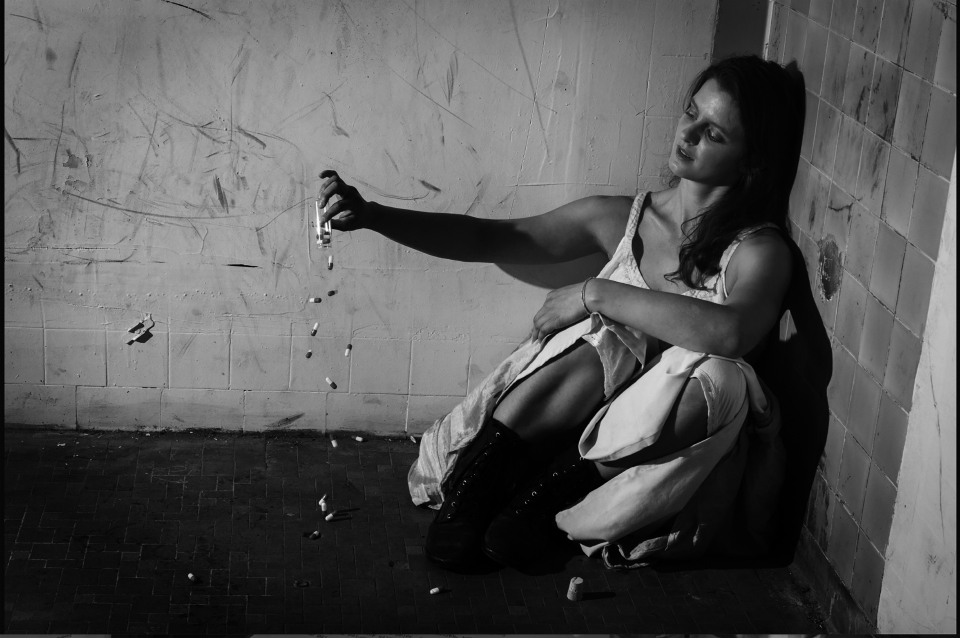
Photo Credit Adam Jason Photography used by permission.
Then She Fell, with its emphasis on the stimulation of the senses, offers participants a connection to disruptive and affective immersive practices. The immersive experience in Then She Fell begins immediately upon the participants’ arrival at the former Kingsland Ward in Brooklyn. Participants are randomly placed in groups, which leads to many being separated from those with whom they arrived. This is quite different from a traditional theatre experience in that participants, unmoored from their comfort zone, experience the performance surrounded largely by strangers. The performance itself becomes a journey through various states of physical and emotional volatility. The title of the production captures the fear associated with this condition of unbalance and loss of control. It reminds us of the perpetual state of “falling” (e.g., falling in love, falling as in a dream with no ending in sight, being tricked or falling for a gag or lie) that is at the heart of Then She Fell.
The rethinking of the audience as participants and collaborators in the performance event can also be seen in the physical environment of Then She Fell. The set design and scenic environments play an important role in stimulating the participants’ senses and provoking their subconscious sensibilities. The work is performed in a three-story building nestled in a residential section of Brooklyn’s North Williamsburg neighborhood. The former Kingsland Ward, St. Johns has been converted into a theatrical space. When participants arrive, they wait outside on a Brooklyn stoop. Then, entering one and two at a time, participants are greeted by an actor playing the part of an orderly of the Kingsland Ward. The orderly guides the participants to a waiting area and asks them to sit along the edges of a musty room reminiscent of an early-twentieth-century doctor’s office. There they wait until all fifteen participants are gathered. The participants are offered a deep red, port-like wine to drink before being asked to give up their personal items, including all communication devices, as one does upon entering a hospital or jail. This serves to redirect the participants’ attention away from the distractions of screens and social media devices.
The environment has an eerie, monastic silence to it that produces a feeling of anticipation over what is to come as well as a sense of anxiety similar to what one might experience waiting to hear about life-altering test results from a physician. Participants sit in relative silence with only a few people occasionally whispering to their companions. Each is being stimulated by the taste and smell of the wine and the scent of the musty room, as well as the physical proximity of the fourteen other “patients.” An unidentified doctor (Gierre Godley) enters the waiting area and welcomes participants. He outlines the primary rules of engagement: no speaking to performers, only respond when asked a direct question, and no interfering with performers physically unless requested by them.
The next scene begins in the waiting room where I am chosen by an orderly to go alone to a large open room with a long table where there is a small locked wooden box sitting at one end. I am directed to sit in front of the box at the far side of the table. I am offered another drink of a dark red liquid in a small sherry glass. The orderly leaves me alone in the room where I sit and wait in silence. It feels like a very long time, but in reality, it is probably only a minute or two. Then a “doctor” abruptly appears. He enters the room but does not speak. The entire scene between the performer and me is conducted in silence. Sitting opposite me, the doctor suddenly places three tea cups on the long table in front of him. Under one of them, he carefully places a key. A shell game ensues. The doctor moves the inverted cups in intricate patterns before him, and after several passes, he stops and points, asking me through silent gestures, “Which cup is the key hidden under?” I choose correctly, and he then sends the cup across the table over to me. He suddenly gets on top of the table and crawls down the full length of it like a feral cat. He reminds me through his gestures of the Cheshire Cat who famously tells Alice: “We’re all mad here” (Carroll 73). The doctor stops in front of me and looks at the cup and the box. I lift the cup with the key under it. He wants me to open the box with the key. Then as quickly as he entered, the anonymous doctor jumps off the table and rushes out of the room, leaving me alone once again. I am left to unlock the box by myself. In it, I find a letter about love leading to madness written in the form of a poem.
The sudden movements and sheer intimacy of being in a room alone with one sole performer creates anxiety and titillation in the participant. The events and atmosphere engage the non-distal senses and charge the moment in ways that sitting in an auditorium in a traditional proscenium configuration cannot. There is a significant difference between this solitary immersive performance and what occurs in a traditional collective theatre event. The solo participant does not have the ability to read the responses of fellow theatregoers and react along with them in a comfortable “we are all in this together” way. This is another experience entirely. The anxiety of being left alone in a room for a few minutes before the doctor even arrives, and then being left alone again in anticipation of the next event creates an opportunity for introspection. It allows for an evaluation of the senses and a reflection on the feelings that have been produced by the sensorial stimulation. It should be noted that time, throughout Then She Fell, appears to be suspended, as neither acts nor scenes are demarcated as one event flows into the next, nor is there a playbill where audiences can track the progression of the action as in a traditional theatrical performance.
The choreography of Then She Fell disrupts the logic of narrative dialogue and storytelling. The body becomes the primary mode of communication. This is especially useful for mapping the intricacies of madness represented in the production. The world of Alice Liddel and Charles Dodgson is a labyrinth of mad attractions. The production is a map of consciousness that leads participants through this labyrinth into their subconscious by invigorating their senses. Then She Fell is a journey of randomly assigned events where participants must navigate a voyage that brings them all further and further down the rabbit hole into their own subconscious desires and fears. The lack of cause-and-effect connections between scenes in the production stimulates the participants’ engagement. Moving in and out of environments as in a fever dream, participants are incorporated into each scene by the performers they encounter. Participants are treated as if they are characters in the unfolding action before them. One event that clearly illustrates this journey into the subconscious is the well-known “Mad Tea Party” scene adapted from Carroll’s original Alice’s Adventures in Wonderland.
The Mad Tea Party begins as performers and participants are suddenly thrown together. Sitting silently following my encounter with the doctor and our intriguing shell game of tea cups, three new performers—the Red Queen (Jaime Graham), the White Rabbit (Justin Lynch), and the Mad Hatter (Jessy Smith)—along with three other participants barge into the room. Then a choreographed sequence of manic seduction between the Red Queen and the White Rabbit unfolds. The participants are subsequently gathered around the party table by the performers and encouraged to sit in varying-sized mismatched chairs. The performers quickly and precariously set up mismatched cups, saucers, and spoons along the sides of the table. A frenzied tea ceremony where cups, saucers, and spoons are presented in a choreographed ritual that will spark this iconic event begins in mid-action as performers encourage participants to quickly find a seat. Just as the participants sit down, the performers insist they immediately move one seat to the right. Participants are barely able to rest before they are forced to move again in a mad game of musical chairs. The movement is crazed and intense, as there is a constant circling around the table as participants try to keep up with the rules of the tea party game. The ritual becomes faster and more frantic as the complex choreography of tea-drinking and stirring spoons spins out of control into a collective body-madness.
Unlike the more intimate interaction between me and the doctor, scenes like this one which involve three or more participants become an opportunity to observe each other, and a more playful solidarity forms between participants. These group gatherings provide a much-needed release from the scrutiny of being the only participant who has to engage with performers. Participants in group scenes can observe each other and take cues from the others as in a children’s game where the rules are being made up on the spot. A more playful and buoyant atmosphere is created, which stands in stark contrast to the one-on-one scenes of performer and participant. In addition, there is also a personal and unspoken interaction between performers not directly involving participants that can be observed objectively. As an example, the White Rabbit and the Red Queen appear to be in an adversarial relationship with each other in this moment. This is revealed in the speed by which they carry out the tea cup ritual and in the competitive and compulsive ways they move from seat to seat around the table. The Mad Tea Party ends as abruptly as it began, without warning or transition. The Red Queen becomes frustrated and angry. This is in response to the Mad Hatter, who has been encouraging the frantic competition between herself and the White Rabbit, even as the game was devolving into chaos. When the Red Queen suddenly stops, angered at the defiance of her subordinates, she leaves the room in a fury. Led by the White Rabbit, I am encouraged to follow the Red Queen out the door, chasing after her down a long institutional-style hallway.
The White Rabbit leads me to a twelve-by-twelve-foot room for the next mad interplay between characters. This room feels more confining than the previous ones because the walls and tall ceiling are covered with rose blooms and the floor with dozens of scattered thorny rose stems. The scent of roses is overpowering. The White Rabbit invites me to sit next to a butcher block upon which sits a very sharp and long knife. A single red rose lies next to the knife in a menacing still-life image of potential sacrifice. The smell of roses mingles with my own scent and that of the performer playing the White Rabbit who is in such close proximity. The Red Queen enters with stealth speed and then shuts the door with a quiet but firm hand. There is clearly some combative and sensual relationship between the two characters, signaling to me that this interaction between the Red Queen and the White Rabbit has been acted out in a continual pattern for quite some time. With the precision of a surgeon, the Red Queen picks up the knife from the chopping block, and with a swift, sharp, and shockingly simple movement, she severs the stem from the rose bloom. The Red Queen then delicately places the rose bloom behind the ear of the White Rabbit. In this intimate moment, alternating between violence and sensuality, I have become an unacknowledged participant in the proceedings of this claustrophobic space.
I am forced to witness at close range the Red Queen silently menacing and titillating the White Rabbit. I am becoming a complicit witness. While maintaining eye contact with the White Rabbit, the Red Queen moves backwards out of the room. The White Rabbit remains seated, enthralled by her. After the Red Queen leaves, the White Rabbit takes the bloom from behind his ear and places it in the wall of roses. The flower joins hundreds of others that have suffered a similar fate. The ritual of the cutting of the stem from the rose, the Red Queen positioning the rose behind the White Rabbit’s ear, and the White Rabbit subsequently placing it on the wall of other roses recalls a kind of ritual sacrifice with overtones of castration and sexual desire. Even though I have done nothing but observe this moment of intimacy through my sensory engagement with the Red Queen’s and White Rabbit’s movements and intentions, I feel like I have participated in this bizarre, erotic, and emotionally violent interaction.
I am left alone in the hallway by the White Rabbit, who then disappears into another room, presumably for his next scene. The Mad Hatter finds me there alone in the hallway of the Kingsland Ward and offers me another strong red wine as if it were medicine. The Hatter then ushers me to the next scenario of madness. As we move quickly along the hallway, the Hatter suddenly stops in front of a doorway and asks: “What did you do before you came here today?” (Morris n.p.). Perhaps it is because of the drinks or the close proximity of the performers or the strange dreamlike world I have been journeying further and further into, I honestly cannot remember anything that happened to me in the outside world that day. The Mad Hatter, sensing my loss for words and baffled hesitation, whisks me into her haberdashery workshop without waiting for an answer.
The next scene happens in the Mad Hatter’s workshop after another participant suddenly appears from an alternate door in the room. We two are alone with the Mad Hatter. The Hatter literally climbs the storage shelves lining the walls. They contain an immense variety of hats, not unlike the rose blooms that lined the walls and ceiling of the room from which I just came. When the Hatter reaches the top of the shelving, she casually lies atop this monument to haberdashery and begins to ask a series of rapid-fire questions, including the famous question from Alice’s Adventures in Wonderland: “Why is a raven like a writing-desk?” (Carroll 77). It is a question for which there are an infinite number of answers. Neither I nor the other participant, however, dares to respond. However, even not responding to a performer becomes a source of dramatic tension as the expectancy of what will happen if a participant is not able to, or unwilling to, respond can be taken as an affront or potential confrontation by a character. The Mad Hatter, for instance, visibly shows her frustration that the participants simply cannot keep up. This exasperation from a performer, especially with a character like the Hatter, whose impatience and manic energy makes the scene even more intense to begin with, provides an Alice-like sense of confusion and embarrassment from both participants and performers alike.
I am asked by the Mad Hatter to pick up an inkwell and plastic dip-pen so I can take dictation for a message she is addressing to Alice. The Hatter dictates the letter so quickly and with constant changes that I cannot keep up. While spouting her font of dictation, the Hatter adjusts then rejects several hats she has chosen for my fellow participant to wear. Then the Hatter suddenly stops and asks me to read the dictated note back to her. I just see a blur of black ink on white paper. To add to the madness, I realize that in my nervousness I had been holding the dip-pen upside down. I had been writing with the top of the pen. What I produced was only a blur of ink and a collection of nonsense scrawls. In addition, my right hand consequently is covered in black smears. The Mad Hatter in her frustration with me and the other participant, for whom she cannot seem to find a hat, suddenly throws us both out of the room and into the hallway, slamming the door behind us.
Tom Pearson as The White Rabbit and Rebekah Morin as The Red Queen from the original cast of Then She Fell, 2012
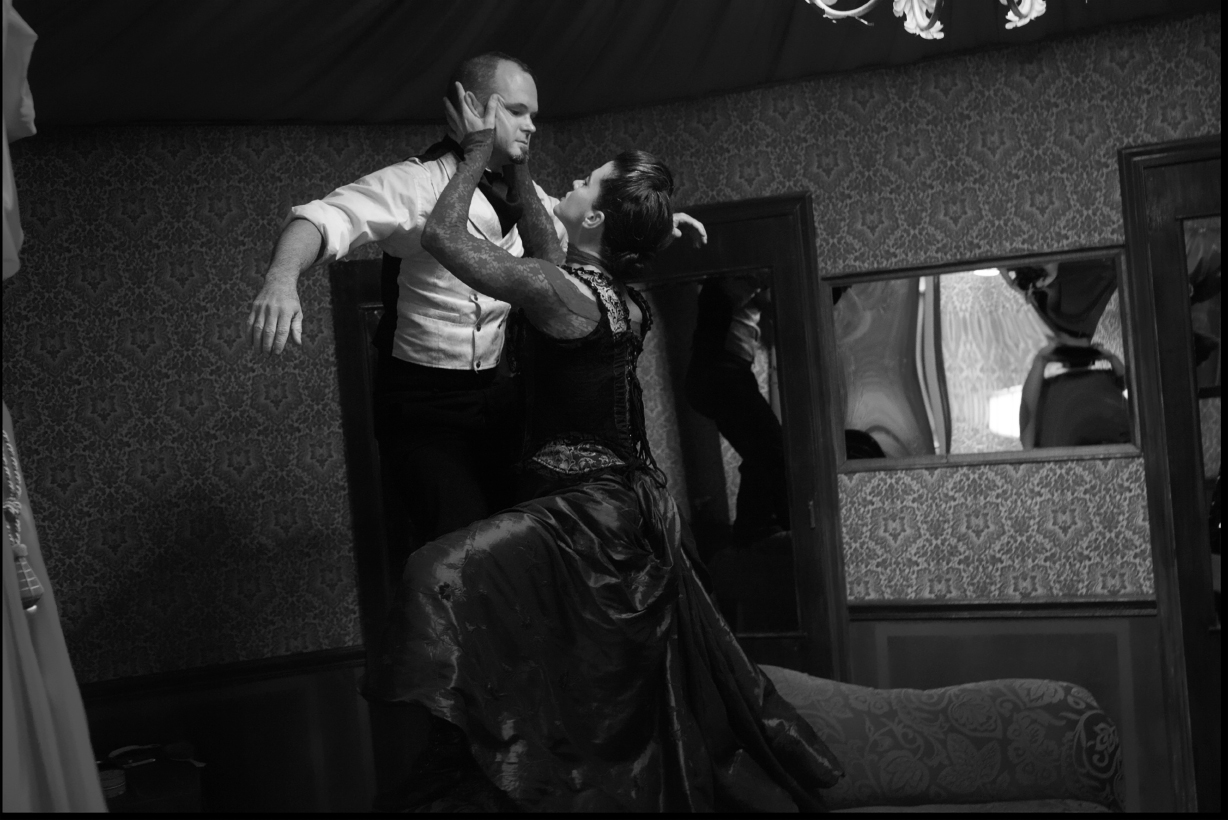
Photo Credit: Rick Ochoa used by permission.
The final foray into madness that brings all of the senses and characters from Then She Fell together in one attraction features the White Queen (Lindsey Ferguson). Four participants are now asked to enter a Victorian girl’s playroom. The White Queen greets us, and taking me personally by the hand, she sits me at her feet. She then gets up on a small table and perches herself directly above me. In a corner of the room, unseen at first, Alice sits silently observing performers and participants alike. The White Queen then takes a bowl of grapes from the table, and offers me one that she holds just over my mouth, expecting me to eat out of her hand. This ritualistic feeding is followed by another dark mystery drink to wash it down. The White Queen then proceeds to do the same with the other participants in the room, as if it is a private performance just for Alice’s benefit. The intimacy of this encounter with the White Queen is eerily erotic, and the vulnerability of the participants, including myself, is palpable. A mirrored wall opposite me is suddenly lit from behind, rendering the opaque surface transparent. It is offering a view of a room through another looking glass.
We are now encouraged by the White Queen to watch what happens: it is a scene within a scene. Suddenly, we are voyeurs looking through a two-way mirror into the private world of an adult woman’s boudoir. The furniture is of a dark red velour. A Victorian fainting couch is featured in the center of the room. The Red Queen leads the White Rabbit into her private chamber, and a darkly erotic game of domination begins as the Red Queen forces the White Rabbit into sexual submission just feet away from us. Participants are watching something truly forbidden. It is both fascinating and unnerving as the White Queen, now with her arm around Alice, observes us and our reactions to this forced intimacy with seemingly innocent glee. Looking through windows, doorways, and mirrors encourages voyeurism of illicit events for participants. Again, as in the Mad Tea Party scene, we take our cues from performers and fellow participants. Performers appear to be titillated by the curiosity and obvious enjoyment of intimate moments between characters. This is reinforced here, where the White Queen is quite pleased with herself for getting participants to expose their desire, witnessed when participants are not able to look away from something that they know they should not be observing, not to mention taking pleasure in the characters’ discomfort and distress.
Windows, doorways, and mirrors are used throughout Then She Fell as portals into private worlds where this subconscious journey is performed. The scene featuring the White Queen illustrates how all the sensory stimuli are enacted in the same place and time. Immersive theatre participants are directly connected to the world of Alice Liddel and Charles Dodgson tactilely through taste (grapes, wines, ink); smell (scent of performers and participants in close proximity, Alice’s hair from the brushing sequence); touch (actors guiding you through the building, sitting next to each other at tea party, participants taking frantic dictation with ink on their hands in the Mad Hatter’s haberdashery); and sights and sounds of voyeuristic curiosity as participants look and listen through windows, door-frames, and two-way mirrors into small rooms and private spaces. It is from the stimulation of these subconscious sensory states that we evaluate our relationship to each other and to the performers. Immersive theatre allows one to participate in the same way that dreams lead you through an internal logic that arouses your anxieties, fears, joys, and desires from the consciousness of the quotidian world. An immersive performance like Then She Fell serves as a visceral and tactile sensual experience for participants in real time. It allows them to follow the characters down the rabbit hole of subconsciousness through the human sensorium.
In the final moments of Third Rail Projects’ production of Then She Fell, I am escorted alone by the performer playing Alice to a tiny space with a writing desk located under a stairway. As if in answer to the Mad Hatter’s question: “Why is a raven like a writing-desk?,” the raven-haired Alice gives me a folded piece of paper with a poem authored by one of the originators of Then She Fell, Zach Morris. Alice then leaves me to read in silence as I wait to be ushered to the original waiting room where the performance began two hours before. Written to seem as if Charles Dodgson penned it for Alice Liddel, the poem synthesizes the overarching journey of sensations of Then She Fell:
I dreamt we were dreaming a dream together you and I, and we were trapped in a house, big as memory. Countless doors. You were there. I could hear you laughing, but I only caught glimpses of you in the glass. Eventually I gave in and found myself staring at myself, reflected. Looking at myself looking back at me. Both of us trying to decipher the face that was in front of us. (Morris n.p.)
Sensory provocation as a window into self-reflection is a recurring leitmotif in Then She Fell. This final and fictional missive to Liddel from Dodgson is really a poem to all of us as participants. The power of immersive performance allows us to enter the Liddel/Dodgson dream-madness world by encouraging our emotional self-awareness through sensual physical stimulation. Both performers and participants dream together as we move through the looking glass and down the rabbit hole of our fears, anxieties, and erotic desires.
Due to the Covid-19 pandemic, after seven and a half years and 4,444 performances, on 10 August 2020, the artistic team for Third Rail Projects sent out a press release explaining that Then She Fell would be closing permanently. The press release begs the following question: can immersive theatre practices be translated to our present online performance reality? As social distancing forces us as a human collective on a worldwide scale away and apart from each other physically, emotionally, and psychologically, we are in a unique position to reevaluate the value of immersive theatre, which has been abruptly suspended in this time of international pandemic.