Introduction
The first Catalan production of Sarah Kane’s Blasted (Rebentats) played a crucial role in changing the theatrical landscape of Catalonia, primarily in two ways: on the one hand, it contributed to consolidating Catalan theatre (that is, theatre produced in Catalonia and in the Catalan language) as a national entity that is part of the European theatrical tradition; on the other, it made it possible to develop the theatre-reception skills of the ordinary Catalan theatre-goer beyond the conventional dramatic frame and its familiar model of reception.
My doctoral research on Kane’s work gave me the opportunity to participate in this production as dramaturge and assistant director. The production premiered in December 2017 at Teatre de Salt, Girona, during Temporada Alta Festival, the leading international theatre festival in Catalonia, and then, from 11 January to 11 February 2018, it went on to be performed in the Sala Petita (“small auditorium”) of the Teatre Nacional de Catalunya (TNC), Catalonia’s national theatre, located in Barcelona. The artistic team for the production comprised young professionals, including the director, Alícia Gorina, the set designer, Sílvia Delagneau, and three actors: Pere Arquillué (Ian), Marta Ossó (Cate) and Blai Juanet (Soldier).
This article aims to explore the two statements made in the opening paragraph. In order to do so, it begins by analysing the cultural role adopted by the TNC currently in relation to the context of European theatre; secondly, it explores the impact of the production on the TNC’s regular audience by discussing the various reactions that the performance generated, which reveal the challenge that Blasted continues to pose as regards conventional stage-audience relationships.
Consolidating and transforming Catalan national theatre
The contribution of the production to consolidating Catalan national theatre as part of the European theatrical scene needs to be framed in relation to the role the TNC plays as a public institution responsible for promoting cultural values and a literary heritage that represent the Catalan nation as a whole. The TNC thus forms part of the long-standing European legacy of national theatres that emerged in the 17th century to reinforce the “national” values embodied by imperial and monarchical powers by entertaining and educating the aristocratic elite. This original model of national theatre, most clearly embodied by the Comédie Française, has changed over time to fit into new political environments and their interpretation of national identity, state and citizenship/audience. As S.E. Wilmer shows in his contribution to the volume National Theatres in a Changing Europe (2008: 9-20), the 18th and 19th century prototype of a national theatre responded to the rise of municipalities and bourgeois nationalism precisely by supplying its bourgeois audiences with drama in vernacular languages meant to “educate” them in national culture. In contrast, according to Bruce McConachie (2008: 53-55), the national theatres founded in the late capitalist, global environment of the past and current century have had to orient themselves towards a broader, more varied cross-section of the population and bear in mind potentially divergent parameters such as regionalism, multiculturalism and transnationalism. The TNC brings together different aspects of these three European models. This is primarily reflected in its idea of the audience as a representational paradigm of national citizenship, its preferential choice of a canonical theatrical repertoire and its linguistic strategy to legitimise Catalan theatre. In this context, as will be shown, the premiere of Blasted evinced both the TNC’s affiliation with the European development of national-theatre prototypes and, crucially, the change of model implemented by the institution’s current management, which aims to place the theatre in the liminal space between national and transnational concerns.
Founded in 1996, the TNC arose from the Spanish process of democratisation after Franco’s death in 1975 and the consequent recognition of Catalan national identity and autonomy. In this cultural and political context, the main purpose of a national Catalan theatre with full public funding was to consolidate and vindicate the language, cultural traditions and theatrical legacy of Catalonia. The Teatre Lliure, a public theatrical foundation created in 1976 by a young company, shared those objectives. However, in contrast to the TNC, its municipalist profile linked to the city of Barcelona instead of the whole of Catalonia and its specific interest in the European innovative theatrical staging rather than the “dramatic” one mean it does not align with the national-theatre scheme. As Marvin Carlson argues in “National Theatres: Then and Now” (2008: 30-1), the desire to emphasise the Catalan national difference —and, especially, the cultural position of Barcelona, which is “far more European oriented than insular Madrid” owing to its geographical location, historical bonds with the continent and internationalist artistic and national aspirations— has made the European model the main point of reference for the TNC.
In line with one of the general characteristics of European national theatres, the TNC was designed to represent and educate the Catalan nation as a whole. As described in the institution’s statutes, this means that the theatre is viewed as a “public service” that is responsible for “facilitating access to culture for all citizens of Catalonia through the performing arts” (TNC: para. 5).1 According to McConachie, national theatres “must address (or seek to address) a part of the national people that can legitimately represent the whole of it” (2008: 50). In view of the impossibility of actually addressing or reflecting a multifaceted society, Loren Kruger (2008: 36) conceives the national theatre audience as a “synecdoche” of the wider populace. The TNC makes a similar logical leap when it defines its mission as set to “orientate the theatre programme towards the [general] interests and needs” of the citizens of Catalonia (TNC: para. 5).2 In other words, like the historic European bourgeois national theatres, the TNC identifies (with) a “representative” cross-section of the population; this leads to the formulation of a reception model that fits this target audience and, ultimately, to the choice of a canonical repertoire that is deemed compatible with an “average” education. In the case of the TNC, its public mission of facilitating access to the performing arts for the general Catalan population has entailed programming a theatrical repertoire whose aesthetics and content can be recognised, and thus understood, by an audience of “all” ages, social classes and cultural backgrounds, and that is broadly supposed to reflect the national identity.
However, like other national theatres that emerged in Europe at the end of the 20th century, the key point of reference taken by the TNC in order to legitimate and promote the Catalan national culture and language and, at the same time, show that it has assimilated European values and artistic standards has been the continental national-theatre concept that emerged in parallel to the modern, bourgeois definition of nation. Therefore, the choice of this model implies that the supposedly “average” national citizen educated in “general” cultural standards to whom the TNC addresses its theatrical programme is actually the current equivalent of the historic bourgeois population, namely, a fundamentally middle-class audience. This has entailed the adoption of the theatrical repertoire established in Europe in the early centuries of the national theatre, based on, as Dragan Klaic (2008: 222) explains, “the traditional canon of the European Bildung [...], meaning a mixture of Greeks, Shakespeare, Molière, Ibsen, Chekhov, some domestic classics and the contemporary hobbyhorses”. This repertoire was essentially nourished by the classic dramas derived from, and reinforced by, the founding of leading continental national theatres in France, Germany and Russia. The cultural hegemony of these countries made their repertoire the model that the rest of European national theatres should embrace: Molière, Racine and Corneille from the Comédie Française; Schiller, Goethe and Lessing from the Hamburg National Theatre; and Chekhov from the Moscow Art Theatre. In the Catalan case, as Carlson pointed out in 2009, “the TNC is still building its reputation and attempting to find a middle ground between a national and a European theatre” (31). Thus, the institution’s “key role in creating a canon” (Albertí n.d.: 35) for an (imagined) national public underpins its distinct preference for the repertoire of the European Bildung performed in the Catalan language, in addition to the touchstones of Spanish classic drama (Calderón, Lope de Vega and García Lorca) and leading figures of the Catalan theatrical heritage, most of them 19th and 20th century authors who adopted classical, Romantic or realist aesthetics.
Such a canonical repertoire fits into the traditional dramatic paradigm based on Aristotle’s classical structure of the three unities of action, time and space, which, according to Peter Szondi, was established as the “absolute” form of European drama. The main characteristics of an “absolute drama” are a causal, progressive plot based on the interpersonal interchange of dialogue and mimetic reproduction of the action to the point that the stage is conceived of as an isolated, yet parallel, reality comparable to that of the audience. As Szondi shows in Theory of the Modern Drama (1987 [1956]), this dramatic paradigm was established and subsequently honed and updated during the modern age (1500-1800), when the first European national theatres emerged. Its perpetuation until the end of the 19th century, when it went into crisis, resulted in a large part of the works that belong to the European theatrical repertoire corresponding to this aesthetic paradigm. Therefore, for centuries, the ordinary theatre-goer has been exposed to and encouraged to acquire the interpretative skills that correspond to “absolute drama”, as opposed to the experimental, postmodern parameters found in Blasted. From the perspective of Stanley Fish’s theory of interpretative communities (Bennett 1997: 41), the European regular audience became more receptive and competent with regard to traditional drama, given its recurrent exposure to plays based on this dramatic mode.
In sum, over the modern age, European national theatres simultaneously defined their canonical repertoires and their audience and reception models. Based on that model, the TNC has sought to fulfil its institutional purpose of facilitating “general” access to the performing arts by designing a theatre programme that is primarily focused on a repertoire of plays whose structure aligns with the traditional paradigm of “absolute drama”. At the same time, the reverse can also be concluded: by consistently favouring the traditional dramatic canon in its repertoire, the TNC has recurrently projected the same specific audience profile and traditional reception model. In this context, the premiere of a contemporary play like Blasted, which is widely known for the way it challenges the traditional dramatic paradigm and pushes the audience’s interpretative framework and its horizon of expectations beyond its limits, conveys the current TNC management’s willingness to redesign the Catalan dramaturgical canon by opening up its rather restrictive repertoire, potential “representative” audience and aesthetics of reception.
Before the premiere of Blasted, the rupture of the traditional dramatic form and the explicit representation of violence and sex that feature in Kane’s oeuvre had excluded her plays from the international repertoire of the TNC. However, Klaic (2008: 222-23) includes Kane among “the contemporary hobbyhorses” that have been added to the repertoire of recently founded national theatres, among which Carlson (2008: 30-31) counts the TNC. Aside from the TNC’s Blasted (Rebentats), the few works by Kane that have been staged in Catalonia have been restricted to the alternative theatre scene. Crave (Ànsia) (1998), the first of Kane’s plays to be professionally produced in Catalonia, premiered in 2000 at Sitges Teatre Internacional, a performing arts festival that was designed to provide a space for the most experimental works produced in the Iberian Peninsula. Significantly, the production was directed by Xavier Albertí, the current artistic director of the TNC. Since then, and particularly in recent years, local productions of Kane’s plays have achieved slightly more visibility, but always on the stages of Catalan drama schools and alternative theatres, where plays written by contemporary playwrights, in addition to experimental performances, are welcomed: 4.48 Psychosis (La psicosi de les 4.48) at La Seca-Espai Brossa (2015) and Sala Beckett (2017), and Crave (Ànsia) at Sala Atrium (2019). These venues attract a niche audience that is generally better equipped to engage with the kind of postmodern dramatic and theatrical language found in Kane’s work.
As noted above, the fact that, for the first time, Blasted was included in 2018 as the type of drama that the TNC considers appropriate for its public signals the theatre’s disposition to broaden the framework of its repertoire beyond the traditional dramatic paradigm. Since Albertí became artistic director in 2013, the TNC’s strategic goals have incorporated “diversification of the theatre programme” by “embracing other artistic languages and sensibilities” (TNC: para. 4).3 The latter objective is also indicative of the interest of the TNC’s current artistic team in expanding the theatrical reception competence of its regular public to encompass postmodern dramatic and performative language. This, in turn, denotes a reformulation of the audience model linked to the bourgeois prototype, because it opens up the possibility of attracting a type of theatre-goer who is more receptive to formal theatrical innovation. At the same time, the presence of Blasted on the 2017/18 season programme responds to the TNC’s desire to update the Catalan repertoire in order to align it with the transnational agenda of other European theatres. The Projecte artístic per al Teatre Nacional de Catalunya [Artistic Project for the National Theatre of Catalonia],4 written by Albertí, emphasises the institutional aim to “create a canon with regard to contemporary texts” by means of programming “contemporary authors and texts that are still not part of our canon” (Albertí n.d.: 35).5 The artistic mission statement further underlines “our audience […] does not know much about works written by key authors such as […] Sarah Kane” and that it is the TNC’s duty “to endeavour to make [these authors] known” to the Catalan public (Albertí n.d.: 50).6 By deciding to stage Blasted (Rebentats), Kane’s first play was therefore claimed by the TNC as a reference piece in the contemporary European repertoire that should be used to build the Catalan one.
As both Carlson (2008) and McConachie (2008) point out, national theatres like the TNC that have recently opened with the purpose of celebrating their distinct languages and cultures need to establish a classic repertoire in the vernacular to legitimise their canons before the audience that embodies a synecdoche of the general population. The practice of translating the European dramaturgical canon into Catalan to gain admittance for Catalan culture into the continental tradition was adopted at the time of the Renaixença (1833-1892), a late Romantic cultural movement designed to reinforce the nation through linguistic and literary restoration. As Helena Buffery notes in Shakespeare in Catalan: Translating Imperialism (2007), translating the works of one of the most iconic canonical European playwrights into Catalan has contributed to giving authority to Catalan theatre itself. Buffery maintains that, by constructing its own Shakespearean canon at a linguistic, performative and critical level, the national theatre, which culturally speaking, had so far reached a minority culture, has sought and ultimately achieved, recognition within majority cultures and even transnational theatre. In this vein, “guaranteeing and encouraging use of the Catalan language in the performing arts, and spreading Catalan cultural heritage” (TNC: para. 6)7 counts among the TNC’s goals.
Unsurprisingly in the light of the above, then, the TNC marked the premiere of Blasted in Catalonia with the publication of Kane’s complete plays, Sarah Kane: Obres completes (2018), translated into Catalan by different translators linked to the national theatrical scene. The translation of Kane’s début play is by Albert Arribas. As in the Complete Plays volume published by Methuen Drama in 2001, the Skin screenplay was also included. The “Preface” to the Catalan volume, written by Albertí, underlines the significance of the publication in relation with Catalan theatrical culture and argues that Kane “is the most recent great classic in contemporary dramatic writing [playwriting]” (2018: 11).8 Among the multiple reasons mentioned by Albertí to support Kane’s status as a contemporary classic, it is worth highlighting the connection he makes between Kane and other European playwrights whose dramaturgical authority has been invoked in the past to strengthen Catalan theatre: “[her work] invites us to consider the traces that our cultural landmarks have left in us, which are so obvious in Kane’s dramaturgy: from Shakespeare, Seneca and T.S. Eliot, to Beckett, Bond and Pinter” (2018: 11).9 Albertí’s “Preface” resonates with Buffery’s argument on translations of Shakespeare into Catalan; taken together, both lines of reasoning strongly suggest that the premiere of Blasted at the TNC and the concomitant translation of Kane’s complete works into Catalan positioned the British playwright as a figure of authority in European drama for the Catalan “general” public. Thus, Kane’s incorporation into the Catalan public theatrical repertoire contributes to both broadening and consolidating the Catalan national theatre, most particularly, its contemporary canon. Kane’s inclusion into this hitherto monolithic dramaturgical canon —consisting of Western male playwrights whose cultural authority has been historically assigned by the theatrical institutions that represent the power of consolidated European nation-states— also opens up the possibility of critically reframing its conventional repertoire in accordance with the need for “inclusiveness” of a transnational, “convivial” contemporary theatre (Holdsworth, 2010: 71-72).
The aesthetic and ethical coherence and complexity of Kane’s work has led it progressively to achieve wide recognition among Catalan academics and practitioners as a contemporary classic that is indispensable to comprehend the postmodern drama that has emerged in recent decades and to open the audience’s mind beyond the traditional realist limits of our national theatre. By contrast, Kane and, specifically, Blasted were virtually unknown among the TNC’s habitual audience until the play’s premiere, as evidenced through their frequently visceral reaction, which is discussed below. In consequence, both the TNC’s and the production’s artistic teams thought it necessary to explicate and publicise the significance of the premiere of Blasted in Catalonia. Rather than seeking to prepare spectators for Kane’s unusual dramatic language, however, their aim was to try and ensure that they would appreciate the cultural change that the performance signified for Catalan theatre.
First of all, emphasis was placed on the work’s status as a contemporary classic so as to appeal to the cultural values of the TNC’s ordinary theatre-goer and justify the play’s inclusion in the season’s programme. Thus, at the press conference to present the production, Pere Arquillué, the actor who played Ian and a well-respected figure in Catalan theatre, stated that Blasted “is a piece of stratospheric importance, one of the most significant from the 20th and 21st centuries” (Cervera: para. 1).10 At the same press conference and in the programme notes for the play, Alícia Gorina, the director, pointed to Kane as “the mother of the kind of theatre I usually stage” because it rejects naturalism and “vindicates another way of understanding the theatre” (Gorina: 2).11 Gorina has indeed focused her theatrical career on exploring the aesthetic and narrative limits of theatricality and reality on stage; she has directed contemporary plays and performances that address spectators who are predisposed to having the conventional dramatic frame challenged. To conclude, Gorina reiterated Albertí’s words regarding the canonical status of Kane’s first play: “staging Blasted (for the first time in Catalonia) is not only a question of theatrical justice, but also a personal need to recover and comprehend the classics” (Gorina: 2).12
Secondly, reference was made to the controversial reception of Blasted in Britain in 1995 both in order to illustrate the play’s historical role within contemporary dramaturgy, and also to warn the audience that Kane’s piece was going to disrupt the usual canon of the TNC, despite its general acceptance as a classic. To achieve this objective, the programme notes and the press dossier for Blasted included academic publications (Saunders 2002), an interview with Kane (Rebellato 1998) and Jack Tinker’s review of the play’s premiere in Britain (1995).
Both previously mentioned concepts were echoed across the media, with particular emphasis in the specialist press, which helped underline the historical value of the Blasted premiere in Catalonia. On the opening night, Oriol Puig, the theatre critic for the online cultural magazine Núvol, accurately captured the media’s recognition of this key moment in Catalan theatrical history on Twitter: “Now that Blasted has finally been premiered in our home, it’s official: we have just reached adulthood” (oriolpuigtaule 2018).13 In sum, before and on the night of the premiere the artistic team worked in tandem with the (specialist) media to frame the first Catalan production of Blasted as a key moment to start broadening the reception habits of the TNC’s regular audience.
Developing a competent reception of postmodern theatre in Catalonia
As mentioned with respect to Fish’s model of reception, the premiere of Blasted (Rebentats) required redefinition of the TNC’s general audience prototype. In particular, this meant expanding the theatrical competence of the ordinary TNC theatre-goer, whose horizon of expectation is usually circumscribed by the traditional parameters of “absolute drama”. Even though the first half of Blasted fits this paradigm, the radical disruption of dramatic conventions in the second half, clearly conveyed on stage under Gorina’s direction, demanded that the TNC’s regular theatre-goer revise their horizon of expectation to try and reduce the distance between their habitual interpretative codes and Blasted. This process was reflected in the attitude of members of the audience during and after the performance and the opinions they posted on social networks, as well as in in Eva Piquer’s article published on the digital cultural magazine Catorze, to which I return briefly in due course. The three main types of reaction described below are indicative of the normally unheard voices of ordinary audience members who are neither theatre scholars nor (specialist) journalists and who, therefore, can be said to synecdochically represent the Catalan nation.
The challenge that Blasted posed to the TNC’s regular spectator’s habitual modes of dramatic and theatrical reception became apparent through a reaction of incomprehension or even rejection of the production, which was strongly expressed during the first weeks after the opening night. As was the case when the play premiered at the Royal Court in January 1995, some members of the audience left their seats in the middle of the performance, particularly in scenes depicting explicit violence and sexual abuse, namely, when Cate is forced to masturbate Ian (scene 1) and when the Soldier rapes Ian and finally eats his eyes (scene 3). Other spectators remained in the theatre to express their displeasure at the end of the performance by staring directly at the actors and not clapping. This hostile response confirms Josette Féral’s claim that “[t]he lack of narrativity and failure of representation in performance frustrates the spectator […] and, furthermore, the audience’s competencies —on which theatre relies— are destroyed” (see Bennett 1997: 74).
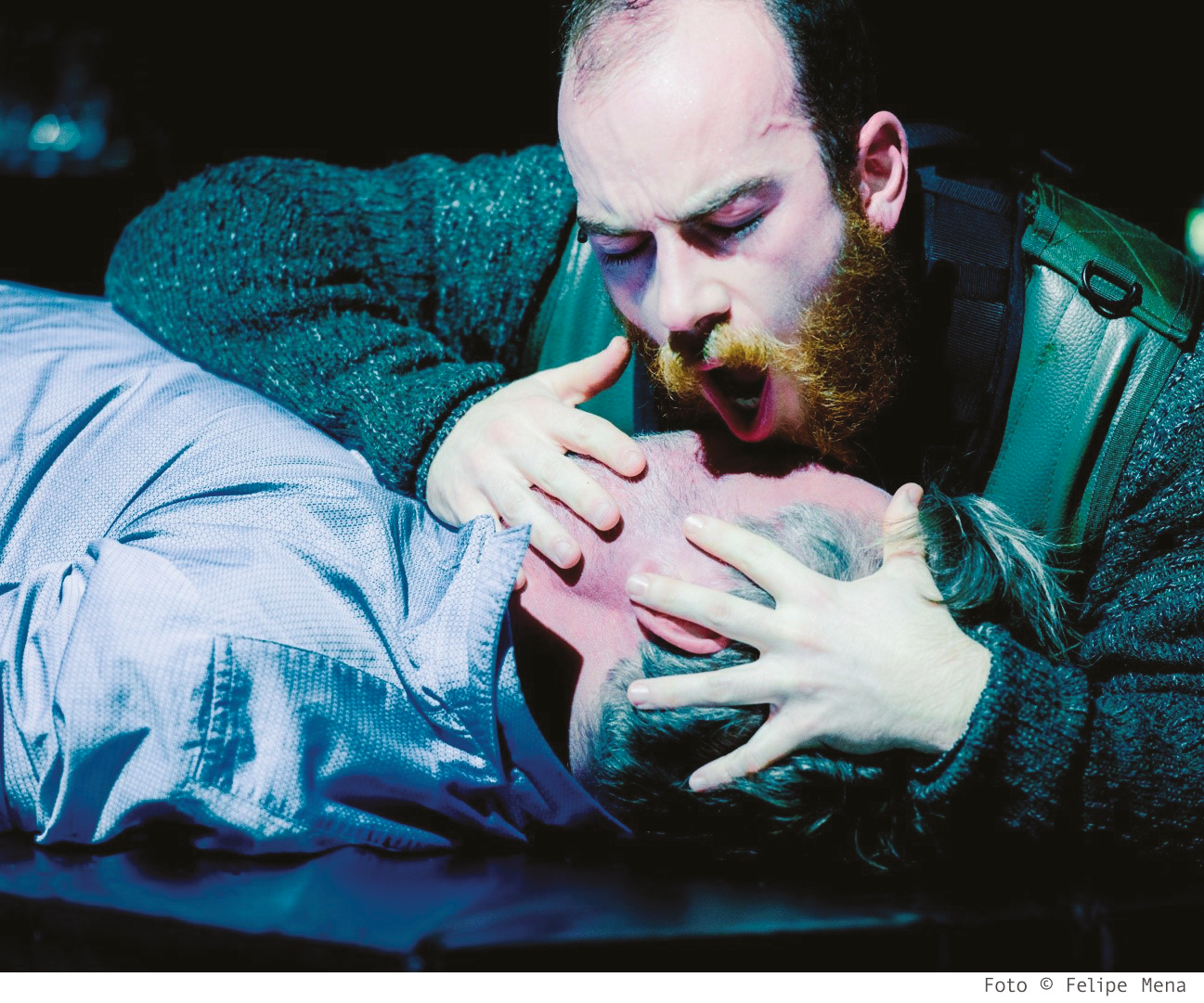
In spite of their familiarity with the similarly hostile reception of the play in London in 1995, the production’s artistic team, all of whom recognised Blasted as a touchstone of contemporary drama and were, moreover, aware of the conventional parameters circumscribing the TNC’s “average” spectator’s horizon of expectation, were still somewhat surprised by this type of reaction. In addition to the twenty-three years that had elapsed since the premiere of the play in 1995, another reason why the hostile response was somewhat unexpected was Gorina’s approach to the staging. Ian’s devastation in the last three scenes was represented through disrupting the performative naturalism that had governed the stage until the Soldier’s arrival and adopting a distinctly non-naturalistic scenic language, more symbolic than realistic, instead of emphasising the brutality of the violence. The violence was conveyed without glamour or excessive display beyond the “linguistic” parameters that are frequently used in the media and art to represent barbarity and achieve an impact on the audience. In accordance with Kane’s aim that the dramatic disruption in Blasted would suddenly present “all those [violent] familiar images […] in an odd theatrical form, which provided no framework within which to locate oneself in relationship to the material” (quoted in Saunders 2002: 28), Gorina’s production did not “authentically” recreate or represent the violence by trying to imitate real brutality, which is what would have happened in naturalist theatre. For instance, Ian’s rape was represented by means of a symbolic action by the Soldier: he shook the bottle of champagne that he had previously simulated inserting into Ian’s anus and completely soaked Ian —who remained dressed throughout the scene— with its contents. Likewise, the Soldier performed the act of eating Ian’s eyes by licking the entire face of the actor who played the role of Ian. Both situations emphasised Ian’s pathos and humiliation and sought to make the audience feel the sense of repugnance and discomfort caused by the direct perception of actual pain and cruelty evinced in the text. As is widely known, when Kane wrote the play she aspired to create “experiential theatre” that manages to carry the audience “to a place of extreme mental discomfort” (quoted in Saunders 2009: 47), so as to “avoid going there in reality” (quoted in Langridge and Stephenson 1997: 133). This implies an affective model of reception that, unlike the TNC’s usual semiotic or intellectual one, is based on firstly appealing to the spectator’s corporeal experience of pain and then inciting them to reflect on its causes and consequences.
The audience’s anger was also expressed on social media. A mere two days after the premiere, the following comment was posted on Twitter:
After watching Blasted and its feast of disgusting scenes, I wonder why Pere Arquillué accepted a role in such a nauseating play and why the TNC has programmed it. Some members of the audience left the theatre before the end, when there was timid applause out of politeness. (AngelBergada23 2018)14
This is clearly reminiscent of Jack Tinker’s review of the premiere of Blasted at the Royal Court (Daily Mail, 1995), whose headline, “Disgusting Feast of Filth”, has often been highlighted, including by Kane herself, as paradigmatic of the British press’s furious attack on the play. As in the just quoted Twitter post, other audience members also rebuked the manager of the TNC for having programmed the piece, arguing that the text did not have the dramaturgical quality required by the cultural institution: “the audience is exhausted after watching Blasted, a very poor and meaningless text. Everything is gratuitous in the play. […] Albertí, please, do not programme rubbish like this” (rocamorar 2018).15 As Kane suggested was the case in 1995 and as the first part of this article has indicated, incomprehension of the play in Catalonia was also probably due to the audience’s inability to “read” the play’s deviation from the “absolute drama” model as defined by Szondi, which led them to focus only on the play’s barbaric content. Unlike the vast majority of plays staged at the TNC, Blasted did not offer a familiar, “clear framework within which to locate” (Kane quoted in Saunders 2009: 52) and interpret it, because the naturalism of the hotel room in the first two scenes is brutally disrupted by the surrealism of the irruption of war at the end of scene two. In consequence, the play “asked the audience to craft their own response” to the atrocities represented (Kane quoted in Langridge and Stephenson 1997: 131), forcing spectators to confront a painful reality that they perhaps had rather ignore. As a response, the members of the TNC audience who rejected the performance also focused more on criticising “the representation of violence [...] rather than actual violence” (Kane quoted in Langridge and Stephenson 1997: 131), just as the British press did in 1995.
As the run of the production continued, the public perspective on Blasted progressively shifted: a substantial proportion of spectators understood and accepted TNC’s attempt to move away from its usual theatrical frame of reference, even when this meant they remained in a permanent state of dissatisfaction during the performance because they did not manage to sufficiently broaden their competencies in response to the play’s “new” dramatic and theatrical parameters. As Anne Ubersfeld points out, the impossibility of apprehending the text’s meaning and establishing personal identification with it puts the audience in the “essential situation of spectatorial dissatisfaction” (related in Bennett 1997: 73). Faced with Kane’s play, this segment of spectators expressed their perplexity and the emotional and physical impact they felt at being confronted with the play’s dramaturgy and staging, but they refrained from passing judgement on the dramaturgical quality of the text. Their bewilderment, also shared on social media, revealed how they were lost for words, unable to describe the play or their own emotional experiences: “I have been left wordless” (eliramirez82 2018); “Blasted. I don’t know what to say. Maybe… ufff…” (amartells 2018).16 Other witnesses precisely conveyed how the emotional and visceral impact sought by Kane’s experiential theatre was achieved through Gorina’s non-sensationalist, understated staging of extreme forms of violence: “Uncomfortable, direct, intense, acid, indigestible. A very hard but attractive work, it produces feelings of rejection and attraction all at once. […] I left the small auditorium of the national theatre in shock” (VictoriOliveros 2018).17
The section of the public that is keenest to keep up with theatrical premieres in Catalonia and equipped to confront theatrical experimentation, including Catalan theatre practitioners, received Blasted with enthusiasm. Its premiere was seen as a promising change of direction for the TNC, whose usual artistic and dramatic policy many of them had previously not felt close to. Some of them therefore praised the inclusion of Kane’s play in the canon of the Catalan national public theatre as well as the new form of staging, watching and understanding theatre put forward by Gorina:
A text replete with harshness. Pere Arquillué is unrecognisable. An honest stage proposal, free of pretentious effects. Bravo, Alícia Gorina. I hope it means a change of direction at the national theatre and is not just a one-off. More brave moves, more women! (onaborras 2018)18
The last phrase in the quoted tweet refers to the recent “On són les dones?” (Where are the women?) campaign to denounce the lack of women in the artistic and management teams of the leading productions and theatres in Catalonia. This relates to the previously mentioned possibility of the Catalan premiere of Blasted contributing to the establishment of a more diverse, inclusive theatre repertoire and industry in Catalonia.
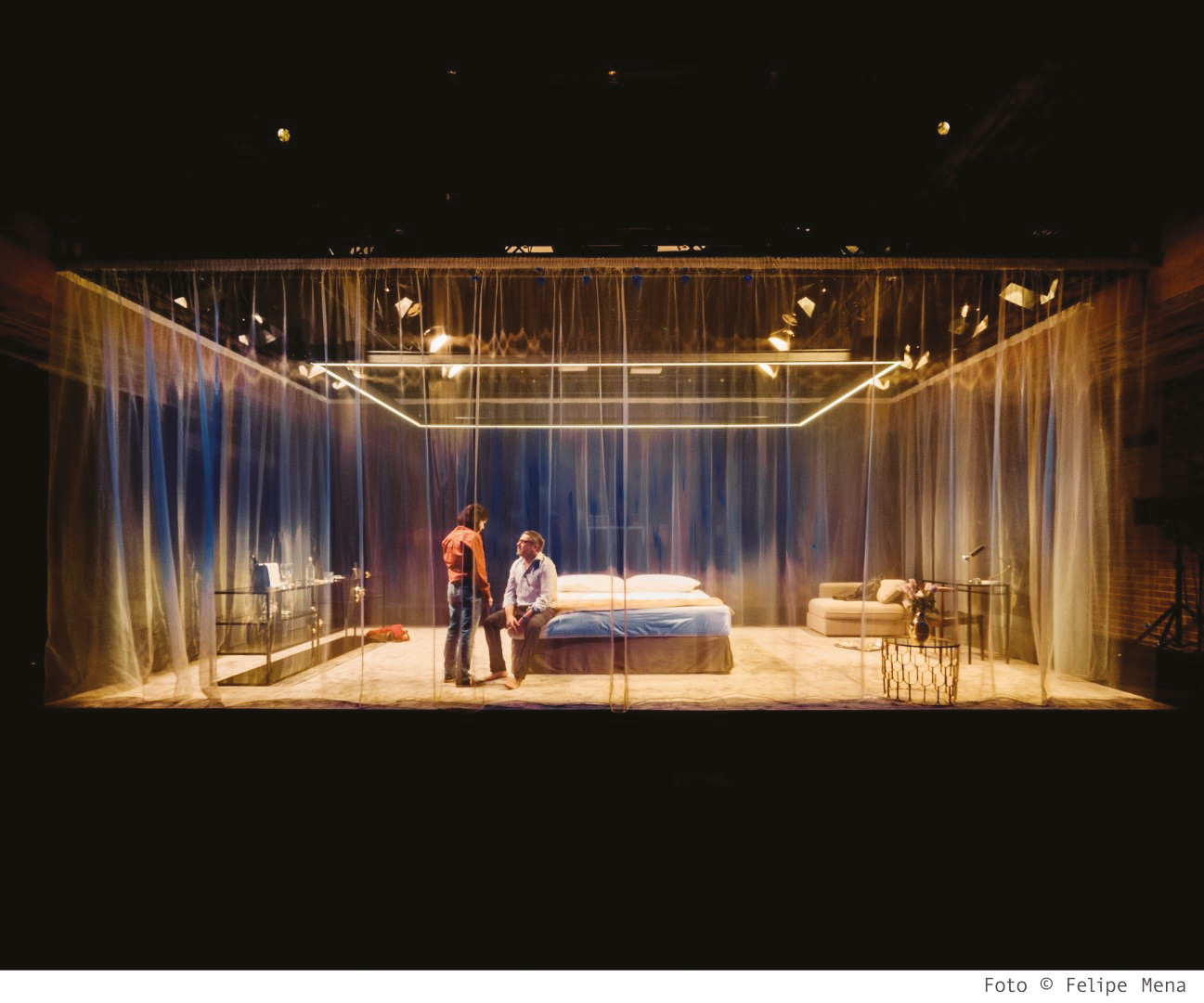
As mentioned earlier, the production took a risk in its choice to represent the violence of the atrocities depicted in the play through non-naturalistic means. By way of Delagneau’s set design, the dramatic rupture between the two halves of Blasted and the change of perception Kane wanted to trigger in the audience were foregrounded. With the audience sitting on either side of the stage and a muslin around the perimeter of the stage separating them from the actors during the first two scenes, the impact of the bomb on the wall of the hotel room was rendered by the Soldier bursting onto the stage, tearing down the curtain and then relentlessly dismantling the scenography to the point of turning the luxurious hotel into a devastated battlefield. Without the curtain, the audience was forced to directly see and confront the new, violent reality, as well as each other across the stage.
Some members of the audience went so far as to defend the ethical need to programme and perform Blasted so as to confront (as a society and through the performing arts) the experience of despair and brutality and reflect on how this affects humanity: “Blasted is hard to watch and assimilate, but absolutely necessary right now. Violence surrounds us and manifests itself in multiple ways… even masked as justice… and the same people always have to experience it” (melindroacid 2018).19 The writer of this comment identified one of the main objectives of Kane’s “experiential theatre”: “If we can experience something through art, then we might be able to change our future, because experience engraves lessons on our hearts through suffering” (quoted in Langridge and Stephenson 1997: 133). In other words, Kane attributed a cauterising function to theatre, whereby showing “real” violence and suffering on stage and making the audience experience it will lead them to resist it in life. In his Artistic Project, Albertí (n.d.: 15) similarly vindicated the cauterising value of contemporary British theatre and suggested that this was the social function the TNC should adopt in relation to its repertoire, so as to shine a light on and take responsibility for the most salient collective wounds that affect the contemporary world. The culture journalist Piquer (2018: para. 4–5) also identified the curative value of Blasted, derived in her opinion from it forcing the audience to face the intrinsic violence in all human beings, so they can confront it in real life. Piquer viewed the scandal generated by the play’s Catalan premiere with concern as denoting a collective refusal to face our pain as a society.
On the basis of the different audience reactions that have been described, it can be concluded that the Catalan premiere of Blasted at the TNC clearly challenged the frame of dramatic and theatrical representation that the “ordinary” Catalan theatre-goer is used to, still largely defined by what Szondi calls “absolute drama”. Consequently, a large proportion of spectators were taken out of their comfort zone as their horizon of expectation was unsettled. In dramatic and ethical terms, this means that, hopefully, the theatrical competence of “ordinary” Catalan theatre-goers was expanded, as was the Catalan contemporary theatrical canon that the TNC is responsible for establishing.