
Scanning through the theatre listings for autumn 2018 in Prague alone, productions of English language plays in translation include: Martin McDonagh’s The Lonesome West, and The Lieutenant of Inishmore, Caryl Churchill’s Escaped Alone, and Cloud Nine, David Greig’s Midsummer; David Mamet’s Sexual Perversity in Chicago (2 productions), American Buffalo, and November, Patrick Marber’s Dealer’s Choice, David Hare’s Skylight, Edward Bond’s The Sea, Duncan MacMillan’s Every Brilliant Thing, Dennis Kelly’s After the End, and Orphans, Mike Bartlett’s Cock, Irvine Welsh’s The Sex Lives of Siamese Twins, Moira Buffini’s Welcome to Thebes, Rebecca Lenkiewicz’s The Night Season, Paul Rudnick’s The New Century, Tracy Letts’ August Osage County, Peter Morgan’s Audience … a list that does not include several comedies by Woody Allen, whodunits, farces and evergreen versions of The Importance of Being Earnest.
Anglophone theatre certainly crosses into the Czech language and cultural space with remarkable frequency, and most visibly so in the repertoires in the capital city. It is present in the theatrical canon, as is to be expected, via Shakespeare, but also with productions of G.B. Shaw, Oscar Wilde and Samuel Beckett. If the RADAC 2018 conference took the privileged position of Anglophone-origin theatre post WWII for granted, then in former Eastern bloc countries, such a phenomenon is more aptly traced from the paradigmatic transformations of 1989 and the evolving cultural politics of Central and Eastern Europe following the fall of the Iron Curtain. As my opening anecdote implies, within a contemporary Czech context the significance of work of Anglophone provenance seems undeniable, catalyzed (even when that work is presented in translation) by the dominance of English as a second language of choice propagated via forms of cultural globalization, and prioritized in the education system since the fall of communism. Yet to trace the influence of contemporary Anglophone theatre on European stages is something of an invidious task, not least because of the hazards of essentializing what Anglophone theatre might be, of generalizing about European stages, or of getting lost in so much local detail that no one is listening. Nevertheless, the flow of cultural impulses and interchange within European theatre is surely of consequence, particularly in a climate of resurgent nationalisms and at a time when political borders have become a matter of much negative energy and mistrust. Understanding such flows and the nature of these exchanges requires “thick description” (see Geertz, 1973: 3-32), an attention to the nuances of context, artistic traditions, the roles of individuals, groups and material constraints in interpretation of cultural practice. Moreover, considering the movements of theatrical influence also requires an acknowledgement that they are, frustratingly, neither regular, programmatic nor reciprocal. In what follows I want to explore some of the cultural dynamics of Anglophone drama as it crosses into and circulates within a Czech setting, admittedly in a preliminary and partial way. My approach is informed by three criteria: first, to focus on the National Theatre in Prague, second to focus on work staged since 2000, and third, to concentrate on new writing. The paper does not pretend to account for translational practices specifically, neither does it deal with the adaptational and translational politics of producing Shakespeare (a topic much more extensively discussed in scholarly work in any case) or other canonical earlier works. Rather it considers what the selection, production and reception of recent Anglophone drama in Czech translation might communicate, and the ways new meanings may accrue to work through transposition to another social and theatrical context.
Prague currently has more than 50 theatres, some are repertory institutions with their own ensembles, some are very small, some are production houses, a few are venues for hire. According to the National Information and Advice Centre for Culture (NIPOS) statistics for 2017, over 5.8 million people attended theatre performances across the country, with half a million of those attending performances (Drama, Ballet and Opera) in the National Theatre, an organization which consists of four branches: Drama, Ballet, Opera and Laterna Magika and four buildings (See Národní informační a poradenské středisko pro kulturu, 2017: 2ff).
The Czech National Theatre is a massive, state funded historical institution that is at the forefront of mainstream national theatrical culture. Often referred to ironically as the golden chapel on the riverbank, it is not a light-footed organization, but it is data rich. A grand manifestation of cultural nationalism, the truncated history of the Czech National Theatre can be traced from an idea in the 1840s, a foundation stone in 1868, the ceremonial opening of the building in 1881, a fire less than a month later that destroyed the core of the building, a subsequent groundswell of countrywide donations, rebuilding and reopening in 1883. The National Theatre is inevitably a symbolically overdetermined space of cultural self-formulation that bears the imprints of the political environments, not only of its nascence, but of the ideological transformations of the twentieth century. The motto above the proscenium arch in the main building – “Národ sobě” – is translated variously as the nation for itself, or to itself, or on behalf of the nation. It is emblematic of the proclamations of national theatres emergent across Europe in the nineteenth century, it is also typical in that it both preceded and anticipated the establishment of the nation state of Czechoslovakia that came into existence, finally, only in 1918. Yet as Loren Kruger notes, despite the emphasis on “national singularity,” national theatres are rooted in “multiple, entangled identities and cultural indebtedness” (2008: 37) that “has always existed in a transnational field” (2008: 35). I am particularly interested in how in the twenty-first century the tension between national singularity and the transnational, global or cosmopolitan is negotiated and articulated in the selection and interpretation of work of English language provenance in the nation’s premier institution.
Following the Velvet Revolution in November 1989, as Czech theatre historian Jarka Burian and others have described, the theatre community newly liberated from the constraints of the communist regime, not only returned to suppressed works and writers, but also found itself disorientated in the face of utterly new conditions and evolving economic realities (See Burian, 2000; Stefanova, 2000; Reslová, 2000, 2003; Vojtíšková & Lorencová, 2015). The risk of generalization notwithstanding, there is critical consensus that theatre in Prague throughout the 1990s embraced postmodern/postdramatic experiment, shunned social realism or topical relevance, and could boast of a number of influential young directors. But also, it struggled to find a new generation of Czech playwrights (Reslová, 2003: 77-81),1 and this has remained a topic of ongoing concern. Until 1997, under the artistic direction of Ivan Rajmont,2 and then until 2002 under Josef Kovalčuk, drama at the National Theatre revisited European and Czech classics, with the occasional inclusion of modern canonical work by J.M. Synge, Eugene O’Neill, Harold Pinter or Samuel Beckett.
By the 2000s, thanks to multiple factors – political, social and technological – attitudes and practices were changing. Altered senses of community and proximity as a consequence of the internet, new conditions of funding, Czech accession to the EU in 2004, the development of festivals, international cultural projects and so on, were pivotal, as were specific individuals. A key stimulus was the new artistic director of drama at the National, Michal Dočekal, who during his tenure from 2002-2014 actively sought to stage contemporary work alongside classics, and to position the National in a European context through transnational co-operation, festivals and programming.3 Another figure influential in bringing Irish and British works to the repertoire was Jan Hančil, dramaturg at the theatre between 1997 and 2006, and presently Rector of the Academy of Performing Arts in Prague.4 In addition, Lenka Kolíhová Havlíková, who worked with Dočekal as dramaturg from 2002-2012, was instrumental in the production of many Anglophone works in Czech translation on the institution’s stages including Caryl Churchill’s Top Girls (Stavovské divadlo / Estates Theatre, 2004), Edna O’Brien’s Virginia (Divadlo Kolowrat / Kolowrat Theatre, 2005), John Patrick Shanley’s Doubt (Divadlo Kolowrat / Kolowrat Theatre, 2007), Tom Stoppard’s Rock’n’’Roll (Národní divadlo / National Theatre, 2007), Tracy Letts’ August: Osage County (Stavovské divadlo / Estates Theatre, 2009), Samuel Beckett’s Waiting for Godot (Nová scéna / New Stage, 2010), Edward Bond’s Saved (Nová scéna / New Stage, 2010) and Lucy Prebble’s Enron (Stavovské divadlo / Estates Theatre, 2012). Notably Havlíková was dramaturg for the two National Theatre productions of Sarah Kane’s work in translation in the early years of the decade, Phaedra’s Love (performed in a temporary festival space called Bouda in the centre of Prague, 2003) and a much-discussed production of 4.48 Psychosis in 2003 at the Kolowrat Theatre that ran for 41 performances. Havlíková in turn is a close associate of an important figure in the translation scene, Jitka Sloupová, co-founder in 1990 of the drama and literary translation agency Aura-Pont, and translator of numerous contemporary English language works.5
A second aspect was the popularity of In-Yer-Face theatre, and a 1990s generation of new British and Irish playwrights (in particular Mark Ravenhill, Sarah Kane, Patrick Marber and Martin McDonagh) whose work was being translated and staged throughout the country. An engagement with British new writing is manifest in Czech theatre periodicals from the late 1990s and early 2000s, as is illustrated by the translation of an article by Aleks Sierz on In-Yer-Face theatre published in Svět a Divadlo (World and Theatre) in 2000, before his book of the same name was published in 2001. Several Czech theatre makers have participated in Royal Court Theatre residencies, giving rise to conversations about the differing priorities and aesthetics of English and Czech theatre and the influence of such collaboration on the register, tone and form of some contemporary Czech playwrights’ work (Hoffmannová, 2006: 588-597).6 As will be clear below, the repertoire of the Czech National Theatre in the first decades of the twenty-first century also reflects something of these broader tendencies. Concentrating on new writing in this context solicits consideration of the currency of contemporary work and the issues to which it attaches, points I will illustrate later in more detail via the case studies of the National Theatre productions of Tom Stoppard’s Rock’n’Roll (2007), Mike Bartlett’s Earthquakes in London (2015) and Caryl Churchill’s Love and Information (2016).
Production patterns: drama in translation on the National stages
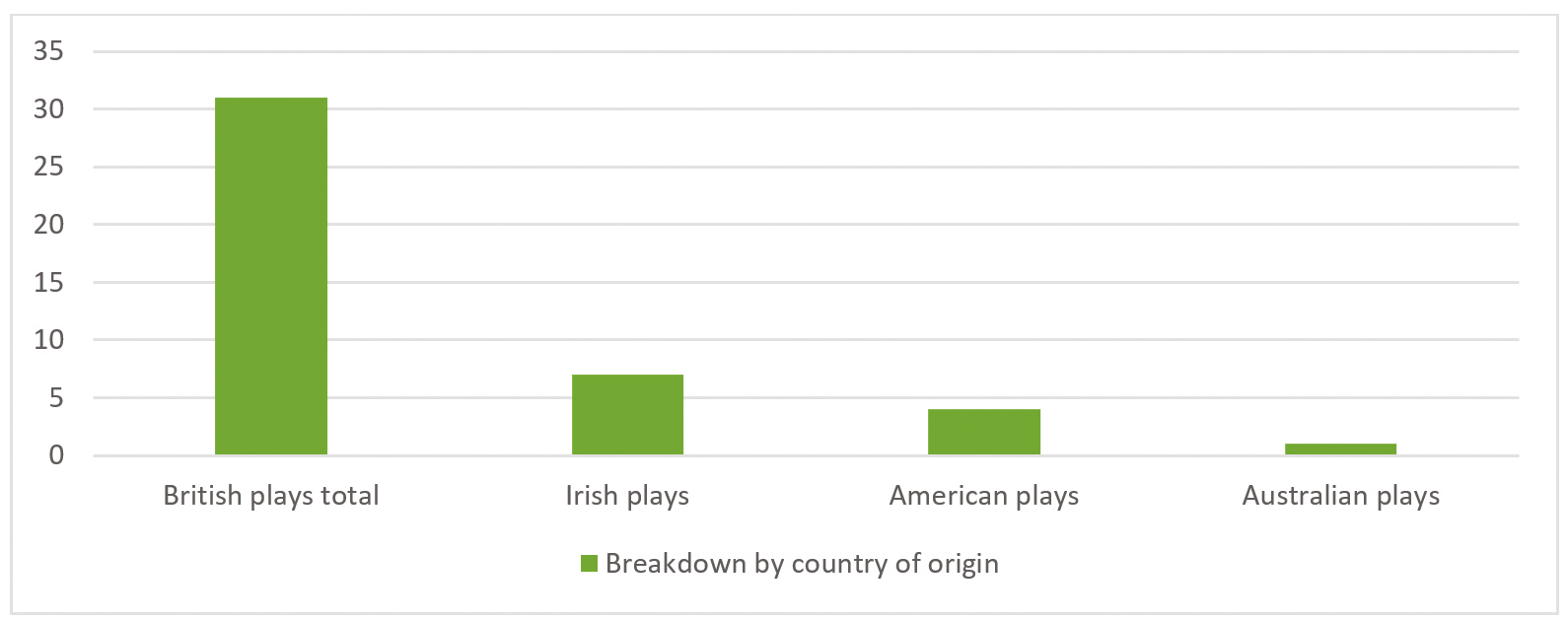
Even though it is not the remit of the drama division to be a hub for new work of Czech or foreign origin, in reviewing the lists of premieres in the National Theatre archive, some patterns do emerge that indicate something of the impact of Anglophone theatre in this high profile, mainstream space. First of all, throughout the period the distribution and proportion of work of English language origin is largely stable (Figure 1). Within the total of Anglophone plays in translation between 2000 and 2018, adaptations of Shakespearean works and non-Shakespearean classics (such as School for Scandal, Pygmalion) account for slightly more than a third of all productions while the remainder consists of modern and contemporary drama (Figure 2). Finally, in looking at the nation of origin of Anglophone works, it becomes clear that, at present, British work dominates (Figure 3).
Figure 1: Premieres at the National Theatre 2000-2018
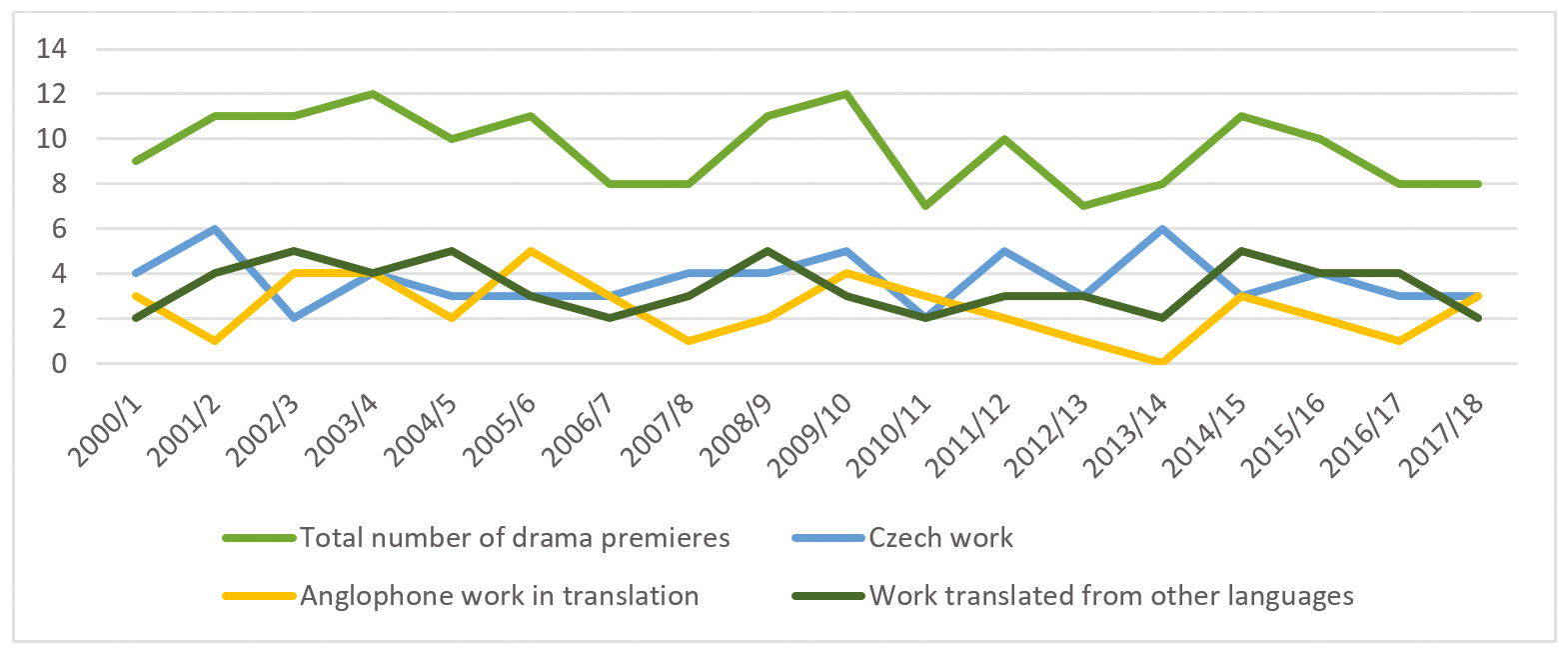
Figure 2: Distribution of Anglophone work produced 2000-2018
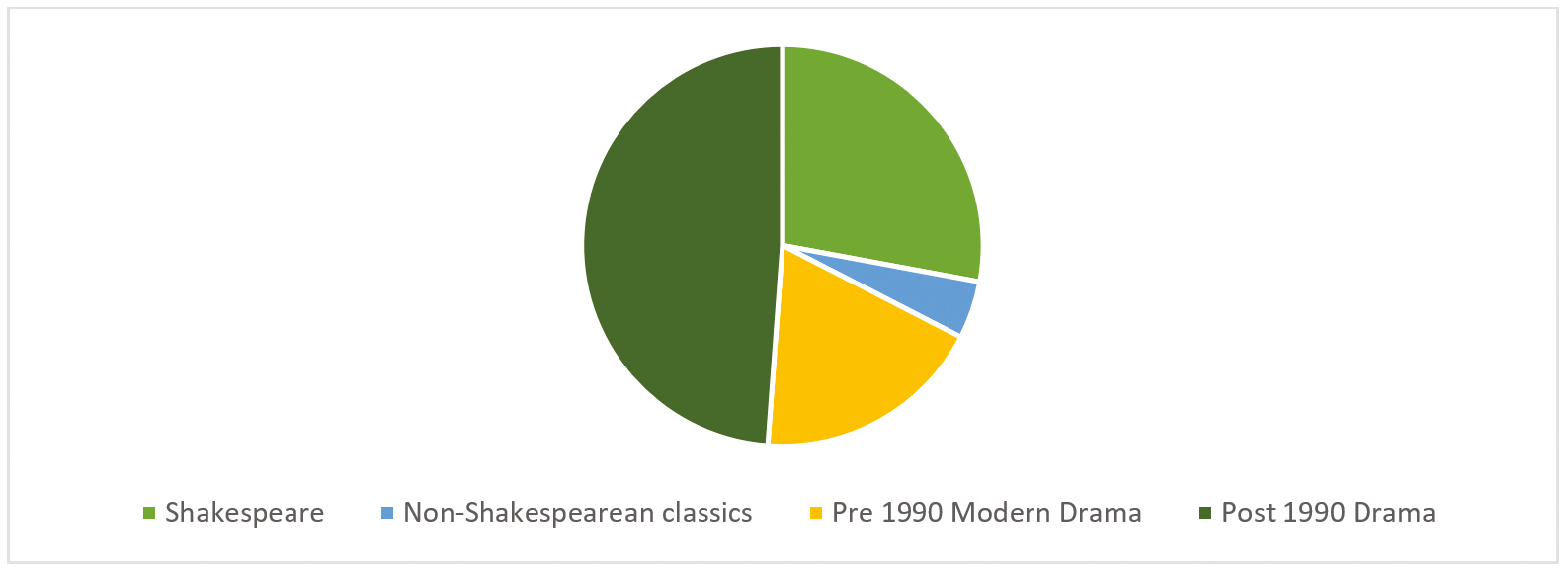
Figure 3: Country of origin of Anglophone work produced
Space is a crucial factor in this picture. Between 1991 and 2014, the National Theatre rented a studio in the attic of the Kolowrat Palace near the Estates Theatre seating up to circa 70 spectators. This technologically ill-equipped space was regularly used for drama in translation including Tom Murphy’s Bailegangaire (2000/1), Martin Crimp’s The Country and Sarah Kane’s 4.48 Psychosis (2002/3), Joe Penhall’s Some Voices (2003/4), William Nicholson’s Retreat from Moscow, Crimp’s Fewer Emergencies (2005/6), John Patrick Shanley’s Doubt (2006/7), Brian Friel’s Performances (2008/9), and David Harrower’s Blackbird (2009/10). Notably, a common denominator among all these works is a sense of scale – small casts and the artistic priority given to dialogue or, as in the case of Kane, poetic verbal content. The symbiosis between the simplicity and intimacy of the Kolowrat space and the verbal/textual focus of these productions contributed to the dominant perception of Anglophone theatre, or more accurately British and Irish theatre, as author propelled, heavily invested in dialogue with fine roles for character actors and, often, dramaturgically conventional.
It must be noted that such work contrasts with the idiom of Czech theatre culture which has historically been highly visual, conceptual and non-naturalistic. These qualities are celebrated by the Prague Quadrennial, a festival inaugurated in 1967, that showcases scenography, theatre architecture and performance design from around the world. The legacy of the Prague School, a rich heritage of scenographic experimentalism, and the influence of directors, and a predisposition towards satire, irony and the grotesque (arguably fostered by a heritage of avant-gardes as well as the visceral absurdities of not only the communist regime, but the Munich Agreement humiliation of Czechoslovakia in 1938) are important aspects of how work is chosen for staging and how it is evaluated (see Jungmannová and Vodička, 2016). More practically, at the National Theatre since 2014 the available stages for drama have been the New Stage, with an auditorium of 400 seats, the Estates Theatre with a capacity of 669, and the historical main stage, with a capacity of 986. Unsurprisingly, small-scale new dramas are generally deemed unfeasible in these spaces. As a consequence, when the institution ceased to use the Kolowrat space, a move which coincided with the appointment of the new artistic director for drama, Daniel Špinar, the repertoire became less accommodating of a certain form of Anglophone drama exemplified by the works listed above.
Daniel Špinar (1979-), who was appointed resident director at the theatre in 2014 and Artistic Director of Drama at the National Theatre in 2015, is exemplary of a generation of post-1989 Czech theatre makers who have imbibed both the provocations of 1990s Anglophone new writing and the more experimental frameworks of contemporary European postdramatic theatre practice. A graduate in acting from the Academy of Performing Arts in Prague, Špinar’s graduation work was the role of the character Tim in Mark Ravenhill’s Some Explicit Polaroids. His concept for drama at the National Theatre titled “New Blood: National Theatre Drama in the 21st Century,” (see Špinar, 2014) emphasizes a commitment to extending the work of his predecessors, but also to innovation, attracting new audiences and making theatre of relevance to the present moment. Špinar’s preference is for expansive, iconoclastic staging, that actively rejects realism, inclining toward postmodern eclecticism, irreverence and irony. Thus, the current interaction of material conditions and aesthetic predilections strongly conditions the processes of adaptation and transposition of work both national and international. In addition to some sense of local aesthetic or contextual relevance, the works selected must in some way have the scale and pliability to performatively and imaginatively occupy these institutions’ large auditoriums, to support often elaborate stage designs and (re)interpretation through the lens of prevailing dramaturgical tastes and concerns of the company, director and dramaturgs at the institution.
Rock’n’Roll: The echo chamber of the past?
Tom Stoppard’s Czechoslovak political retrospective Rock’n’Roll opened at the Royal Court Theatre in London on 3 June 2006 before transferring to the Duke of York’s Theatre in July that same year. The Czech National Theatre mounted the play in translation in February 2007, shortly before the completion of its West End run. In many respects, their haste was to be expected. Stoppard’s drama presented a unique fusion of Anglo-Czech concerns. Here was a play by a British playwright of Czech descent that addressed normalization, ideology and the nature of resistance. It synthesized a richly affective period soundtrack, with a specific local history of oppression, dissidence and liberation that was, and still is, strongly associated with Václav Havel. For all these reasons, Rock’n’Roll was rich with potential significance for Czech audiences, but also for these reasons its transposition to a Czech setting produced a diffraction of associations that amplified and complicated the cultural politics of the work.
Stoppard somewhat self-deprecatingly outlines the background to the play in his introduction to the printed text. In addition to references to his own childhood memories, and his encounters with Havel and other dissidents, he maps the initial associations of his central character, Jan, with Tomas, the protagonist of Milan Kundera’s The Unbearable Lightness of Being (1984). But the more meaningful point of reference, as Stoppard describes, is the bitter exchange between Havel and Kundera about realpolitik and small nations, and the value and meaning of protest – a dialogue by now well-documented, but much less well known in the Anglophone sphere than Kundera’s novel. In the wake of the suppression of the Prague Spring by the Soviet invasion of Czechoslovakia in 1968, Kundera published an article titled “The Czech Lot.” Kundera’s provocative suggestion that the negative reactions to recent political events were overblown, drew a strong response from Havel, rejecting the political quietism of Kundera’s position. Kundera’s rejoinder “Radicalism and Exhibitionism,” charges Havel with pointless, potentially damaging, virtue signalling.7
The play, Stoppard is careful to note, is but a “diagram” of Czech experience from the Prague Spring to the Velvet Revolution and its characters do not neatly correspond to a defined set of antagonists. Rather, in established Stoppardian fashion, it paces around well flagged ideological debates with a surfeit of wit, articulacy and resonant detail: youthful Czech PhD student, Jan, debates Communism with Cambridge Marxist academic, Max, and questions his friend Ferdinand’s efforts to resist communist normalization, while the complacency of British 1960s so-called rebels is ruthlessly satirized. These thematic strands are augmented by references to materialism, debates about music and freedom of expression, Sapphic poetry, cancer and the way love might bridge cultural differences and time. The dense fibre of its content is dressed at regular intervals with a thumping soundtrack of rock and pop music from the period ranging from Pink Floyd and the Rolling Stones to the Beach Boys and John Lennon. Rock’n’Roll reduced many of its British and American reviewers to gushing accolades. Notably, the focus of responses often betrayed the ways a fondness for nostalgic atmosphere and clever dialogue, masked a lack of interest in the political contours of the history Stoppard distills, as was neatly illustrated when New York Times critic Ben Brantley rhapsodized over the New York production as “triumphantly sentimental” while at the same time mistaking the date of the Soviet invasion.8
It should come as little surprise that a Czech audience for whom this history was local and lived, rather than exotic and distant, might not be moved in exactly the same way by the flow of sentiment. The playwas translated by Jitka Sloupová, who worked to domesticate the speech of the young Czech characters, to make them sound less, as she puts it “like Oxford wits” and yet “still let them remain ‘Stoppardian’ characters” (Sloupová, 2018). Those characters, inevitably, resonate differently. The association of the play’s protagonist with Stoppard was reinforced by the resemblance of the lead actor David Prachař with his mop of curly dark hair and strong features, to Stoppard in his youth. Most strikingly, if in London or New York Max comes across as an idiosyncratic, but nonetheless loveable ideologue, then in Prague the unpalatability of the character’s political views and the impact of his behaviour looks a good deal less excusable, and Stoppard’s incipient Toryism goes unproblematized. For some, as Sloupová recalls, Max was simply regarded as a lunatic (Sloupová, 2018). More subtle local meanings attached to the character Eleanor, Max’s wife. A classics scholar of formidable intellect, Eleanor resists the levelling logic of materialism as she battles with the devastating effects of cancer. Her situation recalls something of Havel’s much-loved and long-suffering first wife, Olga, who died of cancer in 1996.9 Finally, the simple joyous uplift at the play’s end, when a Rolling Stones concert stands as a synecdoche for a new political order, by 2007 rang a little false with audiences who experienced first-hand the transitional turbulence of the “wild nineties,” when the term “tunnelling” was coined to describe the wide-ranging asset-stripping and corruption that characterized the privatization fever of the post-socialist scene.
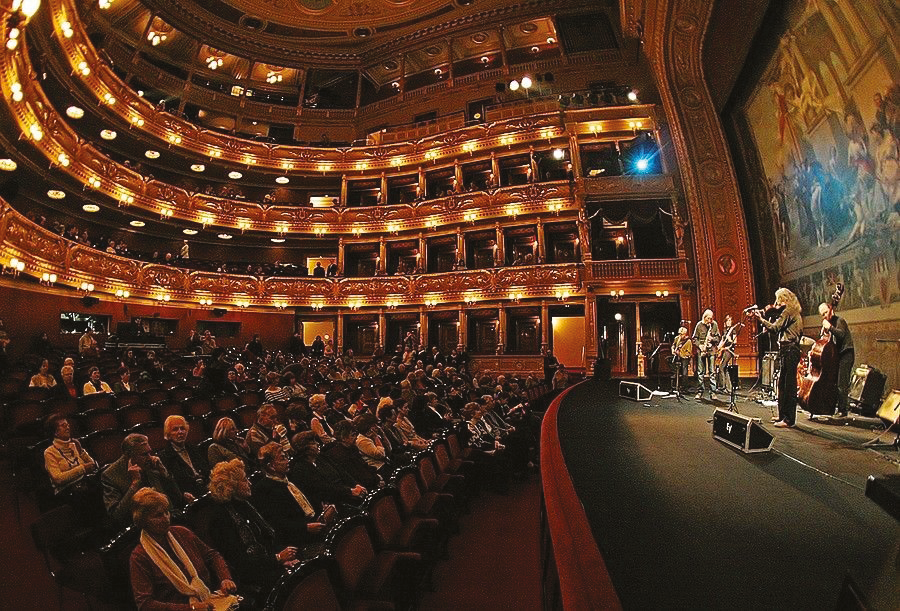
The production, directed by Ivan Rajmont, treated the play in a very respectful, naturalistic manner. Rajmont strategically augmented the local dimension to Stoppard’s fulsome celebration of Western rock by incorporating a concert with the surviving members of the underground rock band, the Plastic People of the Universe. Consequently, a key detail in the play’s plot – Jan comes to understand the impossibility of remaining apolitical as a result of arbitrary persecution of the members of the band – is made present and central in the Czech interpretation of the play. Stoppard leans heavily on the connotative charge of not only the music, but also the lyrics, a semiotics that fails to transmit across language barriers with ease. The incorporation of the Plastics in the Czech staging therefore worked on a number of levels that supplemented and modulated the affective scope of the original, first to help bridge some of the gaps that beleaguered the appreciation of Stoppard’s carefully curated musical references, but also to some extent to reverse the priority afforded to the Western hits in the play. A third aspect of this gesture lay in giving space on the national stage to a dissonant genre of musical performance, one that thumbed its nose at the noblesse of the gilded proscenium of hallowed national pride. In doing so, the production arguably posed questions about the very nature of that space, its history, to and for whom it might claim to speak.
Photo: Tomáš Adamec. The Plastic People greet the National Theatre, 2007
Rock’n’Roll played a very successful run in the repertory at the Czech National Theatre until June 2011, totalling 73 performances. The reception of the play mixed compliments for the lead performers with reservations about its form, especially about the extremely static and verbose second half. Interestingly, the Czech production crystallized the tension between the play’s historical and conceptual overreach and its inherent formal conservativism. The surreal novelty of having aging, underground rockers take the stage in the “golden chapel” was noted and commended by some, nevertheless, the staging as a whole was criticized as dramaturgically flawed, lacking tension and dynamism. Signposting each historical period with surtitles might have made sense to audiences elsewhere who would not distinguish 1968 from 1977 or 1989. Under the sharp eyes of Prague (re)viewers, the mismatch of the music-loving protagonist, Jan, standing beneath a sign reading autumn 1968, carrying albums only released in the 1970s, elicited some acerbic remarks (Mikulka, 2007). To some extent the opportunity for theatrical reflection on the relatively recent past was welcomed by some reviewers (see for instance Šprincl, 2007). But Czech theatre since 1989 has an ingrained ambivalence about openly political themes handled in such a naturalistic manner. It would be inaccurate to claim that Stoppard’s play with its authorial predispositions has alleviated that ambivalence, however its run at the National Theatre might fairly be said to have opened debates about future approaches.
Deterritorialization? New scenes, new blood
In stark contrast to both the form and focus of a play like Rock’n’Roll, several recent choices of British plays for presentation on the National’s main stages are indicative of the trajectory of these new approaches. In the 2014/15 season, a translation of Mike Bartlett’s Earthquakes in London by Lucie Kolouchová was chosen and directed by Daniel Špinar for the New Stage (Nová Scéna) and ran for 27 performances. If Rock’n’Roll needed to gesticulate across a translational abyss, Bartlett’s play was dramaturgically speaking a common language. There seemed little friction between Bartlett’s fragmented, eco-apocalyptic epic play and the aesthetic of the production on the New Stage.
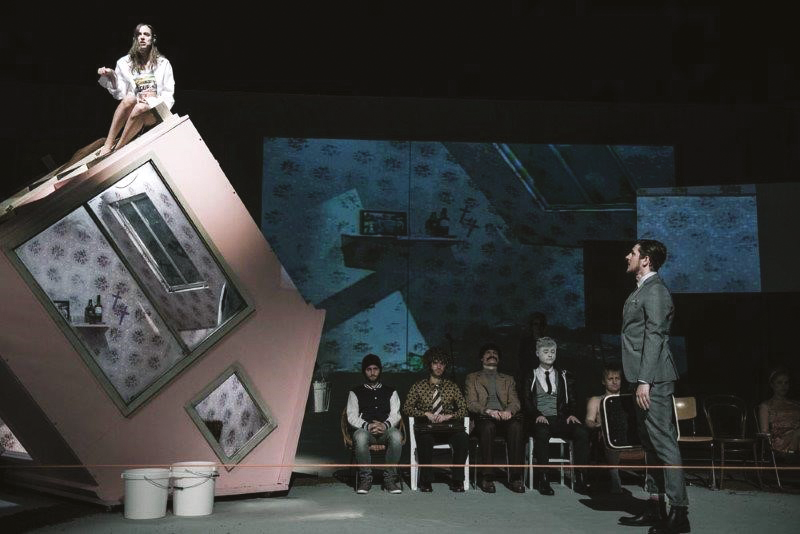
Dan Rebellato has written of the apparent lack of irony in the 2010 London production, probing the potential of “radical naivety” as a political gesture facilitating moments of impossible sincerity (2013: 18). The Czech interpretation of the play definitely reinstated ironic distance maintaining, as one reviewer described, a sympathetic oscillation between seriousness, delight, irony and colourful grotesque (Mikulka, 2015). Špinar and dramaturg Jan Tošovský amplified its cabaret qualities to incorporate the full ensemble and played with music stylization and a blend of retro and contemporary costuming. They also trimmed the dialogue in order to somewhat efface focus on family relationships and to distance themselves from any clear political platform (though clearly the play does not advance one either). The production featured visually arresting and expansive stage images. In the first half, these images are vibrant and chaotic. The set design by Henrich Boráros filled the broad flat space of the New Stage with bold, metaphorical topographies, most notably a large upended pink house and back wall projections. In the second part, the stimulations of clutter and colour are replaced by a minimalist white screen to produce a soberer set of effects, a shift in rhythm and a predominantly monochrome tone.
Earthquakes in London was enthusiastically reviewed in Prague, seen as an artistically successful synthesis of word and image, and a play that addressed contemporary crises in a nuanced and semiotically fluid fashion. Bartlett’s play is a richly suggestive, tonally ambivalent text that clearly could be readily adapted to the local aesthetic tendencies towards grotesque modes and bold stage semiology with little distortion. Despite the director and dramaturg’s caution around distinct political themes, Earthquakes in London cannot but be seen as a work reflecting on contemporary and globally felt anxieties about the environment and the future that extend beyond the national to transnational ethical dilemmas.
Photo: Petr Neubert. Mike Bartlett, Zemětřesení v Londýně, 2015.
Following the success of the Bartlett play, the National opened Caryl Churchill’s Love and Information translated by Jakub Škorpil in the 2015/16 season, also at the New Stage. This work premiered at the Royal Court Theatre in 2012 and as Rebellato has observed, it shares something of the indeterminately personal, yet generalized “apocalyptic tone” already evident in Earthquakes in London (Rebellato, 2017). Love and Information met with some mixed responses in the British media at the time of its initial outing. Its lack of plot or character footholds and extended associational logic is challenging but undoubtedly contiguous with a recognizable form/content direction in Churchill’s twenty-first century work. Inevitably, part of the appeal of the play is its formal plasticity: structured in seven titled sections comprising numerous short scenes; 51 in all, plus more than 12 optional extra fragments or effects, so the final number and arrangement may shift in different productions. Stage directions indicate that the sequence of sections should remain fixed, while the order of the scenes within each section (apart from the final scene) is up to the director, who may also choose where or if to include the remaining suggestions.
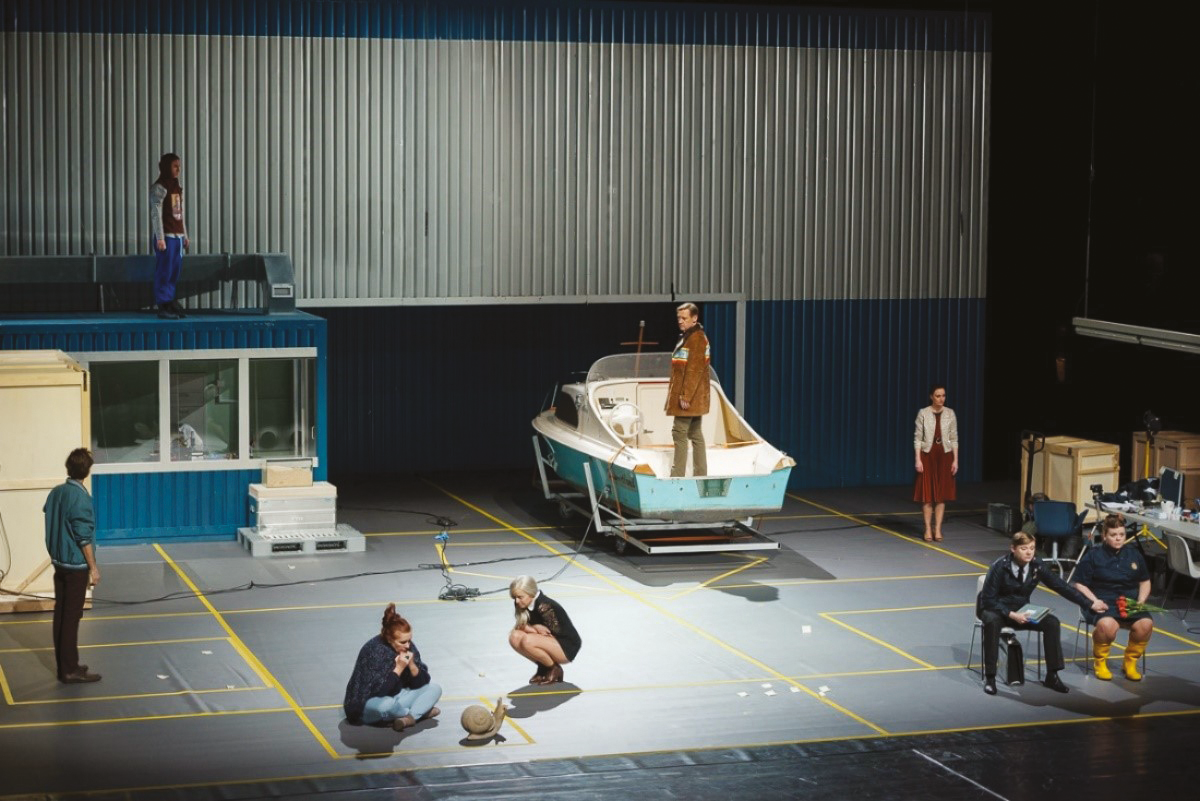
The original English production used a minimalist tiled white box set with changes of lighting and minimal props. The effect was a somewhat sterile, closed space in which a series of vignettes about the disjunctive nature of contemporary communication unspooled. By contrast, the Czech production opted for a distinctly different attitude to space and, consequently, meaning that altered the tenor of the play. As the National Theatre website attests, director Petra Tejnorová and dramaturg Jan Tošovský framed Churchill’s text as a postmodern “detective” drama or psychodrama suggestive of David Lynch’s Twin Peaks. This concept dominates the dramaturgy resulting in a work markedly dissimilar to that presented originally in English, sometimes in fruitful and inventive ways, especially as the desire for coherence and stable meaning is repeatedly denied or complicated by the play text. Again, to a noticeable extent, the ambition of the director and dramaturg to create an epic work, resulted in the use of a large cast of performers and scenographic complexity that was certainly not without interest and nuance. Nevertheless, the production seemed keenly anxious that the generous space of the New Stage be filled. The stage design by Antonin Šilar rose to the challenge with all sorts of props and micro-environments. However, in contrast to Boráros’s concept for Earthquakes, the proliferation of scenes – a glass-faced laboratory, a crime investigation room, a kitchen, a speedboat and so on – failed to cohere in a powerful visual image for the show. The already fragmented nature of the text with its absence of plot or characters was not aided by the semi-realism of these scenes, but rather produced a sense of confused tension and aimless exposition. Although the goal may have been to mimic the play’s accumulative logic, at 135 minutes without an interval, the effect evolved from being mildly interesting to actively gruelling. It must be noted that this, too, is an aspect of the play’s performative outcomes in other productions elsewhere, but it was especially pronounced in the Prague production.
Photo: Jan Hromadko. Caryl Churchill Láska a Informace 2016
By contrast with the response to Earthquakes in London, the Czech reception of Love and Information was generally negative. Reviewer Ester Žantovská remarked on how the detective rationale and visual dramaturgy overwhelmed any subtlety of language in Churchill’s text (2016). Similarly, others noted the production’s distrust of the poetry of Churchill’s language that resulted in a sequence of banal pseudo-realistic Lynch-inspired scenes. I would suggest that these responses arguably seek more poetry in the original text than may be on offer. Love and Information is above all a durational speculation on feeling and knowledge, one that is deliberately associational, formulaic and alienating. Despite its postdramatic potential and topicality, it is not an easy piece; regrettably the Czech production’s framing of the performance as a postmodern riddle proved misleading and counterproductive, revealing the pitfalls of concept over coherence. Arguably too, in broad thematic terms the play perhaps shared too much territory with Earthquakes in London and as such fell foul of a sense of facile, yet unspecified contemporary relevance.
National stages, cosmopolitan impulses
As is evident from this brief and preliminary survey, new Anglophone drama in translation is diffracted through the lens of Czech sensibilities, at times with marked differences in message and aesthetics that alter how those works might be habitually received in Anglophone contexts. So, for instance, the national historical specificities of a play like Rock’n’Roll inevitably resonated differently within the Czech context in ways that drew attention to Stoppard’s own nostalgia and, paradoxically, the inherent formal stasis of a work about political change. More recently, the Anglophone origin work in the repertoire of the National Theatre appears as an experimental platform for globally experienced senses of anxiety, precarity or states of alienation in ways that are sometimes remarkably effective and dramaturgically illuminating, sometimes diffuse and vague. In his critical contribution to National Theatres in a Changing Europe, Dragan Klaic questions the basic premise of national theatres in a twenty-first century context where “spirit of the nation, national identity, and national character – have become worn out and deprived of consensual meaning” (2008: 217). Klaic is dismissive of what he calls the “smorgasbord” approach to repertory programming. He argues for “a more focused and profiled programming, derived from critical analysis of reality rather than from a bookshelf of old plays” so that theatres “can hope to reconnect with their culturally diverse local constituencies and creative peers across Europe and serve as a platform for reflection and critical thinking on an emerging Europe-wide civil society” (2008: 227). A decade later, confidence in any Europe-wide civil society must surely feel less secure. Yet the challenge he poses is one that can be seen at work within the creative culture of the Czech National Theatre where the transposition and adaptation of contemporary Anglophone theatre in translation plays a distinct role in debating what the contours of that civil society and its concerns might be on the national stages.
