In an overtly self-referential section of 4.48 Psychosis, an anonymous voice announces: “after 4.48 I shall not speak again” (Kane: 213). If we trace them to the real person behind the speaking persona, these words ring chillingly true: Sarah Kane killed herself a few days after completing the final draft of her fifth and last play. As an artist’s statement, however, this line has been massively disproved by the striking propensity shown by Kane’s work to continue speaking. Her plays have been performed regularly all over Europe and beyond, on a truly global stage that stretches from Argentina to Singapore, from Australia to Palestine, from Mexico to Egypt, enabling Kane’s distinctive voice as a dramatist to live on in a multitude of verbal languages and stage idioms.
This paper situates itself within a wider research project on the dissemination of Kane’s work in Italy, a context of reception that has generally been neglected in scholarly accounts dealing with the international restagings of her plays (Nikcevic; Delgado-Garcia: 105-113; D’Cruz: 64-79). As has been observed (see e.g. Luckhurst), directors in the UK initially showed some reluctance in bringing Kane’s work to the stage, possibly as a consequence of the unhelpful scandal raised by her debut play Blasted; but this was by no means the case across the Channel, where the writer’s sustained endeavour to break formal boundaries has been noticeably paralleled by the striking readiness shown by her plays to cross national boundaries. Though their role has yet to be appreciated, Italian theatre-makers have been at the forefront in driving the process whereby Kane’s drama was quickly taken on by the European experimental scene as an iconic expression of the contemporary Zeitgeist, prior to its subsequent global spread.
The figures that attest to Kane’s early and pervasive presence on the Italian theatre scene are indeed noteworthy. From 1996 – the date of the Italian premiere of Blasted – to the time of writing (March 2019), I have estimated over forty productions of Kane’s oeuvre, a truly remarkable amount considering that her dramatic output consists of only five plays.1 The most widely performed by far among her texts is 4.48 Psychosis with twenty-six productions, several of which have toured nationally and sometimes also internationally, and/or have received multiple revivals over the years. To mention but the most striking example, Elena Arvigo’s highly acclaimed one-woman version was first presented to Italian audiences in 2010 and has never been out of production since, reaching the outstanding record of 190 performances as of February 2019. The total number of stage versions, moreover, would rise considerably if one included the scores of amateur performances, many of which are available on YouTube. It should also be noted that the play’s appeal continues unabated to the present day, long after the wave of rock-star celebrity following Kane’s sudden and shocking death died down. In addition to revivals, two major new productions of 4.48 Psychosis made their debut in 2018: Enrico Frattaroli’s concert-like rendition, Sinfonia per voce sola, premiered in January at Rome’s Teatro Palladium, and in September Dimitri Milopulos directed the first ever staging of the play by Teatro della Limonaia,2 Sarah Kane’s Italian “home” and the venue where her work was first introduced to Italian audiences. Both productions have been revived in 2019, with new dates announced for Frattaroli’s Sinfonia through to December.
These figures alone would be enough to mark the performance history of 4.48 Psychosis as quite extraordinary by all accounts, and even more so in a country that has traditionally proved impervious to new writing and non-canonical voices. For a telling comparison one need only turn to the belated and still very limited circulation enjoyed in Italy by the work of Caryl Churchill, in spite of her far more substantial dramatic corpus and her unparalleled influence over the landscape of British new writing (Churchill’s disgraceful absence from the Italian stage is an issue that was brought up repeatedly during talks and discussions at RADAC’s 2018 international conference, Crossing Borders: Contemporary Anglophone Theatre in Europe, where this paper was originally presented).
Even more than for its unrivalled popularity, however, 4.48 Psychosis stands out as a unique case because of the readiness with which it became the object of radical reworkings, with adaptations, rewrites and even parodies following hard on the heels of the play’s Italian premiere. In the UK, the operatic version composed by Philip Venables in 2016 was advertised by the Royal Opera House as the first adaptation ever of Kane’s last play. In Italy, a complete rewrite of 4.48 Psychosis made it to the stage as early as 2001: this was Federica Fracassi’s Sinfonia per corpi soli, which opened at Milan’s Teatro Libero just a couple of weeks after Kane’s script had received its Italian premiere as a solo performance featuring Monica Nappo in Pierpaolo Sepe’s production for Naples’s Nuovo Teatro Nuovo. In 2002, the Ubu Prize for Best Foreign Language Play was awarded (posthumously) to Sarah Kane for Crave and 4.48 Psychosis. The prestigious accolade was expressly adjudged in connection with four productions staged during the previous season that were felt to have played a key role in the dissemination of Kane’s work in Italy. Two of them were “regular” productions of the play: Sepe’s first staging of 4.48 Psychosis and the Italian premiere of Crave directed by Barbara Nativi at the Limonaia. Significantly, however, the other prize-winners were Federica Fracassi’s Sinfonia per corpi soli and Pippo Delbono’s Gente di plastica, two self-styled “tributes” to Sarah Kane that are equally marked by an extremely free approach to 4.48 Psychosis. The award can thus be taken to constitute an early acknowledgement, as well as an authoritative critical sanction, of the overlap between “staging” and “adapting” as a distinctive feature of the Italian afterlife of Kane’s play.
This tendency to defy classification, to undermine normative distinctions, is operative on more than one level in the creative responses I have investigated. As I illustrate below, Italian reproductions of 4.48 Psychosis are marked by a considerable variety of staging practices and dramaturgical approaches, and by a parallel desire to extend the theatrical vocabulary of performance by relying on a plurality of languages and media. The processual counterpart to this fluidity of forms is the frequent overlap between the figures of writers, directors and performers, and their respective roles and prerogatives, as they engage with Kane’s writing. With their tendency to merge different forms and agents of creativity, the more innovative performances of 4.48 Psychosis seem specifically designed to challenge the distinction between text-based and devised theatre and, more in general, to invite a perception of theatre-making as an integrated, collaborative endeavour.
Textual mobilities
The untenability of the distinction between “faithful” staging and “free” adaptation in the Italian context becomes apparent once one turns to consider the actual textual practices beyond perceived or stated binaries. To begin with, it is fairly common for productions that present themselves as radical reworkings to introduce extensive verbatim quotations from the play. A prime case in point here is Gente di plastica, the multi-award winning show by the internationally-renowned avant-garde artist Pippo Delbono that has already been mentioned as a recipient of the Ubu prize. Delbono’s “adaptation” of 4.48 Psychosis in fact opens as a new work taking inspiration not from Kane’s play but, as the title indicates, from Frank Zappa’s song, Plastic People and its scorching critique of conformity and consumerism. The show is structured as a radio broadcast featuring Delbono as a late-night DJ in the league of Wolfman Jack: from his cabin upstage, he introduces us to Zappa’s world and plays a rather eclectic compilation of music while the rest of the company put on a sequence of wordless sketches evoking as many television or cinema formats – the overall effect is that of a kind of channel-surfing on mute while we listen to his radio programme. About half an hour into the performance, the DJ switches onto the Sarah Kane channel and from this moment onwards we stay tuned to 4.48 Psychosis almost until the end of the performance. Delbono reads from the play, with the stated intent of telling Sarah Kane’s story through her own words; for the best part of the show, this narrative unfolds as a parallel text to the ongoing visual and musical scores.
Dramaturgically speaking, Delbono’s approach is that of a collagist: Kane’s play is cut and reassembled, further increasing its fragmentary quality, but actual rewrites are very minor. As a result, approximately one third of the original script makes its way into the performance. For all its considerable reliance on Kane’s text, however, Gente di plastica does not figure in the list of licensed productions of 4.48 Psychosis that was kindly provided for me by Danesi Tolnay, Kane’s Italian agent. The more immediate reason for this omission lies in a very peculiar backstory to the production. Surprisingly enough, Delbono did not initially apply for performance rights; even more surprisingly, however, the agents apparently only took notice when the show reached Rome’s Teatro India in February 2003, more than one year into a nation-wide tour that had included major venues in Genoa, Naples and Milan. When the agents finally intervened, giving Delbono warning to stop quoting from the play, the artist offered to clear the use of copyright but his request was rejected on the grounds that the Sarah Kane Estate had instructed its representatives abroad to only license performances which maintained the integrity of the text. Consequently, Delbono suspended the run and went home to rewrite the incriminated passages in order to bypass the veto.3
This episode may have instigated more radical forms of rewriting on the part of the non-canonical, experimental takes on Kane’s play which in Italy, at least for the time being, have far outnumbered its “authorized versions”: the agents’ list only records eleven productions of 4.48 Psychosis out of the twenty-six that I have been able to identify. Io sono Sarah Kane, a mock-autobiographical reworking staged in 2014 by Paolo Scheriani, is designated as “my vocal testament / my unpunctuated pain / my final draft” by its unnamed speaker but as the writer was keen to point out in our email exchange, “not a single word from 4.48 Psychosis” has been reproduced in the script.4 An equally recent example to the contrary, however, is provided by Ofelia 4 e 48, a show devised by Stefano Cenci and Elisa Lolli which was originally presented in 2009 but was revived intermittently through to 2017. Advertised as “freely adapted from Sarah Kane’s 4:48 Psychosis”, the show features large and fully recognizable portions of Kane’s play interpolated into a metatheatrical narrative about a female performer and her sadistic director. Even more crucially, moreover, the “integrity of the text” tends to be likewise forgone also in performances that offer themselves as a “straight” mise en scène of 4.48 Psychosis and that were regularly licensed by Kane’s Italian agents. This is the case, for example, of Psicosi delle 4 e 48, Valentina Rosati’s 2010 production for Teatro Stabile delle Marche. The title seems to promise a “faithful”, integral staging of 4.48 Psychosis, but in fact this is a highly condensed version of Kane’s play, lasting only thirty minutes against the average sixty to eighty of a complete version and involving not only cuts but also the reshuffling of individual lines and whole passages as well as some original interpolations. Rosati’s production regularly appears in the official list compiled by Agenzia Danesi Tolnay, but her approach to the play does not significantly differ from Delbono’s bootleg version of Gente di plastica.
With very rare exceptions, there has been virtually no staging of 4.48 Psychosis in Italy that has not involved some degree of textual manipulation, whether overt or silent. Contrary to what the “Delbono affair” would seem to demonstrate, this free approach to Kane’s script has been to some extent endorsed by the agents themselves. Already hardly applicable when the text in question is a translation, the notion of “integrity” has been further undermined, in the Italian context, by the concomitant existence of two different official versions of the play from the very outset of its performance history. The first Italian translation of 4.48 Psychosis was authored by Barbara Nativi, the late artistic director of Teatro della Limonaia and the acknowledged champion of Kane’s work in Italy. Nativi, who had already translated or retranslated the other four plays in the canon, worked from an unpublished typescript released by the British agents only a few days after the play received its first production at the Royal Court Theatre in June 2000, and she raced against the clock in order to be able to include Kane’s last piece in the complete edition of her work which was due out with Einaudi, one of Italy’s largest publishing houses, in December of the same year.5 For all its authoritativeness, however, Nativi’s translation was unexpectedly sidelined in the first Italian performance of 4.48 Psychosis. Unsatisfied with the available official translation, Monica Nappo commissioned a new version from Gian Maria Cervo which she then used for her solo performance in Pierpaolo Sepe’s production. From that moment onwards, both versions remained available for licensing, with Agenzia Danesi Tolnay leaving it to the producers to choose between the one or the other. Although Nativi’s translation has been used by the overwhelming majority of subsequent restagings, it is important to note that Pietro Maccarinelli decided to avail himself of Cervo’s alternative version for his 2004 production with Artisti Riuniti, probably the more mainstream among authorized reproductions by virtue of its casting of film and theatre star, Giovanna Mezzogiorno.
This textual instability has by no means subsided over the years: if anything, it has increased through the very recent addition of a third version that was expressly commissioned by Danesi Tolnay from Monica Capuani, a professional translator with considerable experience in the field of contemporary Anglophone drama. The text, co-authored by Capuani and her colleague Cristina Viti, was completed in November 2018 but remains as yet unperformed. Revealingly, moreover, only months before this new translation became available the agents allowed Enrico Frattaroli to omit the official translator’s name from the credits for his multimedia show, Sinfonia per voce sola, in acknowledgement of the director’s substantial (albeit silent) reworking of Nativi’s version in the production script.6
Performance interventions
In addition to the laissez faire attitude of the Italian agents, this overlap between staging and adapting has been clearly facilitated by the play’s formal looseness. On the page, 4.48 Psychosis consists of twenty-four fragments, each separated by a line of five dashes on the page and offering a wide variety of textures that are not ascribed to particular individuals and are only occasionally woven into a dialogic pattern. There is an inborn malleability to the play that allows the textual work of its stage interpreters to remain largely inconspicuous and that has enabled, and indeed encouraged, theatre-making practices in which different forms of creativity and professional profiles – director, performer, dramaturg, writer – become fully integrated.
A further driving factor must be identified with the unusual mode of circulation enjoyed by the play as a result of its inclusion in the 2000 Einaudi collection. Very atypically for a new play in Italy, 4.48 Psychosis was made readily available to a very wide readership including, of course, a vast number of theatre practitioners who were granted quick, unrestricted access to Kane’s script. In practical terms, this meant the possibility of bypassing the control exercised by literary agents: not only copyright protection, but also some less beneficial forms of gatekeeping that representatives can sometimes exercise. Even more importantly, however, the publication with such a major and highbrow publisher as Einaudi has deeply affected the perceived status of Kane’s writing. Rather than as a play script to be concretized in performance, and somehow subject to prescriptions, or restrictions, concerning how to give it scenic shape, 4.48 Psychosis has tended to be approached as a repertoire of textual material that needs to be co-created by theatre-makers with each new staging. It is quite symptomatic that in the Italian context Kane’s play is often referred to as a “poem” (Frattaroli 2018), a “story”, and even a “novel”7: an eminently performable piece of writing that has not however been designed as a blueprint for a specific performance.
This is quite unlike what has happened in the Anglophone world, where the Sarah Kane Estate has tended to exert a very strict control not only over the integrity of the text, but also over its “correct” stage interpretation. In Britain, the play has almost invariably been staged with three performers, two women and a man, following the authoritative model established by James MacDonald’s first production at the Royal Court Theatre (Gobert: 151-152). In the United States, requests for performing rights were systematically denied until 2004, when the Royal Court production was taken there on tour; reportedly, Simon Kane, Sarah’s brother and the executor of her estate, wanted to establish MacDonald’s anti-biographical version as the definitive production before other directors began to “fiddle” with a play that can all too easily be turned into “the ramblings of an incipient suicide” (McKinley).
While not completely unfounded, this protectiveness is clearly at odds with the almost unbounded room for maneuver that 4.48 Psychosis offers to its stage interpreters: as is well known, the script has no stipulation of personnel on stage, their gender, how many performers there should be; no setting, action or time frame is given or implied; text is unallocated and at times it becomes unclear not only how but indeed whether it is meant to be spoken at all. With its lack of any indication about the process of mise en scène, Kane’s writing is clearly animated by the desire to challenge the “text as instructions” model (Radosavljević: 81), namely, the idea that dramatic language can or should dictate the conditions of its staging, and that the task of performance is to reproduce, as fully and accurately as possible, the meanings that are already encoded in the text and are simply waiting to be actualized.
Although this was obviously not their intended aim, the mediating practices that have regulated the transmission of Kane’s work in Italy have ultimately contributed to maximizing the creative leeway afforded by her writing and to creating the conditions for installing a more dynamic relationship between text and performance. A signal illustration of this process can be found, again, in Gente di plastica. In this “tribute” production, Kane’s presence remains exclusively textual, confined to the pages from which Pippo Delbono reads as he shares her story with us. Not only the alleged subject of the performance never materializes on stage; but unlike what usually happens in solo versions of 4.48 Psychosis – the default mode in Italy – here the performer’s gender as well as his stance as an intermediary foreclose identification between the speaker and the words spoken. What we are presented with is not the enactment of a pre-existing script, but a performer’s response to it: the notion of theatrical production as a one-way transfer of content from page to stage is blatantly disrupted.
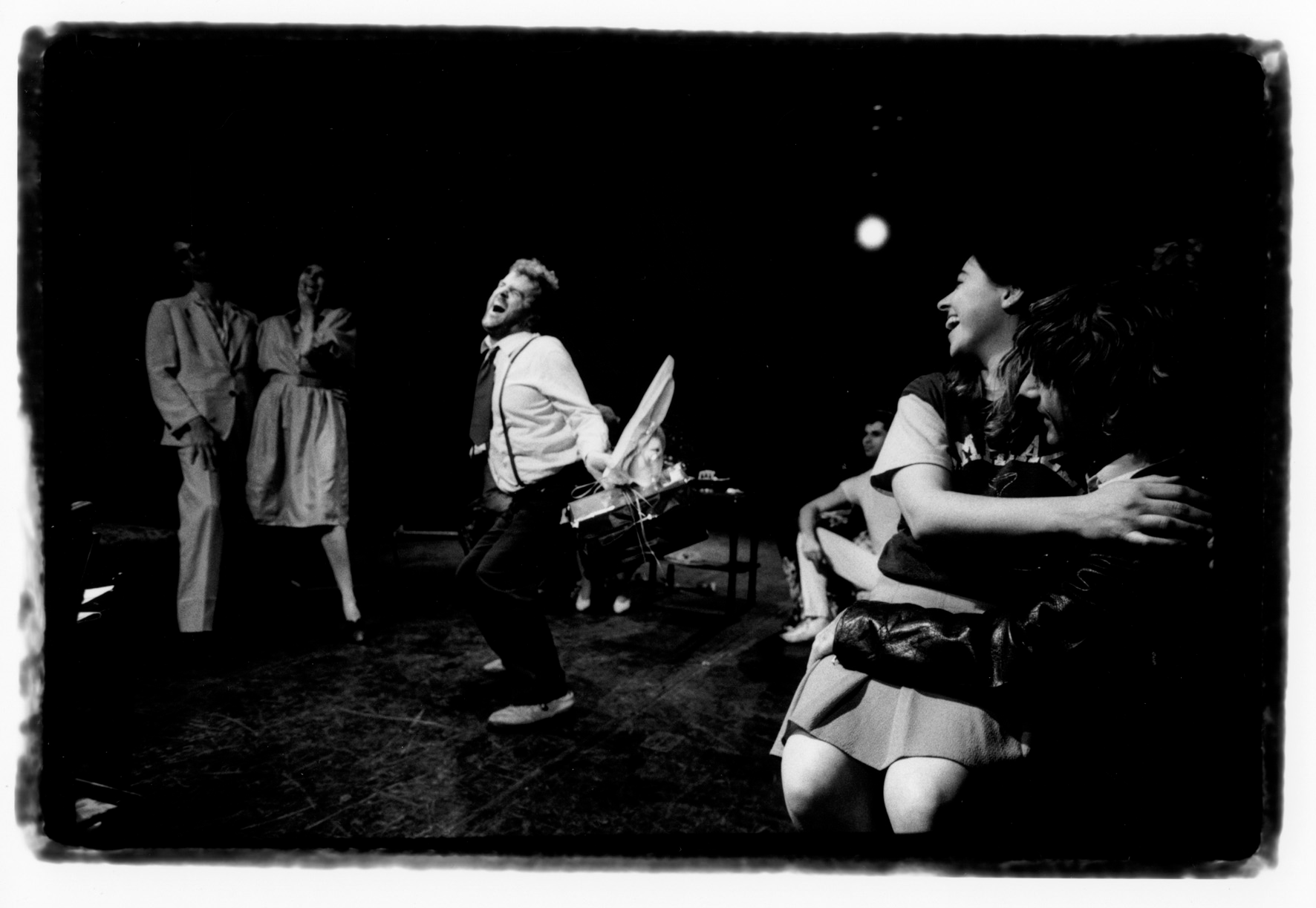
This becomes even more evident when one turns to consider the interplay between Kane’s words and the parallel “text” of silent scenes performed by the company (Figures 1 & 2). Just as Delbono’s monologue never suggests that the speaker is the originator of the words spoken, so too the parallel performance text cannot be seen as originating from 4.48 Psychosis: in a meaningful reversal of the customary hierarchies, this unscripted visual score pre-exists the Sarah Kane interlude and continues well after its conclusion; the “original” verbal text is actually framed by the visual poetry devised by the company. It would be reductive, however, to classify Delbono’s take on Kane’s work as a one-sided celebration of the disengagement of “theatre” from the authority of “text”. With its focus on the artist’s response to the play as a reader, Gente di plastica draws specific attention to its connection with 4.48 Psychosis as a piece of writing and places significant emphasis on Kane’s words as a source of theatrical meaning. Effecting a highly seminal move, this early reproduction of 4.48 Psychosis positions the playwright as a partner in theatre-making: her text ceases to be a transcendental object that determines its own representation in performance to become instead a catalyst for a complex dynamic of interactions among the different theatrical vocabularies of the performance. By undermining the traditional opposition between text-based and devised theatre, Delbono’s take on Kane’s play asks us to recognize that this distinction is no longer fit to account for the manifold ways in which writing gets consumed – and produced – on the contemporary stage.
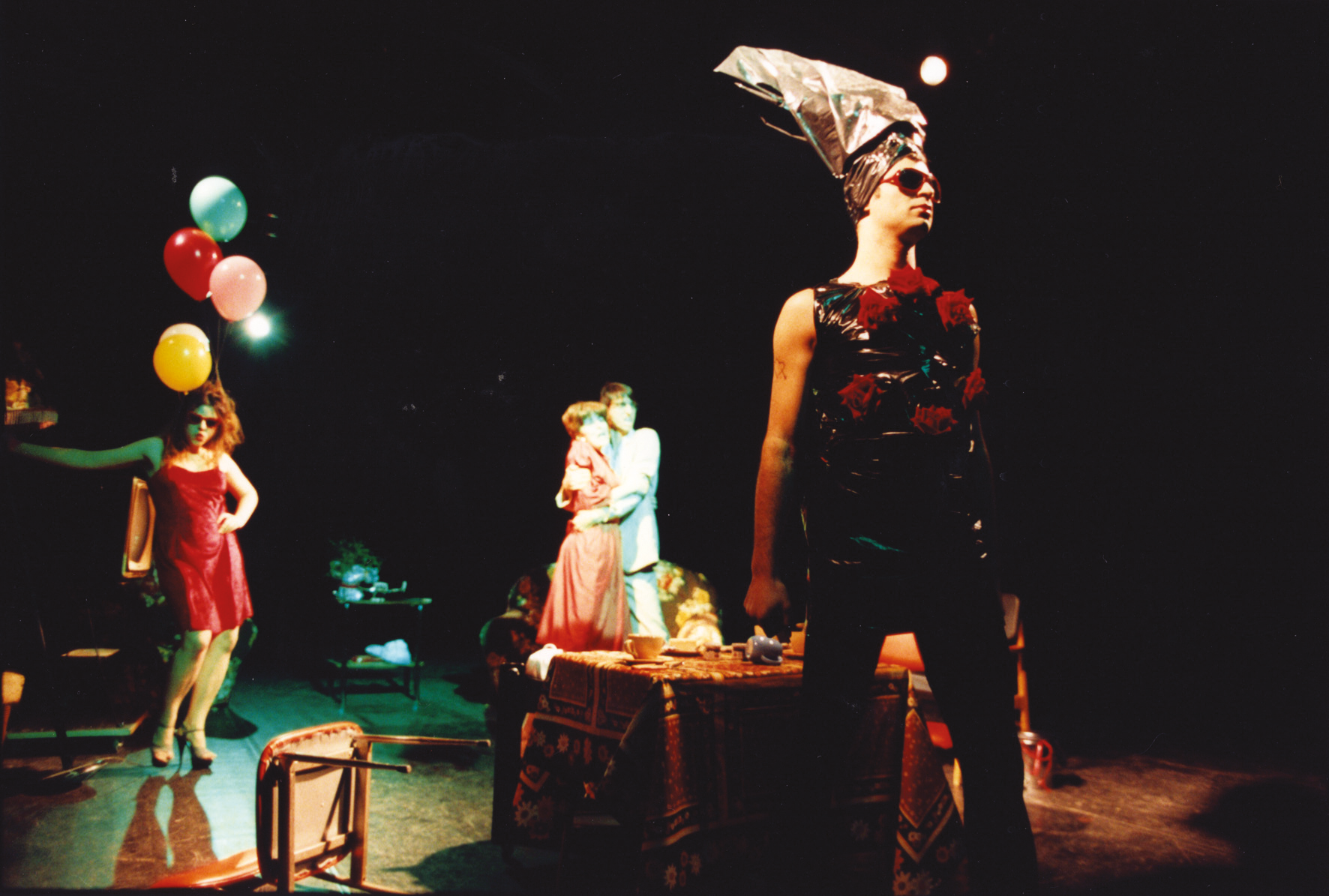
Figures 1 & 2: Gente di plastica (2001) by Pippo Delbono. Photo: Compagnia Pippo Delbono.
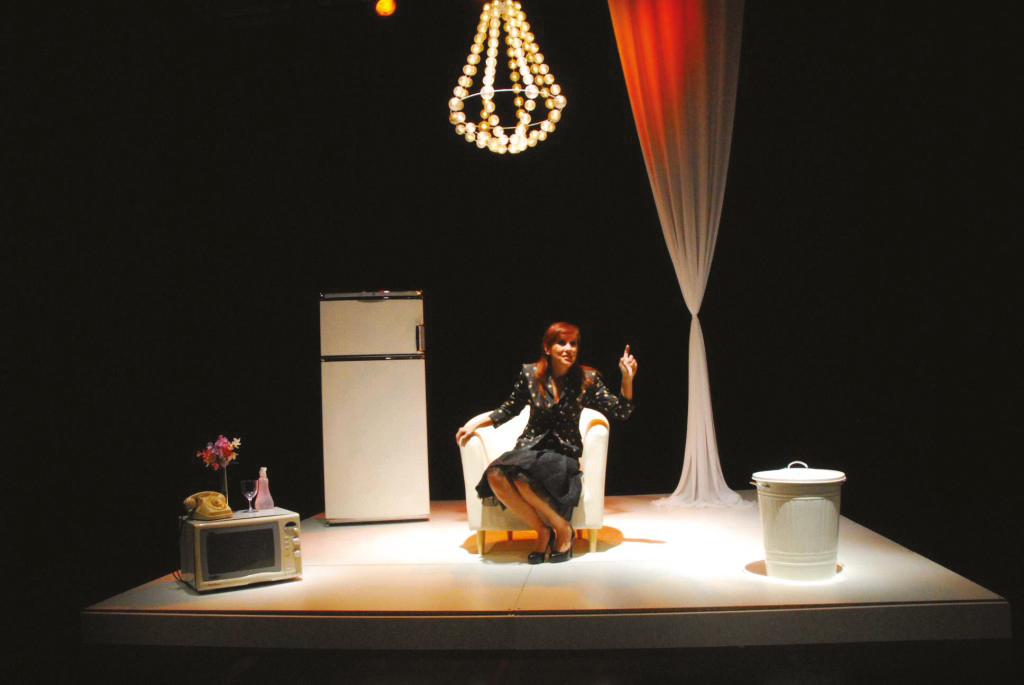
As I have already pointed out, this approach is by no means confined to Delbono’s experimental piece. A number of the productions I have mentioned so far were authored through creative processes that combine writing, directing, devising and performing. Sinfonia per corpi soli, the first Italian reworking of 4.48 Psychosis, was developed by director Renzo Martinelli and the theatre collective Teatro Aperto out of a scripted scenario provided by Federica Fracassi, who also formed part of the cast. On stage, three actresses share Fracassi’s original text, an alternative version of Sarah Kane’s dramatic testament which they partly enact through recourse to grotesque puppets. When they are not engaged in playing out their scenarios, the performers return to their undersized metallic beds, their breathing amplified by a specially-designed in-mouth microphone; meanwhile, the countless small objects that clutter the stage became eerily animated, creating a fizzling, crackling, mechanic counterpoint to the inner “voices” of human bodies. Ofelia 4 e 48, another devised piece that contaminates Kane with Shakespeare and Beckett, began as an acting exercise and eventually evolved into a metatheatrical two-hander in which the creative process is exhibited and scrutinized. (Figure 3) Stuck in an Ikea-like interior that doubles as a stage set, Elisa Lolli plays herself as an actress who is tasked to perform the multiple and overlapping selves of Winnie, Ophelia, and the unidentified “I” in Sarah Kane’s play under pressure from the despotic prompts and wry directorial advice voiced by Stefano Cenci from his control console offstage right.
In Gente di plastica, the notion of theatre-making with Sarah Kane finds an eloquent embodiment in Delbono’s stage persona as a DJ. A true Master of Ceremonies, Delbono presides over the production, orchestrating its flow of text, action and music, blending and mixing its discrete tracks through a principle of counterpoint: an expression in Sarah Kane’s text gains added resonance through its association with an image or action; the mashup of a passage from the closing fragment of 4.48 Psychosis with Starless, the heart-rending swan song by King Crimson, helps us feel the pulse and rhythm of Kane’s distilled poetry in the final journey towards annihilation.
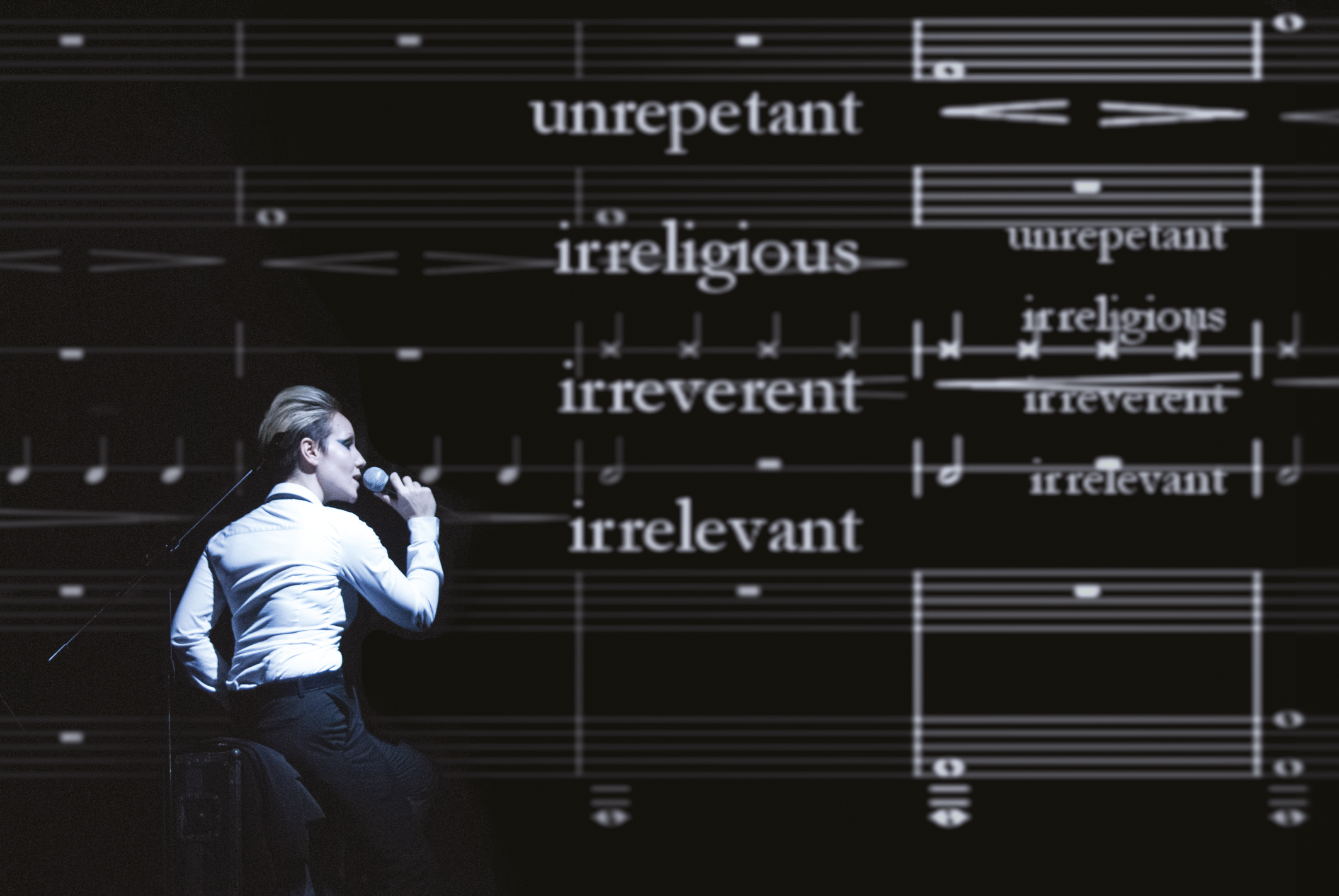
As a dramaturgical process, the principle of musicalization that informs Gente di plastica has set an important precedent for subsequent reproductions of 4.48 Psychosis on the Italian stage. With increasing frequency over the last decade or so, the theatre-makers who have engaged creatively with Kane’s play have relied on music as a means to extend the theatrical vocabulary of performance and its affective possibilities but also, sometimes, to altogether develop an alternative formal construction. This seems poised to become a mainstream method, as recently shown by Philip Venables’s adaptation for the Royal Opera House, a superb response to the in-built polyphony of Kane’s writing. The perception of the creative potential of 4.48 Psychosis as a piece of musical theatre, however, has been current with Italian theatre-makers for more than one decade, finding its fullest incarnation to date in Sinfonia per voce sola, a highly original multimedia performance that was devised by Enrico Frattaroli at around the same time as Venables’s operatic reworking. Adopting a similar approach to the play as a “libretto waiting for a composer” (Ashley), Frattaroli’s “solo symphony” harmonizes Kane’s vocal track, here delivered by a single actress, with live and pre-recorded music, both contemporary and classical, and associates this mixed soundtrack with a very powerful visual score that combines evocative images and projected text (Figures 4 & 5).
Figure 3: Ofelia 4 e 48 (2009) by Stefano Cenci. Photo: Stefano Vaja.
Since it made its debut in January 2018, Frattaroli’s production has continued to evolve. In September, a new version featuring soprano Patrizia Polia and pianist Diego Procoli performing live on stage premiered at Andria’s “Castel dei Mondi” festival. The transition from the initially “all digital” to the mixed “digital/live” mode has resulted in dramaturgical adjustments and a further level of textual mobility involving not only the introduction of new variants to the existing translation but also, more intriguingly, the intensification of the performance’s polyphonic quality through the transposition of spoken text into song and the replacement of verbal with visual elements. These changes have been subsequently incorporated in the “all digital” version which is still currently being produced as a more portable alternative to its live iteration.
Sinfonia per voce sola is but the last in a long line of performance interventions produced in response to the challenges as well as the endless possibilities opened up by Sarah Kane’s final theatrical masterpiece. Almost twenty years on from the first Italian staging of the play, the metamorphic, work-in-progress quality of its latest incarnation seems to suggest that 4.48 Psychosis has in no way exhausted its potential for stimulating ever new and highly imaginative ways of theatre-making with Sarah Kane.
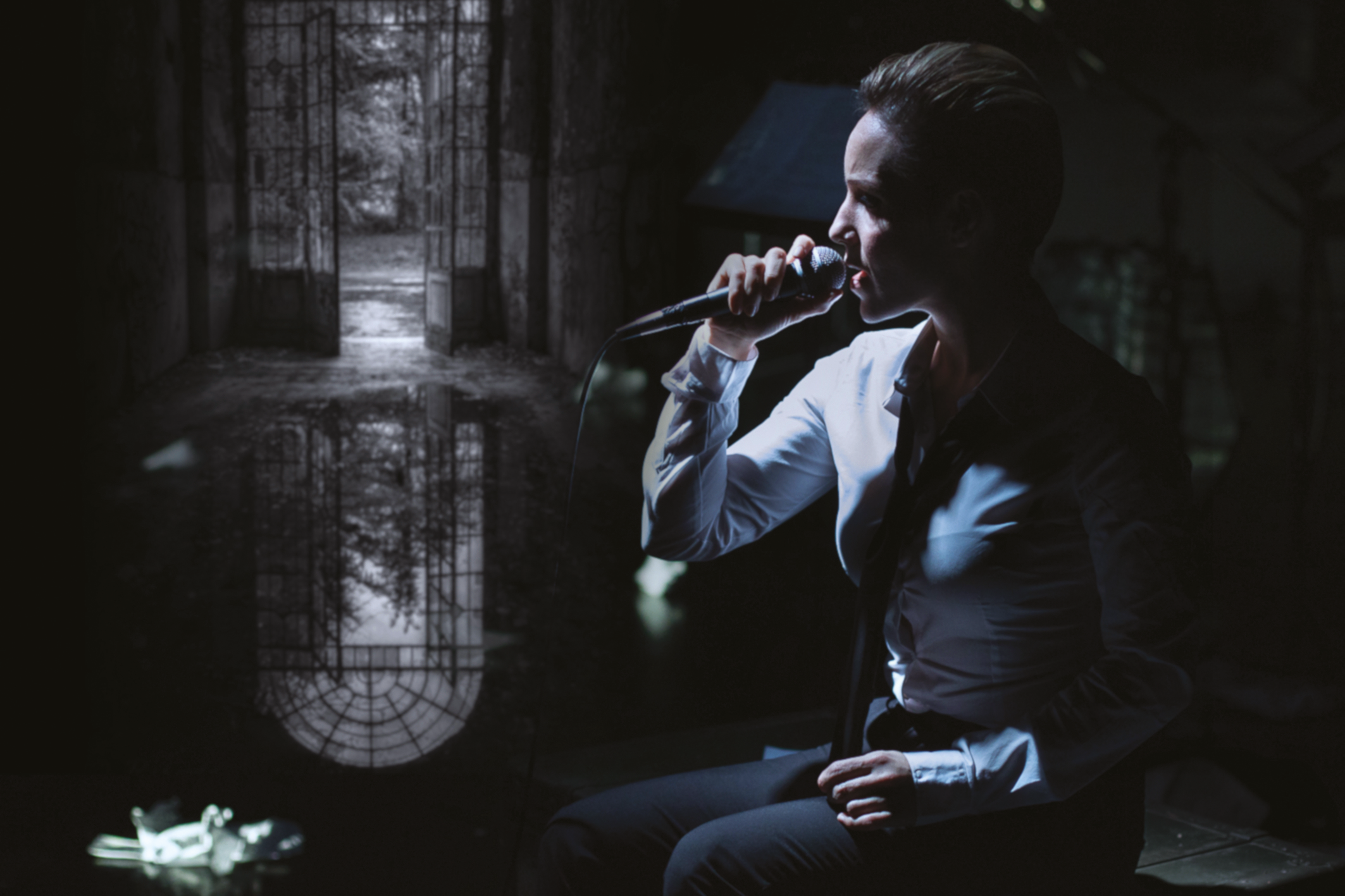
Figures 4 & 5: 4.48 Psychosis di Sarah Kane in forma di “Sinfonia per voce sola” (2018) by Enrico Frattaroli. Photo: Enrico Frattaroli.