
1. Crimp’s Reception in Italy
If the Sixties and the Seventies were marked by the so-called “teatro-immagine” (“theatre of images”),1 which emphasised visuality over words, the last twenty years have witnessed a turnabout on the Italian stage. Since the end of the twentieth century there has been a revival of interest in contemporary playwriting, a return to textuality explored in variously fascinating ways. In this phase of renewed attention to the script, British new writing has become a rich source of texts for Italian theatre-makers. Probably the most important figure in this process of cultural transfer and dissemination of contemporary British plays, Barbara Nativi – the artistic soul of Sesto Fiorentino’s Teatro della Limonaia – has brought to Italy the work of Sarah Kane and Mark Ravenhill, by staging plays such as Blasted in 1997, Shopping and Fucking in 2000 and Fame-Crave in 2001 and by translating into Italian the entire output of Kane (Sarah Kane – Tutto il teatro), published by Einaudi in 2000. Another Italian institution devoted to contemporary Anglo-American playwriting and which has contributed to this transplant of English-language plays is Milan’s Teatro dell’Elfo, where Kane’s Blasted, Tony Kushner’s Angels in America, and Ravenhill’s Shopping and Fucking and Product have been staged in the past ten years.
Kane and Ravenhill are not the only British dramatists who have been successfully exported to Italy at the turn of the millennium. As its title suggests, my article examines the enthusiastic reception of Martin Crimp in the “Bel Paese”. In his The Theatre of Martin Crimp (2006), Aleks Sierz noted that the English playwright has never been a prophet in his own country, where the average theatregoer looking for a good night out is not interested in cryptic and challenging drama:
The key to the puzzle is simple: Crimp’s work is difficult. He doesn’t write crowd-pleasing social comedies, gritty council-estate dramas or easy plays about ‘me and my mates’. He doesn’t do West End hits, soap operas or lyrics for pop musicals. His plays are hard work. Typically, they are experimental in form and unsettling in content. (Sierz 2013: 1-2)
Nevertheless, most of Crimp’s ambiguous plays have entered the repertoire of several theatres across Europe and overseas (remarkably, his dramatic jigsaw Attempts on Her Life (1997) has been translated into more than twenty languages, as indicated on the back cover of the playtext published by Faber and Faber in 2007 on the occasion of the National Theatre revival directed by Katie Mitchell. The reasons why this elusive English dramatist is so appealing abroad are to be found in his Continental influences: “Crimpland”2 is an in-between theatrical space where different traditions such as the absurd and surrealism intermingle and converge with British taste.3 According to some scholars such as Heiner Zimmermann (2002) and David Barnett (2008), Crimp’s most experimental plays should be considered “postdramatic”, a term first used by Hans-Thies Lehmann in his seminal study Postdramatisches Theater (1999), translated into English by Karen Jürs-Munby only in 2006. Even if the German critic never refers to Crimp in his book, in her Introduction to the English edition, the translator and academic Jürs-Munby lists Attempts on Her Life, Face to the Wall and Fewer Emergencies as postdramatic plays, in that they can be described as “‘open’ or ‘writerly’ texts for performance, in the sense that they require the spectators to become active co-writers of the (performance) text” (Jürs-Munby 2006: 6). By contrast, Crimp himself rejects this term (“Please don’t call me post-dramatic. I don’t want to be considered like that. I don’t think I write that sort of thing”, personal interview, 2009) and other scholars have stressed that we should be cautious about applying this label to his work, even if some of Crimp’s plays feature postdramatic elements. For instance, Sierz points out that, in a very British style, the language used by Crimp “remains based on the spoken word and is not artificial literary language drawn from writerly fantasy” (168), entirely in keeping with Martin Middeke’s words: “by far the largest part of Crimp’s language is the everyday speech of dialogue of ‘real people’ that seems fairly grounded in the tradition of British drama” (98).4 As it frequently happens, the truth probably lies somewhere in the middle. In his 2009 talk on the British perspective on post-drama at the University of Bologna, Nicholas Ridout observed that Lehmann’s book did not have a considerable impact in the UK, at least until its long-overdue translation. Moreover, we have to bear in mind that the British tend to define themselves as a nation of philistines who are suspicious of any form of intellectualism, evoked – in this case – by the prefix post, which reminds them of terms such as postmodernism and poststructuralism (see Ridout 2010: 44). At the same cycle of conferences held in Bologna, when I asked Lehmann if he considered Crimp a postdramatic writer, he answered that, in his opinion, the most emblematic postdramatic British text was Sarah Kane’s 4:48 Psychosis. He added that one thing does not exclude the other, since “postdramatic theatre can exist even with dramatic texts and, vice versa, you can stage postdramatic texts in a very classical fashion” (Lehmann 2010: 10, author’s translation).5
As the variety of Italian productions suggests, Crimp’s work has been well received over here. His first encounter with the Italian stage dates back to 1996-1997, when “Intercity Festival” in Sesto Fiorentino was devoted to London, the home of British new writing. In 1996, Crimp’s The Treatment was translated into Italian (Il trattamento) and staged under the direction of Roxana Silbert. Even more interestingly, in collaboration with “Intercity Festival”, in 1997 Ubulibri published Nuovo teatro inglese (New English Theatre), a collection of Nineties plays, introduced by Michael Billington, including Kane’s Blasted (Dannati), Ravenhill’s Shopping and Fucking, Butterworth’s Mojo, Ridley’s The Pitchfork Disney (Il killer Disney) and Crimp’s Attempts on Her Life (Attentati alla vita di lei). In 1999, Crimp’s postmodern – or, as some critics believe, postdramatic – masterpiece was directed by Katie Mitchell as Tracce di Anne at the Piccolo Theatre in Milan, two years after Giorgio Strehler’s death. This production, which constituted his first professional encounter with Mitchell, showed that Crimp had officially attracted the attention of institutional Italian theatre:
I’d been to the Piccolo years before when Giorgio Strehler was heading the Union of Theatres of Europe, which involved workshops with young directors. Then the Piccolo offered these directors the chance to direct a play in the studio, although by this time Strehler had died [in 1997]. I took this opportunity to direct Attempts on Her Life because I didn’t think I’d ever get the chance to do the play in Britain, where second productions of new plays are very rare. So I met Martin, who was very keen on the idea, although he wasn’t involved in rehearsals because he was writing something else at the time. (quoted in Sierz 2013: 197-198)
The Piccolo was not the only theatrical institution interested in Crimp at the start of the new millennium: in 2000, The Country was first presented by Franco Però at “Benevento Città Spettacolo” and later staged at Brescia’s Teatro Santa Chiara under the direction of Cesare Lievi (2001). It is interesting to point out that two well-educated and renowned Italian directors such as Lievi and Però approach the most traditional and Pinterian of Crimp’s texts – one which tries “to put a play back together again” (Crimp quoted in Sierz 2013: 56), after having deconstructed dramatic and theatrical rules in Attempts on Her Life – while younger and more radical theatre-makers grapple with his most innovative and challenging pieces.
2. Accademia degli Artefatti’s Project on Crimp’s Theatre
After this brief overview of Crimp’s early reception in Italy, this article aims to focus on the experimental work carried out by Accademia degli Artefatti, a theatrical company based in Rome and founded in the early Nineties by Fabrizio Arcuri (b. 1968), who believes in contemporary theatre as a crosspollination of art forms. Holding a degree in Art History from Rome’s Sapienza University, Arcuri started his career as a director with installations in alternative venues such as fringe theatres, art galleries or other non-conventional spaces. Among these installations, we can mention Kindergarten (2000), which recreated a baroque garden characterised by a sumptuous scenography, quite complex from an architectural point of view. However, Arcuri realised that his early theatrical vision was too sterile and self-referential, and too close to the avant-garde tradition of “teatro-immagine”, “that of Perlini, Carrozzone, Gaia Scienza and then Raffaello Sanzio, Valdoca and many others” (Arcuri 2010: 64).6 Moreover, Arcuri affirms that the Italian government’s increasing cuts in the arts did not allow the realisation of expensive installations anymore and this led Artefatti to a greater minimalism.7
Deeply upset by 9/11 and the subsequent invasion of Iraq, in the early Noughties Arcuri increasingly focused his gaze on current political affairs. It may be argued that contemporary global(ised) conflicts such as the War on Terror are rooted in the world-wide proliferation and consumption of images celebrating the gruesome spectacle of war. What Jenny Hughes dubs “[t]he performance-like, theatrical nature of war and terrorism” (Hughes 2007: 150) has been noted by various commentators from different backgrounds. Among them, the French sociologist and philosopher Jean Baudrillard, whose quote opens Crimp’s Attempts on Her Life,8 stresses the theatrical nature of the terrorist attack in New York, enacted through the highly “spectacular” collapse of the Twin Towers causing the death of over three thousand civilians: “it is the radicality of the spectacle, the brutality of the spectacle, which alone is original and irreducible. The spectacle of terrorism forces the terrorism of spectacle upon us. […] This is our theatre of cruelty, the only one we have left […]” (Baudrillard 2012: 23, original emphasis). With their immediate transmission and global consumption, images become a powerful weapon sustaining a sophisticated war machinery:
[T]he terrorists exploited the ‘real time’ of images, their instantaneous world-wide transmission, just as they exploited stock-market speculation, electronic information and air traffic. The role of images is highly ambiguous. For, at the same time as they exalt the event, they also take it hostage. They serve to multiply it to infinity and, at the same time, they are a diversion and a neutralization […]. The image consumes the event, in the sense that it absorbs it and offers it for consumption. Admittedly, it gives it unprecedented impact, but impact as image-event. (Baudrillard 2012: 21)
Arcuri thought that this proliferation of images and simulacra should lead contemporary artists to reflect upon the idea of the representation of reality, a reality that in our world is falsified and distorted. Thus, the young director decided to investigate contemporaneity through “open texts” – that he defines, more or less consciously, as “postdramatic” – encouraging an artist to formulate his/her own idea of theatre and spectacle:
[A]fter 9/11, we decided to reset everything, to start from scratch: respecting our identity, we wanted to understand how we could come into contact with the society to which our work refers. We started to look for postdramatic texts, open works with a sense of authorship, allowing for a performative writing parallel to the dramatic one. We deeply respect texts, considering them untouchable classics. However, in these postdramatic texts, relationship is primary, not the word. The internal relationship among actors and the one between actors and spectators are crucial. (“Intervista a Fabrizio Arcuri” 2009. Author’s translation.)9
Contemporary dramatists such as Chris O’Connell, Sarah Kane, Mark Ravenhill, Tim Crouch, and especially Martin Crimp offered Arcuri and his actors exactly what they were looking for. Indeed, these British writers have written a number of plays which satisfy the need for artistic exploration and experimentation to which the company is devoted and stimulate its increasing interest in the study of language and communication. As Arcuri himself declared:
The exploration of language and the mechanisms of communication inexorably reveals the appeal of certain theatrical writings. The current work of our company should be placed here. It is within a reality which has strongly manifested itself that we can trace the refusal of the homogenisation of the image and the vision.10 (Arcuri 2006: 139. Author’s translation.)
Artefatti’s project “Dress-code: Reality”, a sort of theatrical workshop, started in 2001 with O’Connell’s Car, followed by Kane’s Phaedra’s Love (2003). After that, fascinated by the meaningful ellipses and linguistic ambiguities permeating Crimp’s plays, Artefatti started exploring the “unsaid” in this slippery theatrical territory with Tre Pezzi Facili – Meno Emergenze (Fewer Emergencies), Avviso alle donne irachene (Advice to Iraqi Women), Faccia al muro (Face to the Wall) – which received the prestigious Ubu award in 2005. Their project “Crimpland”’, entirely devoted to the English writer’s output, also included a successful production of Attempts on Her Life /Attentati alla vita di lei – 17 soggetti per il teatro, translated into Italian by Margherita D’Amico, and the mini-project Be-sides (Misantropo: Molière / Crimp).
It is important to note that a wide-ranging and well-structured project such as “Crimpland” shows the fertile intersections between theatre, dramaturgy, translation, and the publishing industry. Indeed, Artefatti’s work captured the attention of Editoria & Spettacolo, one of the most important publishing houses in the field, which in 2006 published Oggetti da interpretare – Il teatro di Martin Crimp nelle messe in scena di Accademia degli Artefatti. Introduced by the dramaturg Luca Scarlini and by a 2004 interview with Crimp, this book offers the Italian translations of Attempts on Her Life, the trilogy Fewer Emergencies, and Advice to Iraqi Women, followed by various contributions written by some of the actors of the company, the artistic director Arcuri, and theatre critics. Remarkably, Pieraldo Girotto, one of the actors, accurately translated Crimp’s short pieces, showing how a practitioner, with his ear for stage dialogue and rhythm (and, in Girotto’s case, for foreign languages)11 can do an effective translation. In his words:
As a translator, who is also an actor in the company, I have always been very aware that what we need is a linguistic code able to help the actor reproduce effectively the contemporary British texts we have decided to stage. These texts adopt a direct and colloquial language which requires an adaptation to the expressive features of the Italian language in order to convey the relationship among actors and the feedback of the audience characterising our theatrical approach.12 (Girotto 2009, email interview. Author’s translation.)
The idea of translation as adaptation and collaboration between the textual and the performative dimension of the theatrical experience should be considered an imperative in the practice of translation for the stage. As the theatre scholar, translator, and actor Andrea Peghinelli points out, the translation of a dramatic script goes beyond a mere matter of linguistic transfer:
When translating a play, the translator should always adapt the text he or she is recreating for performance and be aware that a performer will deliver the lines. Clearly enough then, his/her task is not simply to decode a text into a different language creating a linguistic equivalence. Actually, I believe there’s no such thing as a literal translation because it will always be the product of someone who re-creates a text for performance to grant an audience access to a specific text. After all, a translation consists in changing a text to suit different needs. (Peghinelli 2012: 22-23)
Before concluding this section on the special relationship between the English playwright and the Italian company, it is worth noting that Artefatti’s last attempt on Crimpland was in 2006, when the company worked on a mini-project based on a comparative analysis of Molière’s Le Misanthrope and Crimp’s rewriting of the French comedy. According to Arcuri, Crimp shares more features with Molière, who wrote Le Misanthrope after seeing his Tartuffe censored, rather than with Beckett or Ionesco. What he wanted to show through this game of mirrors was the textual operation performed by Crimp and his desire for new strategies to deal with the unsayable of the subtext, something Molière himself was forced to do in the seventeenth century because of censorship.13 Once again, this theatrical project exemplifies well Crimp’s penchant for elusiveness and Artefatti’s interest in the textual holes and blanks as well as in the constantly evolving relationship between actors and spectators, which the Roman company has continued to explore through the texts of Mark Ravenhill – Shoot/Get Treasure/Repeat (Spara/Trova il tesoro/Ripeti, 2007-2009), of Dennis Kelly (Taking Care of Baby, 2012) and, even more, of Tim Crouch – “Progetto Ab-uso” (2006-2007): An Oak Tree and My Arm; I, Shakespeare: I, Peaseblossom (2013), I, Cinna (2013), I, Banquo (2013), I, Caliban (2014).
Artefatti’s Attempts on Her Life (2005)
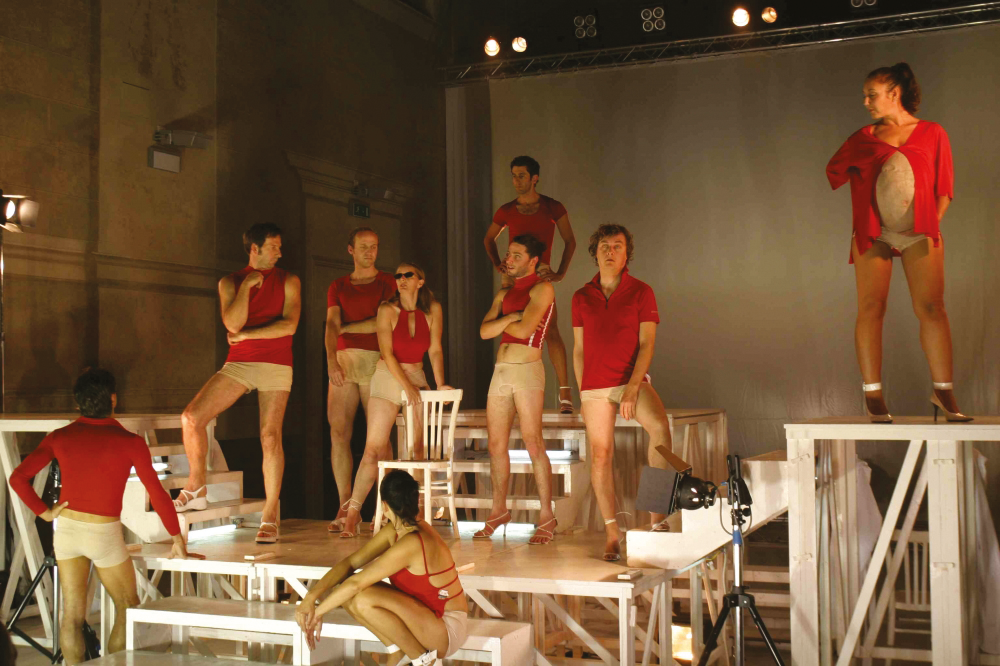
Photo courtesy of Massimo Borsini, production photographer.
3. Artefatti’s Attempts on Her Life / Attentati alla vita di lei – 17 soggetti per il teatro
Accademia degli Artefatti’s exciting production of Attempts on Her Life, a contemporary kaleidoscope lasting three and a half hours, was first presented on 8 September 2005 at “Enzimi Festival”, on Castel Porziano beach (Ostia). After this debut, the company has continued to stage Crimp’s masterpiece over the years.14
Arcuri’s Attempts is performed by eleven actors who constantly play with the typically Crimpian space of the “unsaid”, and this exciting production is divided into seventeen scenarios, just like the original. The show is rich in hints, echoes, reiterations, and allusions that, initially, mislead the spectators into thinking they will be able to put together the pieces of this jigsaw puzzle. However, these clues prove totally useless, in that Anne’s identity is extremely protean and prismatic. Before approaching Crimp, Arcuri and his actors practised a lot on Pinter’s texts, starting in a 2003 workshop in Pescara with Mountain Language (1988), and thus becoming experts at throwing light on the latent irony and the black humour permeating the subtext. Artefatti’s acting modality is undoubtedly effective: actors play characters with no biography and therefore renounce the traditional process of organic creation of the dramatis personae. Eschewing psychologism, actors become mere speakers, turning themselves into empty channels crossed by elusive words that they offer to the audience and/or to their stage mates, adopting a direct and frontal kind of recitation. Even if the directorial structure is always the same, each night the show is pervaded by different affective intensities, also related to the feedback of the spectators, with whom actors frequently interact. Passionate about Commedia dell’Arte, Accademia degli Artefatti always leaves a space for some improvisation in the dialogic dynamics, which can be slightly changed on the basis of the performative context (see Arcuri 2006: 139-143; Angius, Croci, Girotto 2006: 161-168).
From a scenographic perspective, the show is characterised by minimalism. At the centre of the stage the spectator can see a white wooden structure, with stairs and a couple of chairs. This empty and seeemingly anonymous space becomes the perfect setting for each of Crimp’s fragments, turning itself into a middle-class house, a stage for a punk-rock concert or a musical, a contemporary art installation, a gym, and a catwalk. All the scenes are extremely powerful: Artefatti shifts from Crimpian duologues to choreographies. Despite its considerable duration, the show is dynamic and sparkling and the audience is deeply involved in what is going on on stage.
The costume designer Rita Bucchi plays a pivotal role in creating Artefatti’s postmodern jigsaw: actors wear wetsuits, wigs, high heels and fake whiskers suggesting cross-dressing and gender trespassing, sailor costumes, dark sunglasses, Hawaiian shirts, and bulky animal masks. In so doing, the fluid and protean identity of Anne, Anya, Annie, Anny, Annushka is mirrored in every image of the show, a mosaic which, frustratingly, can never be properly assembled.
It is also worth stressing that Arcuri makes a strong directorial choice, that is to change the chronological order of the scenarios, indicating each fragment with a number that appears on the stage. Although Crimp offers directors a text which can be easily deconstructed, he has very clear ideas about the architectural structure and the sequence of the scenarios. Arcuri’s radical and subversive decision was not fully appreciated by Crimp, as he pointed out when I interviewed him in 2009:
I really enjoyed that show, a couple of years ago. I had the feeling that Fabrizio’s production was really amusing, people often laughed. But, at first, when I saw my scenarios put on stage in a different order, I was surprised. It was very disconcerting. I wasn’t completely happy with that decision.
Crimp’s words give us a sense of some of the major differences between Italian (or – more generally – Continental) theatre and the British stage. In Italy, France, or Germany the director has a greater freedom of choice and can re-create the script in a very personal – which sometimes means subversive – way,15 as is well known, whereas contemporary British theatre is text-based and revolves around the figure of the writer.16 In a 2009 interview I carried out with Sam Walters, the artistic director of the Orange Tree Theatre, Richmond-upon-Thames, where Crimp’s early plays were staged in the Eighties, he stated that he did “believe that the director is there to serve the author, the director is a catalyst between the play and the actors. I didn’t have any desire to impose myself”. Two markedly different perspectives on the question of authorship.
4. Conclusion
On the whole, it is reasonable to argue that Martin Crimp’s work has been favourably received in Italy. Everything started in the mid-Nineties, when In-Yer-Face British playwrights were first imported to the “Bel Paese”. Even if Crimp is older than Kane, Ravenhill and Ridley, he sold on the In-Yer-Face ticket,17 possibly because the graphic scenes in The Treatment (1993) – his first play staged in Italy in 1996 – anticipated the provocative plays of the younger generation.18
The Roman company Accademia degli Artefatti, directed by Fabrizio Arcuri, over the years has established a close relationship with the English dramatist. Crimp’s challenging and unsettling plays have provided Artefatti with the new writing texts the company needed in order to investigate the subtle mechanisms of communication and the crucially active role of the audience in trying to create meaning out of the contemporary chaos. Thanks to Crimp and other present-day British playwrights such as Ravenhill and Crouch, the members of Artefatti have developed and refined a particular acting style that has become their distinctive trait. Moreover, the “anti-conventionality” of Crimp’s drama, especially of a play such as Attempts on Her Life (Luckhurst 2003: 49), embraces Artefatti’s penchant for radical theatre and alternative spaces, which has characterised the company’s work from the very beginning. In this light, non-conventional venues have been the most appropriate settings to stage Crimp, at least initially.
Even if Artefatti’s ambitious and successful project on Crimp can be considered concluded, at least for now, the English dramatist continues to be staged in Italy. Among others, we might mention the production of The Country starring the well-known Italian actress Laura Morante as Corinne under the direction of Roberto Andò, which toured Italy between 2012 and 2013, and Antonio Syxty’s Cruel + Tender. Tenero e Crudele, Crimp’s contemporary take on Sophocles’ Women of Trachis, first presented at Milan’s Teatro Litta in 2011. This confirms that the plays of the English author have enjoyed notable success in this country. If the most experimental texts (Attempts on Her Life and the trilogy) capture the attention of younger directors fascinated by a “restlessly exploratory dramaturgy” (Aragay, Escoda, Monforte 2014: 389) which stimulates them to experiment with new dramatic and theatrical languages by “interpreting the ‘blank’” (Obis 2014: 388), the “traditional” Crimp (if someone like that exists), with his The Country or with his rewriting of a classical tragedy, has been adopted and adapted by Italian institutional theatre. Because of his “open texts” and his Contintental influences, Crimp – as said before – might be considered an unrecognised prophet in his own country, but – thanks to this – his theatrescapes can be exported quite successfully across the Channel, showing how contemporary British theatre is a breeding ground for aesthetic (and ethical) investigation also in Europe.